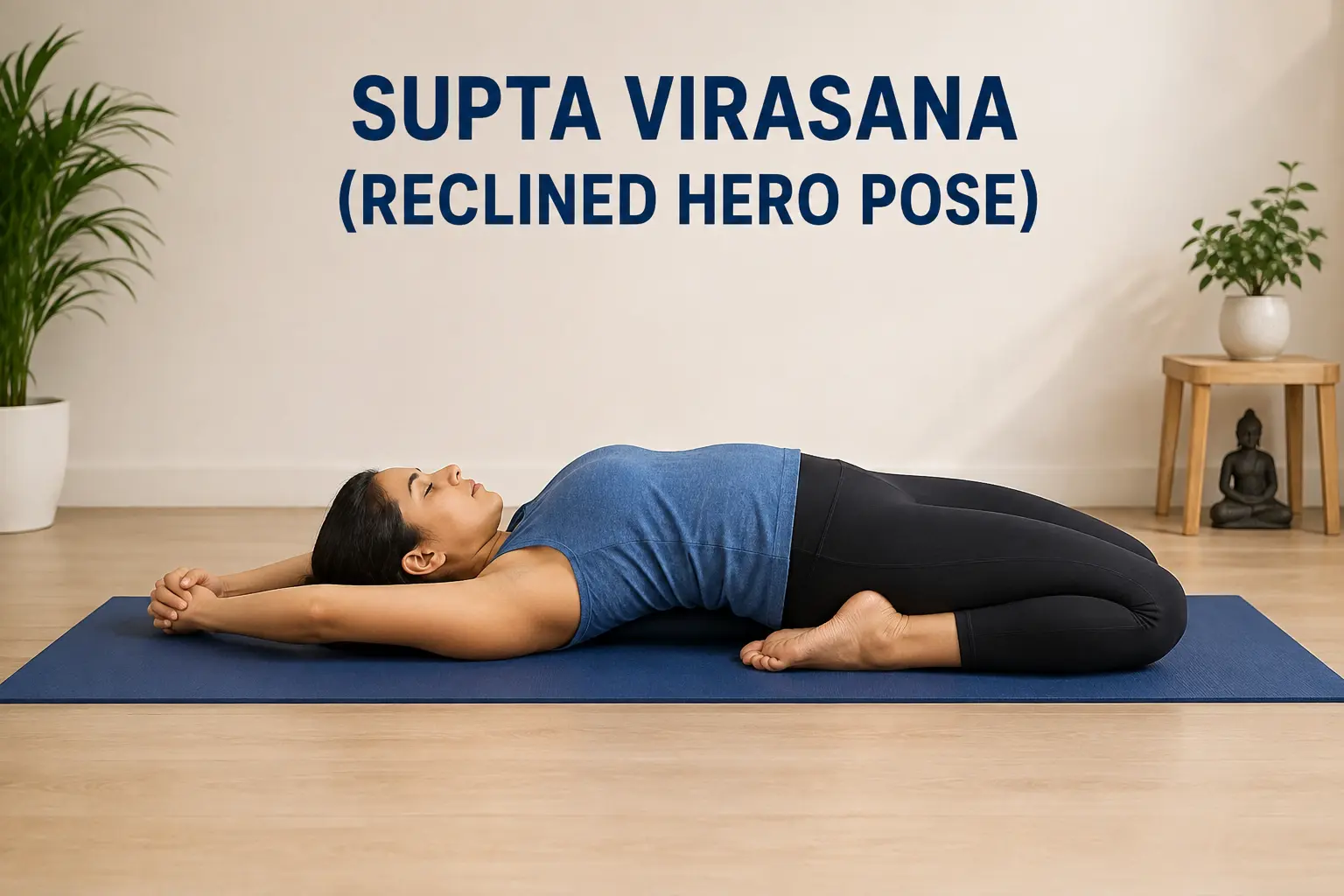
Supta Virasana (Reclining Hero Pose)
Supta Virasana (Reclining Hero Pose) is an excellent representative of the practice of true yogic flexibility. Flexibility is a profound down-regulation of the nervous system, where the body learns to stay psychologically calm while experiencing a lot of physical sensations.
This posture involves taking a base position of Hero Pose and elegantly going into a backwards reclining position. This creates a big opening for the entire anterior side of the body: opening of the thigh, hip flexors, and the abdomen is created in order to counteract the compression that occurs due to sitting in a chair for too long. The requirement of this pose is that it requires a very high level of mobility from the ankles up to the knees, hips, and low back area. In other words, it disproves the myth of passive stretching.
Key Takeaways
- Stretches thighs, knees, ankles, and abdomen deeply.
- Relieves tired legs and improves digestive health.
- Calms the nervous system through passive reclining.
What Is Supta Virasana (Reclining Hero Pose)?
The term 'Supta Virasana' is made up of three Sanskrit words, namely ‘Supta’ meaning “lying”, Vira meaning “hero”, and ‘Asana’ which means “posture”. Hence, the term is commonly interpreted to mean Lying Hero Posture.
Supta Virasana starts when the legs are placed in the Hero posture position with the practitioner sitting between the heels and lowering himself/herself back until he/she lies on the forearms, elbows, or lower back.
In contrast to other forms of lying down stretches, you must be able to put your hands and feet in appropriate positions for the posture. In this case, it would be better for practitioners who can comfortably sit in Virasana.
How to Perform Supta Virasana (Reclining Hero Pose)
Perform each step carefully:
- Get into a kneeling position with the help of a comfortable yoga mat.
- Spread your knees apart by a comfortable distance.
- Extend your legs outward by the width of your hips.
- Carefully move your sitting bones down toward the floor while your heels are placed in front of you.
- Position your feet and ankles in a comfortable manner.
- Place your hands on the ground behind you.
- Start bending backward carefully.
- Move down on your forearms if it feels comfortable.
- Slowly move your back down toward the mat if it is possible without straining your body.
- Try not to allow your knees to move up or away from each other.
- Relax your arms and take deep breaths.
- Stay in the posture for some time.
- To get out of it, push yourself with the help of your hands and come to an upright posture.
Benefits of Supta Virasana
When performed correctly and within a comfortable range, Supta Virasana (Reclining Hero Pose) may offer several physical and mental benefits.
|
|
|
|
|
|
|
|
|
|
|
|
|
|
|
|
|
|
|
|
|
|
|
|
The intensity of the posture varies considerably between individuals. Someone with limited mobility may experience a strong stretch without reaching the floor, while a more flexible practitioner may be able to recline fully.
Precautions
The practice of Supta Virasana calls for some attention due to its possible strain on the knees, ankles, hips, and the lower back.
Here are some recommendations that you should follow:
- Do not do this pose if you find it painful just to sit in Virasana.
- Do not force yourself to touch the ground with your body.
- Use aids if necessary for comfortable lying down.
- Individuals with injuries to their knees, ankles, hips, and the lower back must first receive proper advice from professionals.
- Perform the exercise with an experienced yoga instructor.
- Feel pain, numbness, or dizziness, stop immediately.
- Come back to the upright position gradually.
Who Should Avoid Supta Virasana?
This position might not be suitable for individuals suffering from any joint or musculoskeletal problems, especially when it comes to joints such as the knee, ankle, hip, or lower back.
In case you have any preexisting injuries, have had recent surgery, or experience joint pain, do not practice this pose until you get some instructions from a medical specialist.
Also, pregnant women need to seek guidance individually and not rely on the classical version being suitable during their pregnancy.
To Conclude
Supta Virasana is a demanding pose in which you sit in the same way as Hero Pose, followed by an incremental movement of the torso backwards. Flexibility, body awareness, and relaxation can be gained through Supta Virasana if the pose is done properly with sufficient preparation and alignment. The point is not to touch the floor, but rather to use props and respect the limits of one’s range of motion. Supta Virasana is one of those poses that can be included in a yoga practice of an advanced level.
Frequently Asked Questions
1. What should I concentrate on while practicing Supta Virasana?
Breathing calmly, keeping shoulders relaxed, having comfortable positions of the knees and ankles, as well as controlling the movements, are important.
2. What should I do if I cannot recline fully in Supta Virasana?
It is not necessary to recline till the floor. You can try using a bolster or blankets to practice this asana.
3. Why do I experience pain in the knees while practicing this posture?
It may mean that your hips and ankles are not flexible enough to perform this posture. It is necessary not to put your knees down forcefully.
4. How long should I practice this pose?
You should practice this pose for several seconds, like 15-30, and increase it if the pose is comfortable.
Disclaimer: The content on LifePositive.com, including articles/blogs on yoga, acupuncture, naturopathy, and other alternative healing modalities for holistic wellness, is for informational and educational purposes only. It is not a substitute for professional medical advice, diagnosis, or treatment. Always consult a qualified healthcare provider before starting any new health protocol or making changes to an existing treatment plan.
Also Read: Merudandasana
By Umesh Kumar Khiri
Discussion (0)
No comments yet. Be the first to comment!
Leave a Comment
You need to login to post a comment.