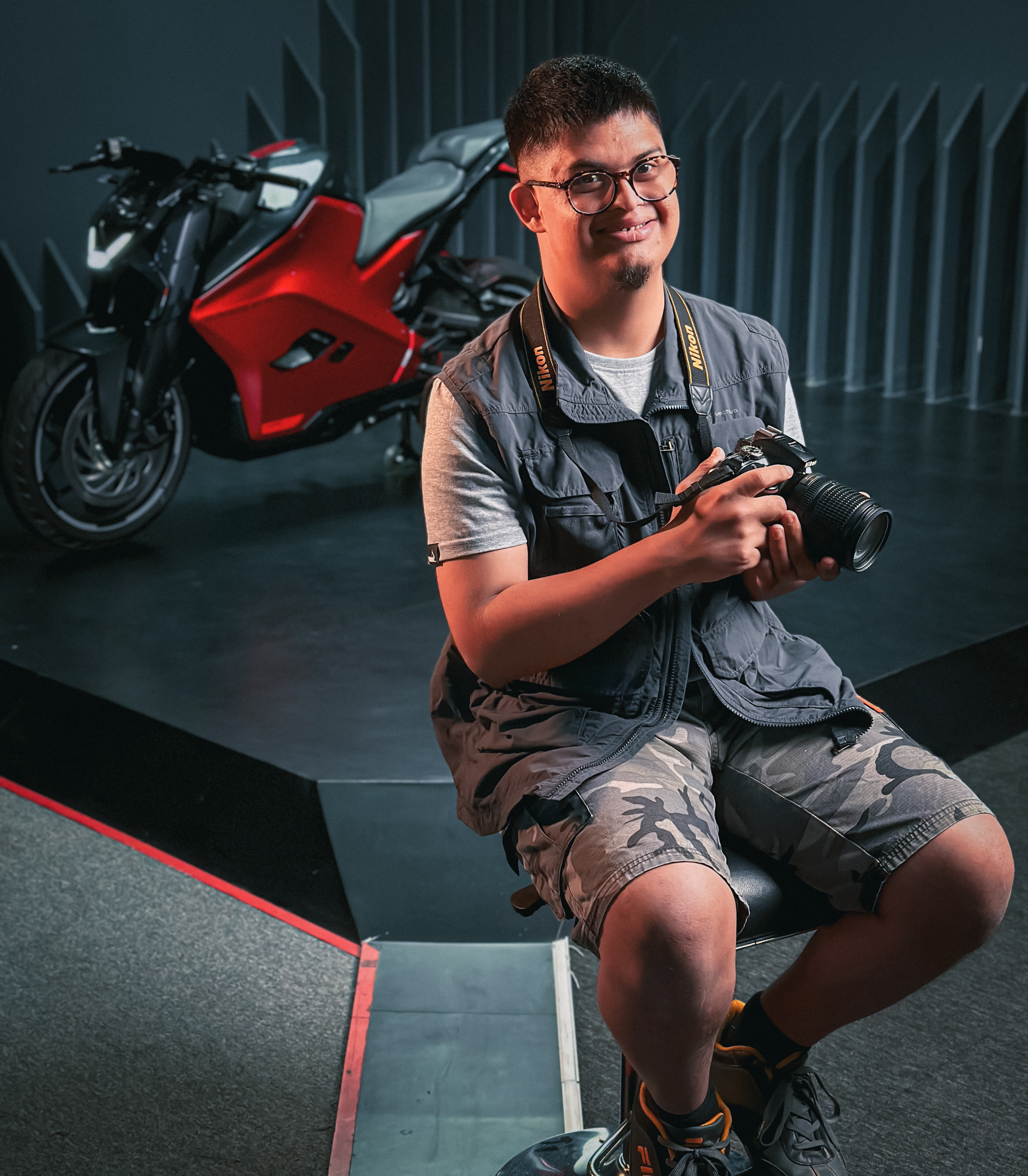
Success story worth learning from
There are some people who make us introspect deeply and do the best we can in the journey of our lives. One such person is Jojo Das who never gave up on life despite the challenges he faced due to Downs Syndrome.We bring to you his answers of leading a wonderful life below.
He was inspired by Life Skill Talks by Swami Sarvapriyananda of Ramakrishna Mission, New York For MINDSET (Indian Army, CS Santosh, Ashish Raorane, Chris Nikic), For ART (Jin Kim, Subodh Kerkar, Upamanyu Bhattacharya, Neerav Doshi, Abhimanyu Ghimiray) • For PHOTOGRAPHY (Samar Jodha, Ishaan Bhataiya, Larry Chen, Varun Aditya) • For DRUMMING (Rzhude David, Late Joey Jordison, Jonathan Moffett, Chris Adler)
He states I am very fortunate to have been supported by my mom (Moushumi Das), dad (Anirban Das) and my elder brother (Aniket Das). They are my family and my biggest supporters. My mother is my teacher and life guide, my father is my travel buddy, and my brother is my art and design teacher and also my manager!
His family says “We as a family nurtured his potential from the very beginning for everything, we saw him take interest in, nurturing a belief in his abilities beyond barriers. We had a headstrong vision of seeing him earn a living out of what he can do than be known for what he can’t. Jijo was very attached to animated Disney-Pixar movies from a very young age as it helped him understand the world, people and emotions through movies like Lion King, Finding Nemo, Brother Bear, etc. We observed him sketch a lot on paper and on a blackboard after watching these movies . He couldn't speak but he was visualising his imagination for us to know his beautiful mind. After years of encouragement and support with him watching, observing and creating at a constant pace, and with his little vocabulary and speech, he told everyone his goal in life - “I want to be artist in Disney!” Jijo was not only sketching, but his observation also made him imagine things out of the ordinary. He found it fascinating that a small basic digital camera could capture what he was seeing in the way he saw it. He would take shots of objects in ways we wouldn’t imagine and make his photographs look like abstract pieces of art with great composition. We knew this was something he should be doing more often as well so with the advent of the smart phone, his passion for photography grew immensely leading to him attending a neuro-diverse smart phone photography workshop by the renowned photographer - Samar Jodha during the difficult times of the lockdown. This elevated his skills in telling a story and capturing feelings that was seen when he was on road trips and also when he shot Bigrock Dirtpark’s Trail Attack for the first time with his DSLR - foraying into the world of motorsport photography.
Jijo just loves music, and every kind from Rabindra Sangeet to Slipknot. We observed how he loved rhythm and would take pencils, sticks or whatever he could find to create rhythm by beating cushions when fully engrossed in it. If there was nothing around, he would create beats with his hands paying on his thighs or the table. Whatever was around, was used to create rhythm. We saw the potential in him to be a percussionist and found teachers to teach him from a very young age.
Beyond the physical and cognitive challenges in the early years, where early intervention helped us develop his basic skills in standing, walking and speaking in whatever way he could to express his thoughts or emotions, the endeavour to educate him on design and art was the main objective of the family.
It started at the hospital where he was born when the doctor handed over Jijo to his mom by saying, “I am sorry your child is born with Down Syndrome.” Imagine how a young mother would feel who has no clue about this condition. That’s where the hopes crashed.
Friends and family came together to motivate my mom to not overthink and focus on her strengths and her career. It gave her the opportunity to think about Jijo’s growth in a pragmatic manner with early intervention and education about his condition. The worry changed into opportunities with this approach, and that’s what we intend to do as Art of My Optimus to show abilities beyond barriers for anyone - through sharing our approach in making Jijo that much more able.
Lack of real inclusion in schools and lack of awareness about the condition led to the parents running pillar to post to find ways in empowering and enabling the child.
We didn’t stop. We wished things were better, but we knew there was no other way. Understanding what true inclusion really is (which didn’t really exist in India) helped us choose the right special school for him, as we wanted high levels of individual attention to help his cognitive abilities develop, than just be in a socially inclusive environment. We also took it upon us to never hide him from the world as he grows and celebrate his presence amongst our friends and family who also took initiatives looking at his sheer determination towards reaching for his dreams.
In Delhi, hearing unwarranted comments by others on the mother in public places (about the child) when going out for a walk. Bangalore was way more welcoming and helpful to people like him in comparison.
We didn’t let the ignorance of others affect our belief in our child. But we knew we had to eradicate such perceptions through showing abilities beyond barriers. Hence Art of My Optimus expanded into raising awareness (beyond Jijo’s work) to evoke a positive response always in society.
Scarcity of schools and teachers who could give individual attention to the child for his growth affected our progress with him. Lack of individual attention on students like Jijo led to making us believe that he really couldn’t do something which we later realised he could, when we got involved.
We knew how hard it could be for a teacher handling a classroom full of people with special needs, especially when there’s such scarcity of good special schools. Knowing our vision for Jijo, we started getting involved more and realised that no school can fully educate a child so unique, without the intervention of his family. What the school couldn’t teach, we found ways and taught him - for only the family will know the intricate details of the mind of such an individual than a special educator handling a classroom full of unique minds. Jijo learnt a lot in school that we couldn’t teach him, and wherever the school faced challenges, we stepped in. We were not going to take, “No, he can’t do that.” for an answer till we have tried 10 different ways and failed. If we have to teach Jijo something we don’t know, we learn it first and then teach it to Jijo. The schools really appreciated this approach and even highlighted this to other parents to inspire them to empower their children.
Lack of motivation amongst parents who have individuals with special needs led to a negative outlook with lost hope. We realised we need to take things on our own hands with Jijo by never losing hope - for we believed that apart from food, care and shelter there are dreams they have (just like us) for which they relentlessly work towards.
We never gave into negativity, no matter how we felt when we saw other families lose hope. We always talked about ideas and opportunities through observing abilities. It was hard to brainstorm with people who have lost hope, so we worked on ourselves and Jijo more to celebrate every little milestone. We realised our biggest inspiration was Jijo as he taught us the value of resilience. We never let Jijo know or believe that he is any different than the rest. In fact, we told him he is better. We brought him up telling him how his extra chromosome is his superpower, and he is not like the rest, just like Superman. We didn’t let complacency set in either with real world simulations that taught him what it takes to be an independent young creative professional. And this is where we saw inclusion do its magic, carving his path towards his dreams. Like his dad always says, “Don’t underestimate the power of Jijo!” which leads to Jijo overcoming every perceived barrier in front of him!
All this led to Jijo Das feeling empowered
He says India Bike Week 2024 making me IBW People and giving me a stall to show all my work. My brother and I speak on stage to show the world the power of my extra chromosome!
Winning the official #LotsofSocks Design Competition for World Down Syndrome Day 2020:
His family has a few hopes. They say First and foremost, we hope we are able to help Jijo reach for the stars and realise his big dream of working in Disney-Pixar someday! We hope more and more people empower and enable the ones who are different. One will be surprised how able they are with abilities beyond their barriers. They would in turn inspire them to push their boundaries and discover their true abilities. • We hope Doctors provide positivity to parents than be “Sorry” about a child being born with Down Syndrome. We hope Jijo’s story through Art of My Optimus is a benchmark to all new mothers with a special child and may there be more Jijos in the world through empowered families with a vision from day one.
They add, Inclusion that starts at a grassroot level, stays forever. It’s about time we have policies that educate children from their very first year of schooling on the differently abled individuals and their positive impact on society than just label them as disabled. Every school should have a special education division with special educators; to help both the normal students and the special ones grow a strong bond of support as they inspire each other to break new boundaries. There will be a surge in highly determined and motivated students from this, in both the categories.
By Jamuna Rangachari


Discussion (0)
No comments yet. Be the first to comment!
Leave a Comment
You need to login to post a comment.