
Film offers spiritual solutions to corruption female foeticide etc. So, yogi Bano ya Bhogi ya fir rogi Choice is yours
A Reflective Opening
Some films do more than narrate a story—they quietly awaken the conscience. Yogi vs Bhogi, written and produced by Delhi-based filmmaker Vandana Khaitan, begins on a deeply contemplative note that gently prepares the viewer for its spiritual and social exploration. The film opens with the serene presence of devotional singer Siddharth Mohan, whose soulful bhajan fills the screen with reverence and calm. It is his birthday, yet there is no display of extravagance. Instead, Siddharth uses the moment to reflect on what true celebration truly means—sharing resources with the underprivileged, supporting education for those who lack access, feeding others with compassion, and remembering God through music and prayer. From the very first scene, the film invites us to question our own definitions of happiness and success.
This serene worldview soon finds a sharp contrast in the life of Siddharth’s fictional friend and symbolic counterpart, Raj Singhania. Raj, portrayed as a powerful corporate leader, is driven by relentless ambition, material obsession, and moral compromise. Where Siddharth represents simplicity, truth, and service, Raj thrives on deception, manipulation, and unchecked desire. Their opposing paths reflect a larger conflict within society itself—between spiritual awareness and material excess.
The film’s core idea emerges when Siddharth proposes conducting spiritual workshops within Raj’s company, Satya Group. What starts as sessions for junior executives gradually expands into a deeper dialogue on leadership and purpose. Siddharth introduces the concept of Raj Rishi—individuals who may command wealth and authority outwardly, yet inwardly live with restraint, wisdom, and spiritual discipline. The message is clear: true leadership balances material success with inner integrity.
Awakening Through Awareness
Through these workshops, the film highlights the root causes of many societal crises. Crime, corruption, and moral decay are portrayed not as isolated issues, but as consequences of a collective fixation on money, power, and sensual gratification. Siddharth reminds participants that human life unfolds in Mrityulok—a transient realm marked by uncertainty, illness, disasters, and inevitable death. In contrast, ancient scriptures describe brahmalok, the eternal abode of the soul, as a realm free from suffering and fear. To progress toward that higher state, one must live with simplicity, selflessness, and spiritual practice, accumulating punya that liberates the soul from the cycle of birth and death.
The film reinforces its message with creativity and clarity. In one compelling demonstration, Siddharth explains that all human beings are composed of the same cellular matter—the same protoplasm—underscoring the truth that the soul within us is one. Harm done to another ultimately harms oneself; goodness offered outwardly elevates the giver as well. Unity here is not just a spiritual ideal but a scientific reality.
Another memorable sequence is the playful yet profound “Fashion Show for the Soul.” Participants wear T-shirts emblazoned with phrases like MAD (Making A Difference) and HEP (Highly Empowered Person). Beneath the light-hearted presentation lies a serious reminder: beyond social roles and material identities, each individual is a divine soul, inherently peaceful and radiant.
Inner Journeys, Deeper Truths
The spiritual narrative deepens through three powerful guided visualisations led by Siddharth. These inner journeys act as mirrors, reflecting the illusions that dominate life in mrityulok.
In the first visualisation, participants are asked to imagine their own skeleton. Siddharth points out that most of life is spent decorating this skeleton with luxuries, indulgences, and comforts—only to ultimately end up in hospitals at the end of life. This stark reflection brings the gift of vairagya, or detachment, highlighting that our true identity lies not in the perishable body but in the eternal soul. Purity, he stresses, is our greatest wealth.
The second visualisation delves deeper into the body’s intricate systems—organs, blood, and vessels functioning in perfect harmony. Siddharth asks a simple but profound question: who orchestrates this miracle? The realisation dawns that life itself is a divine drama, with God as the ultimate director. In this awareness, ego dissolves, giving way to humility and surrender.
The third visualisation shifts focus to social reality. Participants are urged to experience the life of someone living below the poverty line. Siddharth highlights how the wealthiest sections of society often remain disconnected from the suffering around them. Yet he also acknowledges modern-day Raj Rishis—figures such as Ratan Tata and Narayana Murthy—who demonstrate that success and service can coexist.
Social Responsibility and Moral Choice
Beyond philosophy, Yogi vs Bhogi urges tangible social change. It raises awareness about rejecting dowry, empowering girls, and nurturing ethical future leaders—emphasising that a nation’s strength is reflected in how it treats its daughters.
A poignant musical sequence follows, placing the audience at a moral crossroads. Will we chase fleeting pleasures, live as bhogis, and suffer the consequences of excess? Or will we choose the path of the yogi—marked by simplicity, prayer, service, and inner joy?
The narrative then confronts one of society’s darkest realities: female feticide. In a disturbing scene, Raj questions his pregnant wife about the gender of their unborn child. His disappointment at the possibility of another girl triggers a haunting nightmare, where a crying girl child pleads for her life. The next morning, as she paints a lotus, Siddharth explains its symbolism—remaining pure despite being surrounded by impurity. Overwhelmed, she confesses the pressure to abort her child and admits that many educated, affluent women are complicit in this crime. Siddharth is shaken by the moral erosion he witnesses in Kaliyug.
The film reinforces this message by cutting to Kiran Bedi’s talk show, where the devastating consequences of female feticide are discussed—from skewed demographics to rising crimes against women and the breakdown of social harmony.

In a stirring collective moment, Kiran Bedi, Siddharth Mohan, and the audience take vows to reject dowry, oppose female feticide, educate and empower girls, and support simple marriages. The film reminds us that India has produced powerful women leaders and that safeguarding girls is essential for the nation’s future.
Filmmaker Vandana Khaitan herself appears alongside Siddharth in a talk-show segment, emphasising the importance of instilling values early through what she calls “value vaccination.” She speaks of beginning spiritual and ethical education even before birth, through Garbhad?n and Garbha Sa?sk?ra, and weaving values into family life, education, and business.
Fall, Realisation, and Redemption
The film does not shy away from life’s harsh truths. In a shocking turn, Raj’s wife is diagnosed with HIV. Her response is rooted in faith—she prays for pras?d buddhi, the wisdom to accept both joy and suffering as divine will and views her pain as the unfolding of karmic law. Her resilience reflects the strength of her spiritual grounding.
Soon after, Raj’s empire collapsed. His fraudulent businesses crumble; he resigns as CEO and is eventually imprisoned. Stripped of power and pride, he finally confronts his inner emptiness. In a deeply moving prison scene, Siddharth visits him—not to judge, but to guide him. He leads Raj into meditation, asking the timeless question: Who am I?
Through chanting Om, Siddharth reminds Raj that he is not the mortal body but the immortal soul. The vibration of the mantra becomes a healing force, cleansing the mind and opening the heart to peace. The film also touches upon modern scientific acknowledgment of meditation and sound vibrations in promoting mental and emotional well-being.
The journey concludes with the meditative chanting of Om Nam Ke Heere Moti, leaving viewers with a resonant truth: life is not defined by wealth or status, but by purity, service, and connection with the Divine. The film ultimately leaves us with a powerful question—Yogi bano ya Bhogi? The choice, it reminds us, is ours alone.
Yogi vs Bhogi can be watched on the Vandekrsna YouTube channel.
 The book “Yogi vs Bhogi” is also available on Amazon India.
Vande Krsna Foundation was established in 2013 to promote Science & Spirituality, especially the teachings of Yogi Protoplasm on Science and Vedanta worldwide.
Satchitananda Vandana Khaitan
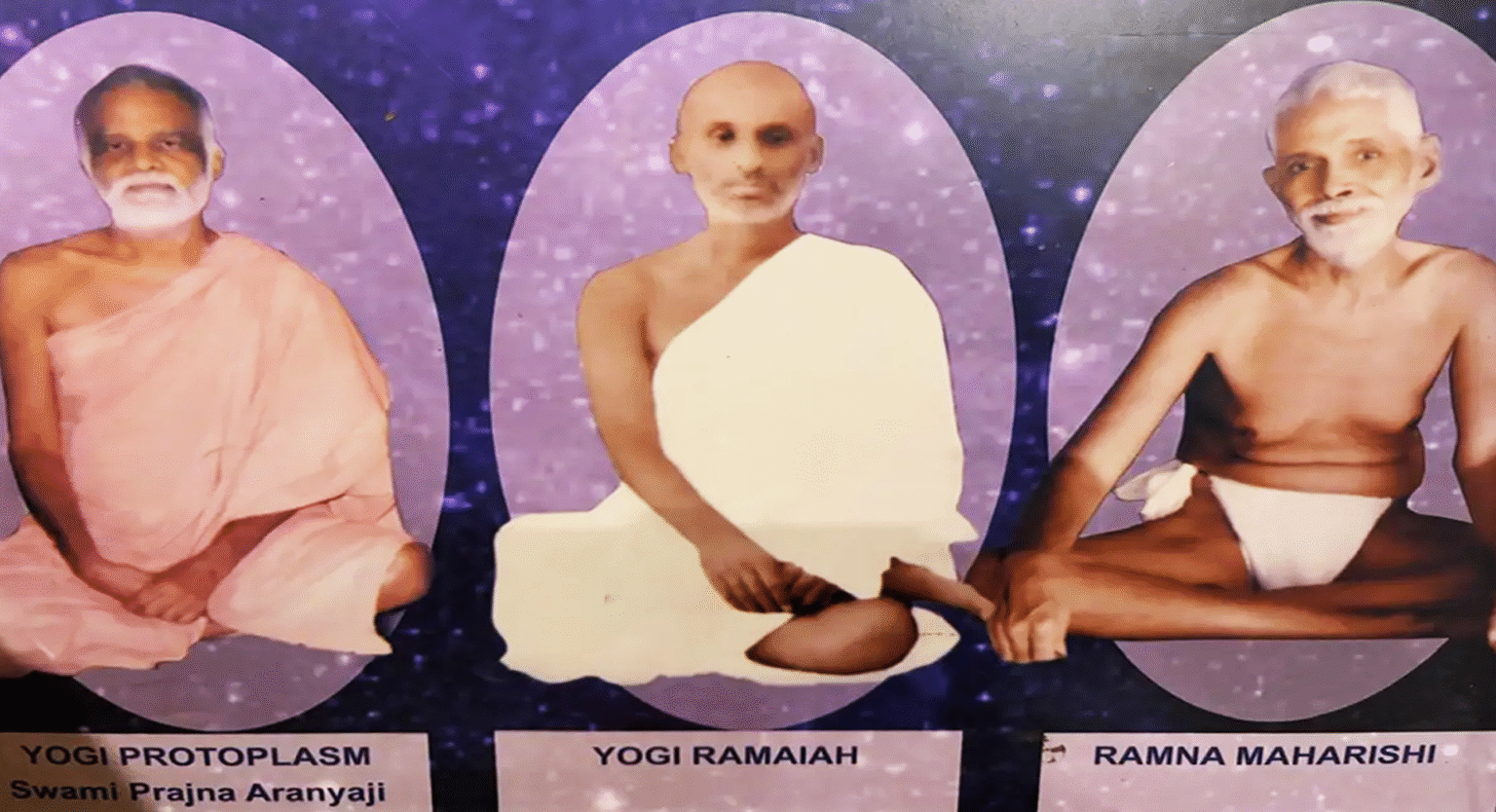
Vandana’s Guru Yogi Protoplasm has taught her to add Satchitananda in front of her name so that the focus shifts from the perishable body to the imperishable soul & the ego gets killed. Vandana studied fashion design at the London College of Fashion, but by divine grace is now pursuing Fashion for the Soul. There was a tragedy in her life. But her Guru Yogi Protoplasm (Swami Prajna Aranyaji) blessed and healed her life and inspired her to walk on the path of Self Realisation. She founded the Vande Krsna Foundation in 2013 to promote teachings on science and Vedanta worldwide. She has edited and published a book on Yogi Protoplasm’s teachings on Science and Vedanta and has made a 3D animation film based on the book, which was screened at the International Spiritual Film festival in Ujjain, India in 2016. She has written a book called MAD – Make a Difference, which explores spiritual solutions to problems on the planet, such as corruption, female foeticide, and poverty. She aspires to set up.
Scientific Spiritual Spas where mind, body and soul – all 3 are being healed holistically. She is also deeply inspired by Mahatma Gandhi and aspires to be a spiritual activist like him. She plans to launch the Bapu Brigade in college to try and awaken the youth. She has made a film called Yogi Vs Bhogi, which shows scientific spiritual solutions to corruption, female feticide, aids etc. She conducts movie workshops in schools, colleges, etc., and aspires to remake the film for the big screen with top stars as part of a mission to make films that not only entertain but also enlighten. She has made a film called MUM- Meditation Ultimate Medication. Also conducts workshops on Meditation. Her hobbies are singing bhajans, painting, and writing. They say if suffering takes you closer to God, it really is a blessing in disguise. A sincere spiritual seeker, thokar (tragedy) in her life turned her towards Thakur (God).
Yogi bano ya bhogi ya fir rogi, choice is yours.
By Dharamveer Negi

.jpg)

Discussion (1)
Life Positive · Jan 30, 2026
That was a wonderful article. Jai Gurudev.
Leave a Comment
You need to login to post a comment.