A spiritual resurgence
August 2023
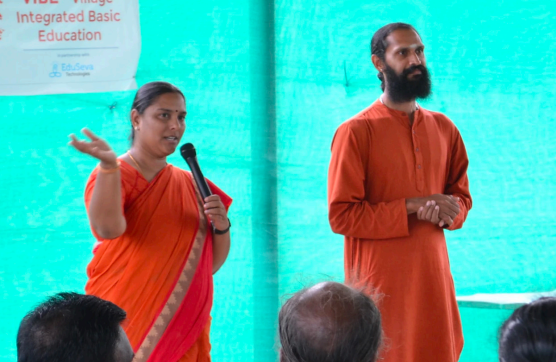
Charged with the mission of reviving and propagating the great spiritual values of India, Adinarayan and his wife Sm ti set up the Anaadi Foundation and ashram, near Palani, Tamil Nadu. Pradeep Krishnan interviews this dynamic duo.
When a story begins with a young professional couple renouncing their lucrative careers in 2015 to spread awareness of our country’s spiritual wealth, you know that you are dealing with an unusual duo. That would be an understatement in the case of Adinarayanan and Smrithi Adinarayanan, founders of the Anaadi Foundation Ashram, located about 18 km away from the famous temple town of Palani, Tamil Nadu.
In the eight years of its existence, the Anaadi Foundation and ashram has produced a network of activities for children, youth, and families, which are both online and in-person. There are programmes on yoga, Itihasa-Purana, and Vedanta, blended with unique insights from modern science. Since its inception, the foundation has been actively involved in conducting classes for school children, as well as pursuing research on Indian sciences, astronomy, ayurveda, yoga, and ecology.
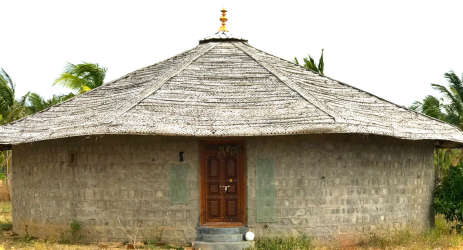
Situated in the picturesque foothills between two holy rocks, Periya and Chinna Iyvar Malai (respectively, the big and small hills), the nine acre ashram is intended as a place for seekers to practise sadhana, yoga, and ayurveda.
After their marriage in 2004, Adinarayanan and Smrithi worked in the software industry for a couple of years, before functioning for a decade as teachers in the Amrita Vishwa Vidyapeetam (part of Mata Amritanandamayi’s initiatives) in Coimbatore. Adinarayanan is a native of Tirunelveli, Tamil Nadu, a graduate in electrical engineering, with an MS in computer science from the USA. It was during this latter phase that he underwent a deep spiritual experience (which he later recognised as samadhi) and it ignited a strong desire to return to India to dedicate himself to spirituality and service to society.
Occasionally, the couple still teach at various premier educational institutions, including IIT-Delhi. Adinarayanan is an adjunct professor of practice at NRCVEE, IIT Delhi, And Smrithi was formerly an EdTech and cognitive science researcher teaching computer science and engineering. Both are core group members of the Value Education panel at NCERT MHRD and fellows of Europe Spirituality in Economics and Society (SPES). The ashram runs a residential gurukulam titled Dharma School, for boys and girls in the age group of 8–11, with a curriculum designed to promote the physical, mental, intellectual, and spiritual development of students.
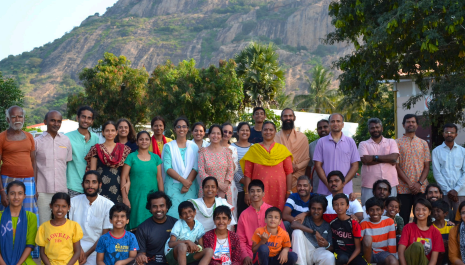
Team Anaadi, grouped in the background of one of the Holy Rocks that ring the ashram. The day of our visit to the ashram coincided with an exhibition on Indian knowledge systems featuring 16 stalls, each devoted to individual subjects such as mathematics, astronomy, Vaastu, ecology, and agriculture. The students, dressed in traditional attire, explained the concept and achievements to visitors, which included over 600 students from various schools.
Excerpts from a freewheeling conversation with Adinarayanan in his modest kutir.
Let us begin with your spiritual journey. As I grew up in a family that blended traditional and modern thought processes and values, the spiritual path was not alien to me. Our entire family was deeply interested in the Hindu and Indian way of life, and self-reliance was always emphasised. My father introduced me to yogic practices and they became a daily abhyasa since childhood. After my marriage with Smrithi, we became followers of Mahavatar Kriya Babaji, who has inspired several traditions and schools of thought.
What was the turning point in your life? After completing my Master’s in the US, one day, spontaneously, I had a deep relaxing experience which I later identified as samadhi.
I was at a juncture where student life was over, and I had no specific plans. This experience led me to delve deep into yoga and meditation, and prompted me to return to India to dedicate my life to making this inner experience available to as many young people as possible.
What made you leave the corporate world and pursue a spiritual path?
The corporate world is very rewarding in many ways as it gives you global exposure and enough means to have all the comforts. Given our multidimensional interests, we felt that academia would be better suited to us. After a decade of working at the college in Coimbatore, during which some of our students dedicated their lives to the spiritual journey, we left academia and started the Anaadi Foundation. Our former students are currently at Anaadi taking care of various youth-led initiatives.
What are the activities of the Anaadi Foundation?
Anaadi Foundation is a creative expression of the diverse interests of its members. Through our various programmes, we share the depth of Indian culture, sciences, and values with young people. In 2018, we moved full-time into our ashram, situated in a spiritually significant region near Palani. The local legends say that Iyvar Malai had been visited by the Pandavas and has a Draupadi Amman temple and Jain caves. It is visited by hundreds of people every year.
We have several programmes for all age groups: English education for rural school children, annual science fairs, technology certification programmes for rural youth to enhance their livelihood skills, and free ayurveda camps. The Mouna Sadhana programme is a blend of asana, pranayama, dharana, and dhyana for physical stability. In addition to the Bhagavad Gita sessions, we are also engaged in the scientific exploration of interdisciplinary domains of ayurveda, yoga, neuroscience, and artificial intelligence.
Our annual youth leadership retreat at Rishikesh is quite popular among the youth. We also have Mahabharata sessions, which explore the various dimensions of governance, education, Indian sciences, gender issues, justice, and dharma narrated in the grand Itihasa. Some of us also travel to various places sharing insights from our shastras, blending ancient and modern wisdom. Our monthly magazine, Parnika, released every Pournami, has subscribers from all over the globe.
How does the Mahabharata programme benefit corporates, families, and students? It is famously said that everything is found in the Mahabharata. What is not found here, cannot be found anywhere else. The Mahabharata provides us with a powerful narrative exploring the complexities of life and a framework of dharma, among other concepts, that helps resolve the apparent conflicts and contradictions of modern-day existence. With better understanding and insights, we would become better equipped to face the challenges of life and be successful. Our success will impact the success of our immediate community, nation, and the world at large.
In our lives, we are constantly making decisions, and these decisions involve not only outer conflicts but strong inner conflicts too. Listening to the story and philosophy of the Mahabharata brings clarity to the mind, thereby enabling people to make the right decisions.
The Mahabharata is replete with anecdotes and instances that emphasise the need and means to make optimal decisions, keeping in mind personal well-being and the larger good of society. Young leaders have the energy and power to execute things but need proper guidance. The Mahabharata Leadership programme is designed to enhance the action orientation of participants. We now offer Mahabharata programmes online after the COVID lockdown.
According to you, what ought to be the aim and purpose of human life? How can one move towards that?
In the Indian tradition, the purpose of human life is guided by the purusharthas [objects of human pursuit]: dharma, artha [prosperity, economic values], kama [pleasure, love, psychological values] and moksha [liberation, spiritual values]. Focussing on pleasure and material wealth looks exciting for some time, but when one starts feeling empty, one must turn to dharma and moksha. When all our actions are guided by dharma, we feel more fulfilled, and society prospers. At one level, moksha could mean a complete dissolution of our identity, but at a simpler level, moksha is freedom from limited identity. We feel caged in this identity, and when we break free, our identity expands and there is a sense of fulfilment. That is the purpose.
What do you mean by the self-unfoldment of individuals? How can this be achieved? Many of us do not realise that the body is covering the atman [soul] or enshrining the atman. This inside-out perspective is key to understanding the fundamental aspects of life. We are so focussed on the body and mind that we believe that we are the body and mind. When we take up jnana [the path of knowledge] or dhyana, these layers slowly fade away from our mind, bringing in an awareness of the deeper layers. This can be achieved through multiple ways such as karma [service], bhakti [devotion], jnana, and raja yoga.
Please throw light on the Indian sciences seminar organised for school and college students, highlighting the achievements and depth of Indic sciences.
India has been a cradle not only of refined civilisational best practices but also of multitudinous scientific developments.
Evidence and knowledge of voluminous literature produced in Indian scientific pursuits have been well established by serious researchers. In contrast, there is ignorance about the facts and feats that we have inherited. Awakening Indians to Indian sciences is important to build a better perspective about this land and its people, to own up to what is truly ours and align our actions in coherence with the vision and momentum set forth by the great jnanis [realised ones] of our civilisation. Just as we protect, preserve, and celebrate various temples, monuments, artefacts, and places of historic eminence, so too, must we preserve and protect intellectual breakthroughs in our Indian traditions through awareness, assimilation, and dissemination.
The Sustainability Immersion programme integrates various aspects of sustainability including sustainable health, self-reliant agriculture, natural buildings, alternative energy, waste management, and chemical-free living.
Introducing Indian sciences to the youth and children can help create a young generation that has a better connect with our land, has enhanced multiple intelligences, is value oriented, and is socially and environmentally conscious.
We have created online modules that schools can use to teach the Indian sciences of ayurveda, yoga, ganitha, and jyotisha [the last two are astronomy related] as club activities. Our current online summer camps for children too focus on this.
Critics are of the view that our scriptures are outdated and primitive. How can the study of the scriptures help modern man?
In every culture and civilisation, the past has always been important, and history has played a major role in shaping the present and the future. It is for no trivial reason that we call our scriptures Santana Dharma. The principles enshrined in them are eternal. Many get lost in the specifics and hence find them outdated. Take modern science, for example. To understand modern man, we need to delve into evolutionary biology, cosmology, genealogy, and archaeology. Aren’t these, in a way, ‘digging into the past?.’ Similarly, our Puranas had the Pancha Lakshana [five characteristics] that precisely talk about these aspects. The shastras provide guidelines for human aspirations and endeavour. With adaptable architecture, they become relevant in every era.
In the past, the people of Bharat revered and worshipped the rivers, mountains, plants, animals, and Bhumidevi as expressions of the Mother Divine, and they consciously maintained the balance of Life. However, nowadays, even while we worship the rivers, mountains, and trees, we indiscriminately act against Mother Nature. Why this paradox? What is the solution?
This is something called ‘distancing.’ We are typically distanced from the source and destination. We do not know where things come from and where they go. This is true of our consumption as well as our spiritual path. While we are totally dedicated to our devatas [gods] and respect various life forms, we are disconnected from the consequences of our actions. There could be multiple reasons. It could be happening because of modern education or a disconnect with traditional knowledge systems or because of the yuga [the time we live in]. But a great transformation is happening. People are recognising the impact of human actions on the planet. They now feel more connected to nature. There is a big movement happening. For instance, so many young people come to the Anaadi Foundation’s Center for Research in Ecology and Sustainable Technologies [anaadicrest.org], to learn and experience a connect with Mother Nature. They work on self-reliant and sustainable models built with ecological principles coming from the Indian tradition. They also learn about how cows play a central role in Indic sustainability.
How so?
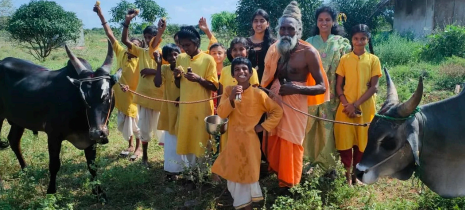
Since the Vedic period, cows have been central to the life of Indians and there is a deep spiritual connection between man and cows. Going beyond milk or just utility, cows were considered a measure of wealth and prosperity of any kingdom and even determined the social status of individuals. There are numerous references in the Vedas, Puranas, and Itihasa about the significance of cows.
Though the 20th cattle count report shows an increase in the cattle population in India by 14.51 crores, it indicates a decline in native breeds of cows, urging the need for the preservation and breeding of indigenous varieties. Farmers, by and large, prefer high-yield milch cows to the desi varieties. Scientific studies prove that cow dung and cow urine from indigenous varieties are superior to foreign breeds in terms of their microbial diversity and contain higher amounts of calcium, phosphorus, zinc, and copper than the cross-bred ones.
Today, land degradation and desertification, fuelled by the use of chemical pesticides and fertilisers, are posing a serious threat to food security. The need to revive cow-based
agriculture that can regenerate the soil on a large scale is evident.
Cows offer the possibility to achieve environmental, social, and economic sustainability in the rural Indian context by drawing upon ancient references to the role of cows in social and religious systems and relating them to modern science and sustainability frameworks. With the world moving away from exploitative and linear systems to circular and regenerative systems, India can recreate and remodel self-reliant villages as thriving ecosystems with the cow at its core.
Please tell us about the unique Sustainability Immersion programme offered by the Anaadi Foundation.
Given the economic, social, and environmental crisis the world is facing today, creating sustainable solutions has become imminent. The more self-reliant we become, the more we would be contributing to the sustenance of the planetary resources. In tune with the UN’s Sustainability Development Goals, Anaadi’s Center for Research in Ecology and Sustainable Technologies which offers the Sustainability Immersion programme integrates various aspects of sustainability including sustainable health, self-reliant agriculture, natural buildings, alternative energy, waste management, and chemical-free living. Through this programme, participants get hands-on exposure, knowledge through field visits, and expert interaction and the opportunity to take up sustainability as a career path.
Your message to the readers?
Self-reliance was at the core of Bharata since time immemorial. We may have lost it briefly for whatever reason. Now is the time to rediscover this. This comes through exposure to various dimensions of Bharatiya knowledge. Invest in them, and a great future is waiting to unravel. In fact, to enable this, we have launched a monthly series called the Essence of Dharma, which is a free 10-hour programme every month focussing on Itihasa-Purana, Vedanta, and yoga. We would like to spread the message of Sanatana Dharma to as many people as possible in the most simple and affordable manner. Please visit www.anaadi.org/dharma
Pradeep Krishnan is a student of consciousness, based in Kerala. A seeker by nature, he is deeply attracted to the teachings of Sri Ramana Maharshi and Sri Nisargadatta Maharaj


Discussion (0)
No comments yet. Be the first to comment!
Leave a Comment
You need to login to post a comment.