
Back to the future
January 2016
By Punya Srivastava
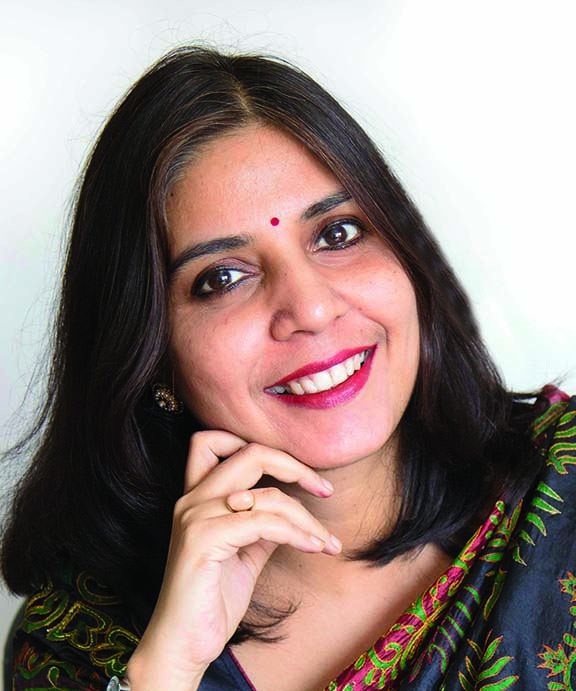
Punya Srivastava meets CB Ramkumar, founder of the wellknown Our Native Village, near Bangalore, and a passionate revivalist Our Native Village has won him many awards for its eco-friendly design Accept what life offers you and try to drink from every cup. All wines should be tasted; some should only be sipped, but with others, drink the whole bottle,” writes celebrated novelist Paulo Coelho in his book, Brida. These lines perfectly sum up the protean life of CB Ramkumar who flowed with life, changing jobs and vocations in keeping with his inner voice. A graduate in English literature from the renowned Loyola college of Chennai, Ramkumar went on to don the hats of a sales and marketing person, an advertising professional, a volunteer for various charities, a trainer and consultant, a speaker on sustainability, an environmentalist, an energy healer, and an author. He has worked in global companies like Saatchi & Saatchi, Ogilvy &Mather, Publicis Group and Standard Chartered Bank. He is the founder of Green Dreams for the Planet, an NGO started in 2006. In short, he has sipped on an array of wines, and like a connoisseur, chooses to imbibe from a clutch of favourites – one of them being his dream resort, Our Native Village. Started a decade back, it is a 100 per cent eco-resort situated in Hessargatta village, a 90 minutes’ drive away from Bangalore City. The initiative won the Skal International Award for Sustainable Development in Tourism and the Excellence in Environment Protection by the GMR Express Travel World Awards, in 2011.These awards are regarded as the most respected business-to-business travel awards based on business innovation rather than volume. “Our Native Village is a result of my meditation practice,” he explained over the phone. Born out of his passion for developing a commercially viable sustainable model, this resort fetched Ramkumar a lot of coverage in the international media. His sustainable model gradually started working. Born and brought up in a typical middle class Malayali family in Chennai, Ramkumar’s professional life kept him outside India, generally in the Middle East for over two decades. His return to India in 2006 was preceded by a decade of mulling over and researching aspects of sustainability, along with dabbling with what he calls modern-day spirituality. He lives with his wife Lalitha, daughter Aakanksha, and son Akshay in Bangalore. Following are excerpts from a telephonic conversation with him: You have donned many hats. How easy was the transition from one to another? I had imbibed the art of going with the flow very early in my life. Hence, the transitions just happened, rather I flowed from one into the other effortlessly, without any planning; though not in a preordained fatalistic kind. But I have always believed that once you start to sharpen your intuitive skill, then you gather the capability to trust in the flow. I had developed that intuitive skill at a very young age. And this intuition, over the years, has helped me a great deal. How? Around three years ago, I had to travel to Vietnam on a sustainability consulting project. However, the day I was supposed to leave, I couldn’t find my passport. Even after frantically searching all over the place for a long time, my wife and I couldn’t find it. And in a flash, I realized that I was not meant to go. I told her to stop searching. She stared at me incredulously, while a sense of calm descended upon me. I cancelled my trip. Just two days later, my wife developed a severe headache which no pills could appease. I rushed her to the hospital where the doctor told me that I had brought her in the nick of time as even a delay of 15 minutes would have been too late. She had had a massive meningitis attack. That is when I realized why I was supposed to remain at home and not take that trip. Moreover, sometime later, when I again needed my passport, she told me to meditate upon it, and voila! I was guided to its exact location in my meditative state. Since then, I have intensified my sadhana and it has worked very well for me. What laid the foundation for practising meditation? I was raised in a very religious environment. My father, who worked as a clerk in a company, prayed twice a day and all four of us kids had to sit around. We were encouraged to recite shlokas and verses from the Ramayana and Bhagavad Gita. My parents became big devotees of Sai Baba. Old world spirituality – which depended on a guru - pervaded that whole growing up period. At 14 or 15, I attended a course in transcendental meditation in Chennai. That was my foundation. Like any other teenager, I soon gravitated towards other distractions of life. Then 20 years back, I took to New Age spirituality and since then I have been a regular meditator. What made you come back to the spiritual path? In 1996 I was rudely awakened from my slumber by the sudden death of a very close friend. I was in Dubai at that time. I started contemplating on how confidently we believe that we know ourselves very well; we take our mind component for granted. These thoughts propelled me towards seeking to know my mind better. And that is when I learnt reiki and pranic healing. Every morning, I take care of my mind wellness through 1.5 hours of meditation followed by an hour of physical exercise, for my body’s wellness. How can the ‘body-mind-spirit’ connection extend to compassion for community and environment? Over a period of time, when you understand that interconnection is the core of a living being, you progress towards applying this truth outside of yourself to the larger community and to your environment. The more responsible you become, the more your energy field starts expanding. Touching the lives of family and friends is our duty, but touching the lives of unknown people while keeping compassion in our heart for the environment, is humanity. Was that the seed that germinated and fruited into Our Native Village? How was the journey, and how did you bring together all the components of development together? The resort was started as a determined idea to set up a 100 per cent commercially viable model of sustainability, on my father-in-law’s land. We host our guests while maintaining harmony with the environment. The bricks used in the buildings were made on site using soil we dug out from the foundation, are sunbaked, and are proven natural air conditioners. We generate 70 to 80 per cent of our electricity using a wind mill, solar panels and bio gas plants. Most of the water is rain water harvested from a channelling system on the roofs of the resort’s buildings. It is filtered and stored in a large underground tank. All waste, except plastic, is processed and reused appropriately. Plastic is sent out to a recycling unit. Organic waste is used in the bio gas plant and for composting; paper waste goes into bonfires and boilers. Similarly, there are provisions for black and grey water recycling as well. Most of the fruits and vegetables are home-grown on our 12-acre organic farm. All the soaps and shampoos in the rooms are 100 per cent natural, chemical-free and handmade exclusively by my sister for our guests. How do you include community in your venture? I am a revivalist. Our Native Village has revived Indian art, old practices from the Indian village, village games to teach people about forgotten things. How do you propose to propagate your idea of sustainability further? I want to take sustainability to the second level – to the health of the human. We are facing an imminent antibiotic holocaust which will render us defenceless very soon. We need to find ways to increase our immunity to such a level that no virus or bacteria can affect us. This is sustainable health and it is determined by the kind of food we eat, the amount of fresh air and sunlight we get, the amount of sleep we get, the kind of practices we need to embrace to exfoliate neurotoxins from within. Which is your biggest reward till now? I absolutely love to see guests, especially children, connecting with the resort. Children hold large spaces in their soul, and when they identify a similar large space in the external world, they connect with it. Most of the visiting kids love to run and play, and connect with the earth. The way guests feel grounded in my resort gives me tremendous joy. Moreover, 60 -70 per cent of my business is either repeat or referral business. Sustainability at Our Native Village is at a very deep, subtle level. Also, it is not spirituality in an airy-fairy manner but has a direct connection with wealth creation; with abundance. I get an abundance of energy from the Universe, of which money is just a small part. The smile on my face and the willingness to serve others are other kinds of energies. I belong to a middle-class family; my mother panicked when I took a loan of rupees one crore to start a business. From that point to now, where I run a successful venture and fly all over the world to give lectures on sustainability, has been a long journey in which I see abundance all around. What is next in line? I am writing a book titled Green Dream to pass on the rich experience and knowledge I have gained throughout my journey, especially in the last 10 years. I named it so because this is a green dream I want everyone to have. I want to inspire people to green their own homes. This way, eventually, cities and urban settlements will also become green. Also, I am a futurist. I can see that a day will come when a mainstream health specialist prescribes not just Vitamin C for fever, cough and cold, but also something for the mind. This has already started happening, though only in pockets. It is just 10-15 years’ wait!
Discussion (0)
No comments yet. Be the first to comment!
Leave a Comment
You need to login to post a comment.