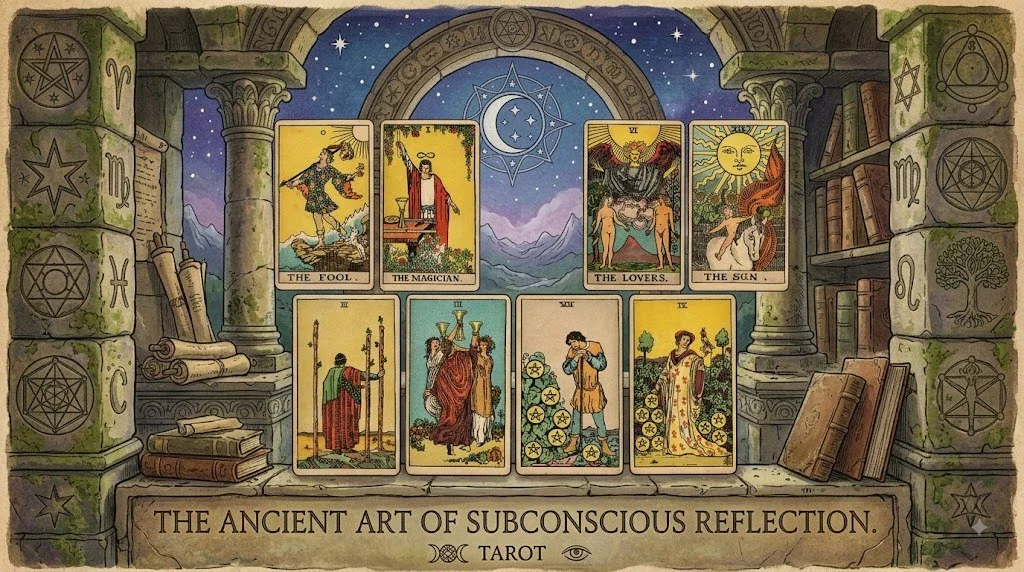
Archetypal Symbolism in Tarot
Introduction: The Ancient Art of Subconscious Reflection
Tarot has fascinated people for centuries because it offers more than a collection of illustrated cards. At its heart, tarot is a symbolic language that can encourage reflection, self-awareness, and a deeper examination of the choices, emotions, hopes, and challenges that shape everyday life.
A tarot deck has seventy-eight cards divided into the Major Arcana and Minor Arcana. Each card contains imagery, symbolism, characters, numbers, colors, and traditional associations. When cards are placed into a spread, these elements can create a narrative that invites the reader to consider a situation from different angles.
Key Takeaways:
- Tarot serves as a symbolic tool for deep self-reflection, mindfulness, and accessing inner wisdom.
- Major and Minor Arcana cards offer distinct perspectives to help decipher personal growth and daily challenges.
- Responsible tarot practice complements practical reasoning to support balanced decision-making.
Tarot: Purpose and Benefits for Intuitive Clarity
Tarot can be understood as a framework for intuitive clarity. A reading creates space for focused attention, allowing a person to move away from distractions and concentrate on a particular question or area of life.
Rather than treating every card as a literal prediction, it is often more useful to interpret the imagery in relation to personal circumstances. The same card can have different meanings for different people. Its significance may depend on the question asked, the surrounding cards, and the emotional response it creates.
Tarot can therefore support a process of reflection in which intuition and conscious reasoning work together.
Unlocking Inner Wisdom through Card Readings
One of the primary purposes of tarot is to encourage access to inner wisdom. People frequently possess more awareness about their circumstances than they realize, but fear, stress, habit, or emotional pressure can make that awareness difficult to recognize.
A tarot reading can slow the decision-making process and create an opportunity for honest reflection. For example, someone considering a career change might draw a card associated with courage, uncertainty, or transformation. The card does not have to predict what will happen. Instead, it can prompt questions such as: What am I afraid of? What change am I resisting? What would I attempt if I trusted myself more?
This approach turns tarot into a reflective exercise. The reader observes the symbolic message and then connects it with personal experience.
Intuition is particularly useful when it is balanced with practical information. Tarot can suggest questions and perspectives, but important decisions involving finances, health, legal matters, or safety should be supported by qualified professional advice and reliable evidence.
Enhancing Personal Growth with Major Arcana
The Major Arcana consists of 22 cards traditionally associated with significant themes and life experiences. Cards such as The Fool, The Magician, The Empress, The Hermit, Death, The Star, and The World represent broad archetypal concepts including beginnings, creativity, nurturing, introspection, transformation, hope, and completion.
These archetypes can be valuable for personal development because they encourage people to recognize the larger patterns within their lives.
For example, The Hermit can inspire reflection on solitude and inner guidance. Death is commonly interpreted symbolically as transformation or the ending of one phase rather than literal death. The Star can represent hope, renewal, and emotional restoration.
Working with the Major Arcana can therefore encourage individuals to think beyond immediate circumstances. Instead of asking only, “What will happen next?” a person might ask, “What stage of growth am I experiencing?” or “What lesson does this situation invite me to explore?”
Deciphering Everyday Challenges via Minor Arcana
The Minor Arcana contains 56 cards divided into four suits: Wands, Cups, Swords, and Pentacles. These suits are traditionally connected with different dimensions of experience.
Wands are often associated with energy, ambition, creativity, and action. Cups commonly relate to emotions, relationships, imagination, and intuition. Swords are frequently connected with thoughts, communication, conflict, and decisions. Pentacles generally concern practical matters such as work, resources, stability, and material responsibilities.
The Minor Arcana can be particularly useful for examining everyday situations. A spread containing several Swords, for example, might encourage reflection on communication or mental pressure. A group of Pentacles could lead someone to examine financial or professional priorities.
Again, these interpretations are symbolic rather than guaranteed predictions. Their usefulness comes from the questions they generate and the perspective they offer.
Psychological and Spiritual Growth Advantages
Tarot can become a meaningful practice when it is used intentionally. Setting aside time for a reading encourages concentration and self-observation. The ritual of shuffling cards, selecting a spread, and interpreting imagery can create a quiet transition away from the demands of daily life.
For some people, tarot has a spiritual dimension. It can be incorporated into meditation, journaling, contemplation, or other personal practices. For others, its value is primarily psychological and creative.
Regardless of the approach, responsible tarot practice should promote agency rather than dependence. A reading should ideally help a person feel more capable of understanding choices rather than suggesting that their future is controlled by the cards.
Fostering Mental Clarity and Emotional Release
Writing down thoughts after a tarot reading can be an effective way to organize emotions. A card may bring an uncomfortable issue into focus, allowing someone to name feelings that were previously difficult to express.
For example, drawing a card associated with conflict might encourage a person to acknowledge unresolved frustration. A card associated with loss could create an opportunity to reflect on grief or transition. A card associated with celebration might remind someone to recognize achievements that have been overlooked.
This reflective process can provide emotional relief because it creates distance between the individual and the immediate problem. Instead of being completely immersed in an emotion, the person can observe it, describe it, and consider possible responses.
Tarot should not be considered a replacement for mental-health care. When emotional difficulties are persistent or severe, speaking with a qualified mental-health professional is more appropriate.
Strengthening Decision-Making through Self-Reflection
Tarot can also support decision-making by encouraging people to examine assumptions. Instead of asking the cards for a simple “yes” or “no,” a person can use a spread to explore different aspects of a choice.
Questions might include:
- What is motivating this decision?
- What fear is influencing me?
- What opportunity might I be overlooking?
- What practical issue requires attention?
- What could I learn from either outcome?
This process transforms a tarot reading into a structured decision-reflection exercise. It can reveal emotional preferences, concerns, or contradictions that deserve further consideration.
The final decision remains with the individual. This distinction is essential because healthy intuition complements reasoning rather than replacing it.
Cultivating Spiritual Awakening and Mindfulness
For spiritually inclined practitioners, tarot can become a mindfulness practice. Focusing on a single card requires observation. Instead of immediately searching for a predetermined interpretation, the reader can study the image and notice personal reactions.
What does the figure's expression communicate? Which symbol attracts attention first? What emotions arise? Does the image remind the reader of a particular experience?
Such questions encourage present-moment awareness.
Over time, tarot journaling can also reveal recurring themes. A person may notice that particular cards appear during periods of transition, uncertainty, or creative activity. Whether these patterns are interpreted spiritually or psychologically, documenting them can deepen self-awareness.
Mastering Effective Card Reading Practices
Learning tarot does not require memorizing hundreds of definitions. Traditional meanings provide a foundation, but effective reading also requires context, observation, and interpretation.
Beginners can start with one card per day. After drawing a card, they can record its traditional meaning, personal impression, emotional response, and connection to the day's events. This simple exercise gradually develops familiarity with the symbolic system.
Selecting Your First Divination Deck
Choosing a first tarot deck is a personal decision. Beginners often find decks with clear imagery and an established symbolic structure easier to study. A deck based closely on the traditional 78-card format can provide a useful foundation because many books and learning resources use its structure.
Visual connection matters as well. If the artwork consistently captures your attention, studying the cards is likely to feel more engaging.
When purchasing a deck, consider the quality of the card stock, clarity of the illustrations, guidebook, card size, and whether the imagery feels intuitive to you.
It is also helpful to remember that there is no universally “correct” deck. Tarot has developed into a diverse tradition with many artistic interpretations. The best deck is one that supports your chosen style of reflection.
Formulating Intentional Questions for Precise Guidance
The quality of a tarot reading often depends on the quality of the question. Vague questions can produce interpretations that are difficult to apply.
Instead of asking, “Will everything work out?” consider asking, “What should I understand about the challenge I am currently facing?” Instead of asking, “Will I get this job?” ask, “How can I prepare effectively for this opportunity?”
Open-ended questions create more room for insight.
Questions should also avoid unnecessarily surrendering personal responsibility. Asking what you can learn, change, or understand generally creates a more constructive reading than asking for an absolute prediction.
Executing Multi-Card Spreads for Deep Insight
Tarot spreads organize cards into specific positions, with each position representing a different aspect of the question.
A simple three-card spread might represent:
- Past influence
- Present situation
- Potential direction
Another useful structure could explore the situation, challenge, and recommended focus.
More advanced spreads may contain ten or more cards, but complexity is not always better. Beginners can often gain more from a focused three-card reading than from a large spread they find difficult to interpret.
When reading multiple cards, look for relationships between them. Repeated suits, numbers, colors, symbols, or themes can create a larger narrative. A single card may appear challenging in isolation but become more constructive when viewed alongside surrounding cards.
The reader should also pay attention to personal reactions. Sometimes the card that creates the strongest emotional response is the one most worth exploring.
Finding Qualified Professional Intuitive Guides
Some people prefer to conduct their own readings, while others enjoy working with professional tarot readers. A skilled reader can provide structure, explain symbolism, and ask questions that encourage deeper reflection.
However, the growing popularity of tarot also means that people should evaluate practitioners carefully.
Evaluating Credentials of Experienced Tarot Readers
There is no single universal credential that makes someone a qualified tarot reader. Experience, communication skills, ethical standards, reviews, and transparency can all be useful considerations.
Before booking a reading, ask how the practitioner approaches tarot. Responsible readers generally make it clear that tarot is interpretive and that clients retain control over their decisions.
Be cautious of anyone who uses fear to pressure a client into additional services. Claims that a person is cursed and must pay money to remove a curse are a major warning sign. Similarly, readers should not present themselves as substitutes for doctors, lawyers, financial advisers, or mental-health professionals.
A good professional reading should leave the client with greater clarity and autonomy rather than fear or dependency.
Avoiding Common Misconceptions in Divination
Tarot is often surrounded by misconceptions. One common belief is that every tarot reading predicts a fixed future. In practice, tarot traditions vary widely, and many contemporary practitioners view the cards as tools for reflection rather than guaranteed forecasts.
Another misconception is that certain cards are automatically “bad.” Cards such as Death or The Tower may look intimidating, but their symbolic meanings can include transformation, disruption, revelation, or necessary change.
A further misconception is that readers must possess supernatural abilities. Different practitioners understand tarot differently. Some view it as spiritual divination, while others approach it through psychology, symbolism, intuition, storytelling, or personal development.
Understanding these differences allows individuals to choose an approach that fits their own beliefs.
Beginning Your Transformational Self-Discovery Journey
Starting tarot can be simple. A deck, a notebook, and a willingness to reflect are enough. There is no need to master every card immediately.
Begin by becoming familiar with the Major and Minor Arcana. Study one card at a time and pay attention to its imagery. Keep a tarot journal and record readings without immediately judging whether they were “right” or “wrong.”
Over several weeks, patterns may become visible. You may discover that particular symbols consistently trigger certain thoughts or that specific questions lead to recurring themes.
The most valuable transformation comes from applying those insights to real life. If a reading highlights the importance of communication, consider having the conversation you have been avoiding. If it suggests a need for rest, examine whether your routine allows sufficient recovery. If it raises questions about ambition, think about whether your current goals genuinely reflect your values.
Tarot becomes meaningful when reflection leads to conscious action.
Preparing for Your Initial Reading Session
Before a first reading, choose a quiet environment where you can concentrate. Decide what you genuinely want to explore and formulate one or two focused questions.
Avoid approaching a reading in a state of panic or intense emotional pressure. When people desperately want a particular answer, they may interpret almost any symbol as confirmation. Taking a few minutes to breathe and settle down can make the experience more balanced.
During the reading, remain curious. Ask the reader to explain the symbolism and how different cards relate to one another. If something does not resonate, it is acceptable to say so.
Afterward, write down the main insights. Rather than trying to remember every detail, identify the themes that feel most relevant and consider how they might translate into practical actions.
Booking Your Personal Intuitive Consultation
A personal tarot consultation can be an engaging opportunity for reflection, particularly when you have a specific situation you want to understand more deeply. Before booking, research the reader's approach, experience, pricing, session format, and professional boundaries.
Think carefully about what you hope to gain from the session. You might want to explore a career transition, understand relationship patterns, reflect on personal goals, or simply spend time examining an important question.
Approach the consultation as a collaborative reflective experience rather than a final authority on your future. A responsible reader can offer interpretations and perspectives, but your choices remain your own.
Ultimately, the enduring appeal of tarot comes from its ability to turn abstract feelings and complex experiences into symbols that can be examined. The cards provide images; the individual provides context. Together, they can create a narrative that encourages curiosity, self-awareness, and intentional decision-making.
Tarot does not need to be viewed solely as a prediction system to be valuable. It can serve as a mirror for the inner world, a prompt for meaningful questions, and a creative method for exploring life's transitions. Whether approached as spiritual practice, symbolic storytelling, mindfulness, or personal reflection, tarot invites us to pause and look more closely at the stories we tell ourselves.
By approaching tarot with an open mind, practical judgment, and respect for personal autonomy, beginners can develop a thoughtful practice that supports self-discovery without surrendering responsibility for their lives.
In this sense, navigating life through archetypal symbolism is not about finding one predetermined answer. It is about becoming more attentive to the questions, emotions, possibilities, and choices that already exist within us.
You could do a free reading here Tarot reading
We wish you all the best in your Tarot exploration.
By Jamuna Rangachari


Discussion (0)
No comments yet. Be the first to comment!
Leave a Comment
You need to login to post a comment.