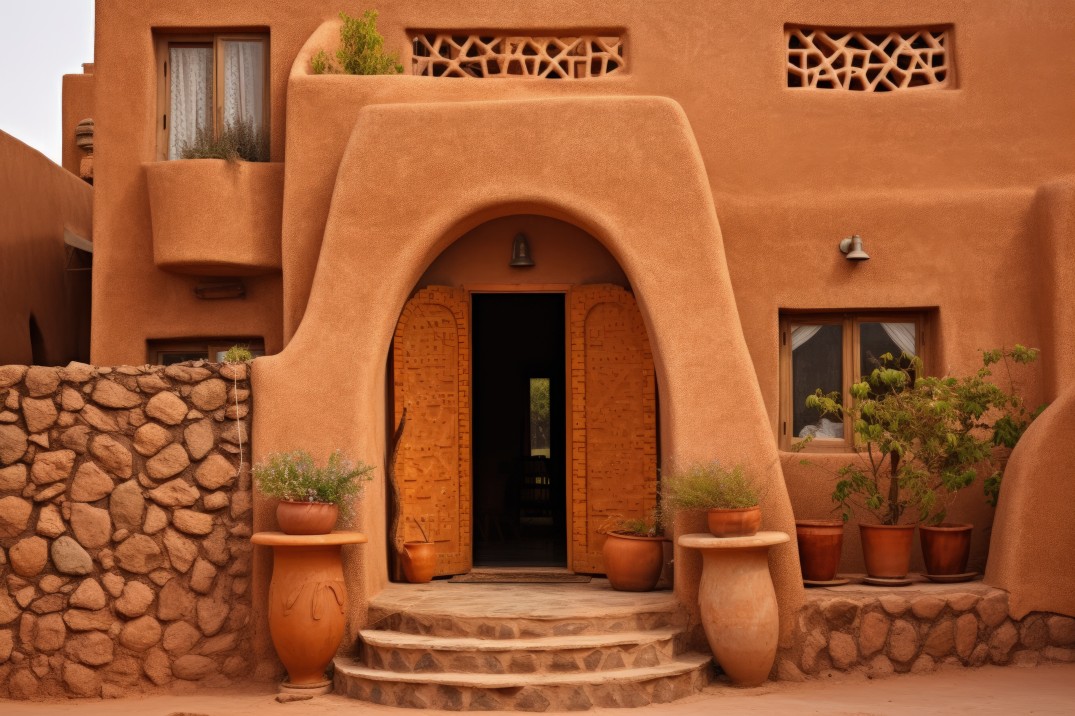
Clay architecture avoids AC in India
Clay architecture avoids air conditioning through a combination of thermal mass, passive ventilation, and evaporative cooling—techniques that regulate temperature naturally without electricity.
? How Clay Architecture Works
Thermal Mass: Thick clay walls act as a thermal battery. They absorb heat during the day and release it slowly at night when temperatures drop, stabilizing indoor temperatures naturally. This is especially effective in dry climates with large temperature swings between day and night.
Evaporative Cooling: The porous surface of clay and terracotta allows water to evaporate, carrying away heat and cooling the space around it. Innovative designs like the "Beehive" system, which stacks terracotta pots as a building's second skin, have achieved average temperature drops of 6–8°C across more than 30 sites in India.
Breathability and Ventilation: Clay is hygroscopic, meaning it naturally absorbs and releases humidity. This helps maintain comfortable indoor air quality without mechanical systems. Modern designs incorporate hollow blocks or perforated screens that create self-shading and allow air circulation through internal channels.
? Efficiency of Passive Cooling
Method Measured Impact Source
Terracotta "Beehive" facade 6–8°C average temperature reduction Ant Studio
Passive design in Mediterranean climates Up to 70% reduction in AC loads Research studies
?? Real-World Applications
Architects worldwide are applying these principles in modern design:
Burkina Institute of Technology: Francis Kéré used local clay walls combined with a saw-tooth roof to expel hot air through the "stack effect," providing natural ventilation for classrooms.
New Ghanzi (Botswana): This project utilizes 3D-printed clay architecture with courtyards and open walls to provide ventilation in hot, dry climates.
MittiCool (India): This company has created clay refrigerators that keep food fresh for 3–5 days without electricity, offering a sustainable alternative for homes without reliable power.
?? Important Considerations
While clay architecture can significantly reduce cooling needs, it has limitations.
Not Always Sufficient: In extreme heat or humid tropical climates, passive cooling alone may not achieve optimal comfort, and clay systems are often designed to reduce, not eliminate, the need for AC.
Site-Specific Design: The success of clay cooling depends heavily on climate, building orientation, and airflow. It requires careful architectural design to work effectively, not just the use of the material itself.
This is certainly environment friendly and easy of our pockets too so this is certainly worth trying in the time of climate challenges and global warming. Let us all work together to make this a way of life slowly but steadily.
By Jamuna Rangachari



Discussion (0)
No comments yet. Be the first to comment!
Leave a Comment
You need to login to post a comment.