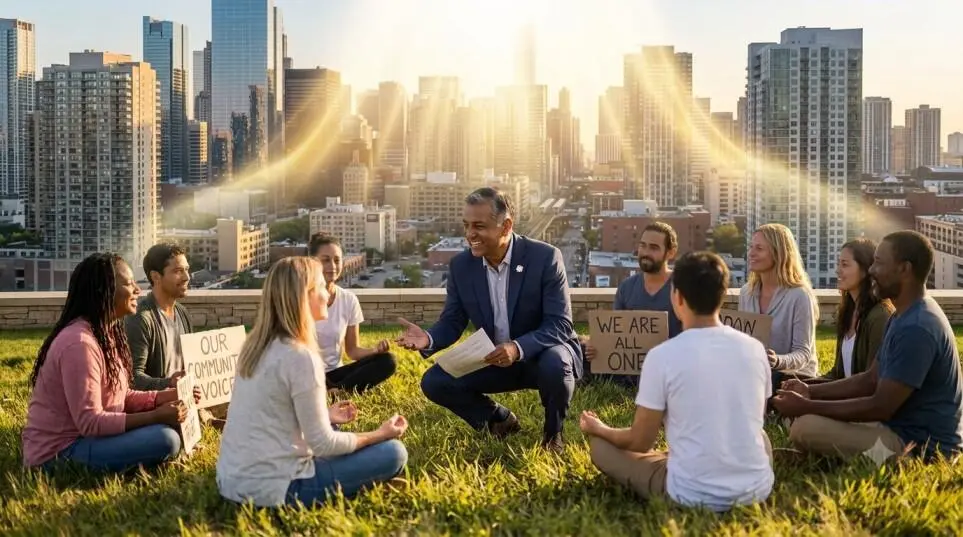
True spirituality behooves speaking against violence on peaceful protests
Speaking against unprovoked violence committed on non-violent protests is not a matter of political opinion; it is a matter of upholding fundamental human rights, the rule of law, and the very foundation of a functional society.? Here is why taking a stand is essential:
1. It defends the right to peaceful assembly
In any peaceful governance system the,right to peacefully assemble and petition the government for redressal of grievances is a cornerstone of freedom. When unprovoked violence is used against people exercising this right, it is an assault on that foundational liberty. Speaking out defends the principle that citizens can voice dissent without fearing for their safety.
2. It preserves the rule of law and equal justice
Unprovoked violence implies that force is being used without legal justification or due process. Speaking against it reinforces the idea that everyone—including the state actors—must be held accountable to the law. Silence in the face of such actions can erode public trust in legal institutions and imply that certain actors are above the law.
3. It prevents escalation and protects social stability
Non-violent protests which are morally sound, are a safety valve for societal tension. When they are met with unprovoked force, it can radicalize participants and onlookers, pushing them toward more extreme measures. Condemning the violence de-escalates the situation by reaffirming that dialogue and legal recourse are the proper paths forward, rather than retaliatory force.
4. It affirms human dignity
Every individual has an inherent right to physical and psychological security. Unprovoked violence treats citizens as threats to be suppressed rather than as people with legitimate concerns. Speaking out affirms that human dignity is non-negotiable and that no one should be subjected to brutality simply for expressing a viewpoint.
5. It protects bystanders and vulnerable populations
Non-violent protests often include journalists, medical personnel, children, and the elderly. Unprovoked violence does not discriminate; it endangers everyone in the vicinity. Speaking against it is a call to protect the most vulnerable who are not even actively participating in the demonstration.
6. It preserves historical and moral integrity
History judges societies by how they treat their dissidents. Speaking against unprovoked violence ensures that we are not complicit in injustice. Silence is often interpreted as consent, and future generations will judge not only the perpetrators of violence but also those who stood by without objection.
7. It strengthens institutions
A healthy Government depends on accountability.Speaking out, citizens put pressure on oversight bodies, courts, and legislators to investigate abuses and implement reforms. This strengthens institutions by forcing them to function as they are supposed to—as protectors, not oppressors.
8. It sets a precedent for future generations
How we respond to violence today shapes the norms of tomorrow. Speaking against it establishes?a clear moral boundary that violence is never an acceptable response to peaceful expression. This teaches future generations that justice is pursued through reason, not through fear.
Let us also see how different lenses of higher consciousness address violence:
1.Spiritual Lens (Non-Duality and Oneness).
In traditions like Advaita Vedanta, Zen, and Sufism, higher consciousness is the direct perception that all life is interconnected. Violence requires you to see another being as "other" — as separate from yourself. From this perspective:
Violence is ignorance. To harm another is to harm your own Self.
A higher consciousness sees the perpetrator and the victim as two expressions of the same universal awareness. Therefore, violence is not just morally wrong; it is ontologically incoherent—it goes against the very fabric of reality.
2.Psychological Lens (Maslow and Jung)
In transpersonal psychology, higher consciousness involves integrating the shadow self and moving up Abraham Maslow’s hierarchy toward "self-transcendence."?
Higher consciousness is characterized by compassion, meta-cognition (thinking about your own thoughts), and impulse control.
Violence is a primitive, reactive state driven by the amygdala (fight-or-flight). To act violently is to be hijacked by lower, survival-based brain functions. A higher consciousness actively overrides this reactivity, choosing response over reaction. It speaks against violence by rendering it obsolete, as the person has better tools (dialogue, empathy, restraint) to resolve conflict.
3. Karmic and Energetic Lens
In traditions that discuss karma or energetic resonance (like Buddhism or Theosophy), consciousness operates on a vibrational scale.
Violence emits low-frequency, contractive energy. Higher consciousness is expansive and loving.
The principle of cause and effect dictates that violent actions bind the actor to lower realms of suffering. Higher consciousness speaks against violence because it recognizes that violence is a trap—it damages the perpetrator's own consciousness more than it damages the victim's body
4. Practical/ Wisdom Lens
Higher consciousness is not passive; it is deeply pragmatic. It recognizes that violence is a spectacularly ineffective tool for solving root problems.?
Violence suppresses symptoms but creates deep psychological trauma that resurfaces later.
A higher consciousness understands that lasting peace comes from addressing the cause of violence (fear, scarcity, trauma) rather than fighting the effect. Therefore, it speaks against violence by advocating for radical accountability and restorative justice.
The One Critical Nuance (The "Paradox")
While higher consciousness speaks?against?violence, it does not always speak?for total pacifism in every microsecond. In many wisdom traditions (such as the Bhagavad Gita or Just War Theory), there is a distinction between aggression (violence born of anger/greed) and protection (force born of necessity).
A higher consciousness might?permit?the?use of force?in the rarest of circumstances—to stop a genocide, to defend a child, or to protect the vulnerable—but it does so with a heavy heart, zero hatred, and profound sorrow.?
In that case, consciousness speaks against violence by mourning it even while it happens. It refuses to dehumanize the attacker, refuses to enjoy the fight, and ceases the force the absolute micro-second the threat is neutralized. It uses force not as a weapon of punishment, but as a scalpel of last resort.
So, if you are operating from a higher state of consciousness, violence feels foreign to your system. You experience a visceral repulsion to causing suffering, not because you are afraid of punishment, but because you instantly feel the other's pain as your own.
Essentially, speaking against unprovoked violence is not an endorsement of any political cause or side. It is an endorsement of the principles that allow a society to resolve its differences without bloodshed. It is a defense of the idea that might does not make right, and that the legitimacy of any system rests on its ability to hear all voices without crushing them. To stay silent is to accept that force can override justice; to speak is to reaffirm that justice must always override force.
This is why truly spiritual people and those with a higher consciousness always speak up against unprovoked violence. Let us all move in this direction to create a truly harmonious world.
By Jamuna Rangachari



Discussion (0)
No comments yet. Be the first to comment!
Leave a Comment
You need to login to post a comment.