Close encounter
November 2022
CLOSE ENCOUNTER
By Pradip Krishnan
Shankar Narayanji speaks to Pradeep Krishnan explaining how satvik veganism can pave the way for a more compassionate and better world,
An article I read about two years ago in an English daily about Sthithaprajna, a man-made forest retreat, and the satvik vegan movement, both founded by Shri Shankar Narayan in Byndoor, Karnataka, prompted me to visit and experience the unique place. However, the sudden spread of the COVID-19 pandemic delayed the trip. Finally, on June 26 this year, on a cool day, amidst drizzles, my wife Sreelakshmi and I visit the sanctuary.
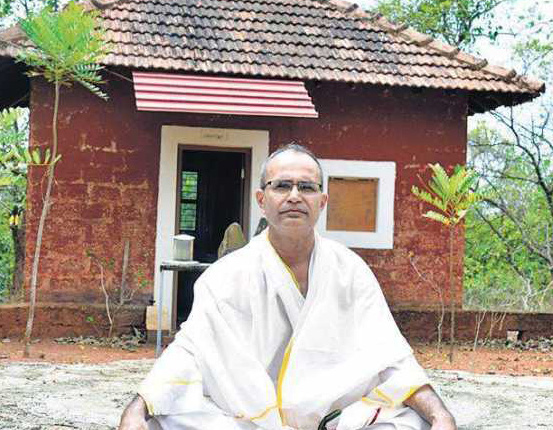
Holding an umbrella, Shankar Narayanji, in a spotless white shirt and dhoti, smilingly welcomed us to his abode. He looked like a Gandhian of yesteryear, often seen in history books. As the pathway had become unmotorable due to recent heavy rains, we got down from the car and crossed a narrow stream on foot to enter the three-acre man-made forest. The incessant drizzles, the chilly weather, the tall trees all around, the chirping of birds, the rattling of insects, and the little forest flowers of yellow, blue, and white, at once thrilled us.
Soon we were ushered into the simple tile roofed cottage, Dhyana, with a 1000-square foot hall, with three-foot-high raised cement platforms on all four walls to be used as cots to sleep, in which mats and pillows were kept. Next to the hall is the kitchen (where guests are allowed to cook vegan food) and a washroom. After resting for a while, Shankar Narayanji took us around the forest he had meticulously cultivated by sowing the seeds of 2000 plants and trees, of which many are fruit-bearing. He said that wild animals such as deer, nilgai, boar, porcupine, peacocks, bonnet macaques,
Indian giant squirrels, grey langurs, mongoose, owls, and rabbits are regular visitors to this jungle. While roaming around the woods, we could see hornbills waiting for their prey, rubbing their yellow beaks in the trees, a couple of Malabar giant squirrels enjoying a ripe jackfruit, and a barrel of monkeys jumping from tree to tree. In a couple of rainwater retention ponds, little birds were bathing and drinking water.
Every year, during August, Shankar Narayanji, addressed as ‘Forest Father,’ organises the Satvik Vegan Festival, with participants from all over the globe listening to talks, enjoying music, tasting vegan dishes, and taking forest walks and village visits. The event aims to take the vegan message to political, religious, and business leaders, the media, and the public.
When asked about the difference between veganism and satvik veganism, Shankar Narayanji explains, “While in veganism, the practice of non-violence is restricted to animals, in satvik veganism, the practice of ahimsa extends even to plants and humans. We also strive to practise truthfulness, simplicity, polite behaviour, etc.
In a message, Prime Minister Sri Narendra Modi wrote, “Ahinsa parmo dharma (non violence is the highest moral virtue) and Atmavat sarva-bhutesu (one should feel the happiness and distress of others as his own) are the golden concepts of our ancestral culture. Mahatmaji followed it throughout his life and Mahavir made it mandatory for modern man to follow a satvik lifestyle. Veganism is the way to wellness and honour the holy soul. To honour the right to live for every creature on earth is the ethical responsibility of mankind.”
About the uniqueness of the vegan forest, Shankar Narayanji says, “Generally, the forest grows on its own. But here, it is grown by human efforts. When human efforts are involved, people may use animal manure, chemical fertilisers, and animals in various forms. Here, no animal manure or animals are used. And when humans make efforts, they carry expectations. Here, everything was done without any expectations, and hence no human emotions are involved.”
After wandering around the vibrant and lively campus free of pollution for about an hour, Shankar Narayanji offered us a sumptuous lunch of rice, dal, fruits, payasam (pudding), and coconut buttermilk. “People can come and stay here but with an appointment. There are no servants and no fixed facilities.
It’s a compromise between forest life and civilised life. There are no fixed charges, though a voluntary contribution is accepted,” said the 56-year-old.
Later in the evening, sitting on the open veranda, looking at two beautiful peacocks dancing in the rain, Shankar Narayanji talked to us about his life, his mission, and the satvik vegan movement that he had initiated.
What was the turning point in your life? In 1989, reading Mahatma Gandhi’s autobiography, The Story of My Experiments with Truth, like him, I too stopped drinking milk, and that was the beginning of my vegan journey. Then in 2006, when I attended a lecture by Dada J P Vaswani, who said, “To win the competition, withdraw from the competition,’ it was a big influence on my spiritual journey. Later, inspired by the visits to Sabarmati Ashram, Ahmedabad, and Sadhana Forest, Auroville, I quit my job and started growing the forest in 2009 by planting different types of trees, which have now become large trees.
What prompted you to become a vegan? What are its advantages?
Being a lacto-vegetarian by birth, I stopped drinking milk in 1989. But, while working abroad as an accountant, through the internet, when I came to know of The Vegan Society of England, it prompted me to become vegan. Later, I started the Indian Vegan Society in 2004 (renamed Satvik Vegan Society). As a vegan diet is original and natural, it is the one meant for man to thrive. As it is suitable for all humans, anyone who follows a vegan diet will not only have better health but will also help to prevent or minimise cruelty to animals and contribute to the preservation and prosperity of the environment. I would say that to realise the full potential of being a human, it is necessary for one to become vegan.
By eating only healthy vegan food, one does not interfere in the lives of animals and thus avoids cruelty to them. By not cutting forests to produce crops that are fed to animals that are being factory farmed, we helps the environment and become healthy ourselves.
Along with the practice of veganism, you also stress the importance of satya, asteya, Brahmacharya, aparigraha, etc.
Ancient Indian values evolved to bring the best out of man and society. Though the practice of each one of these values gives immense benefits to the practitioner, they need to be practised together. All these five values are listed under ‘yama,’ meant for the benefit of others, in the tradition of Ashtanga Yoga. If ahimsa is to abstain from hurting or harming others, so are other values like satya (truth), asteya (non-stealing), Brahmacharya (non cheating), and aparigraha (non-accumulation of wealth or simple living). When we don’t practise any of these values, it affects others. A person who sees God in others or who believes that the same God who created him also created others—making, in a sense, all living beings our brothers and sisters— will have to include all these values in his life.
Do you think that only a vegan diet is suitable for human anatomy?
A healthy vegan diet gives an optimum output from the human body. The whole body is made for the consumption of plant foods. Though the human body likes to have healthy plant food, it has adapted to survive in adverse conditions by eating animals or unhealthy plant foods, although with a lot of diseases and difficulties.
It is often argued that when a vegan diet fails due to poor supplementation, it may result in serious physical and cognitive impairment.
First of all, understand that no one has a perfect life. Vegans, vegetarians, and non-vegetarians will all experience difficulties and deficiencies. And food is not the only problem plaguing humans. We have all the artificialities and unnatural activities in life resulting in endless suffering and diseases; no solution seems to be perfect. Claiming to be a vegan and imitating all the activities that non-vegans indulge in is not the solution. However, a healthy vegan diet with a natural, simple, satvik lifestyle and living in harmony with nature without greed will not have any shortcomings.
What is your answer to the argument by non vegetarians that sustainable, ecological, and harmonious animal production is really a solution to the world food problem?
Such contentions come from people who are selfish and refuse to ponder issues from a holistic point of view. There can’t be sustainable, ecological, and harmonious animal production as long as animals don’t grow on their own, and we need to feed animals to grow. Despite having enough plant food to feed three times the current human population, we have a food problem. This is because we feed the food, which we can eat directly, to animals to produce animal food. Therefore, animal production is not only unethical but also unsustainable, as we use several units of plant food to produce one unit of animal food.
How can the practice of satvik veganism help to establish equilibrium on earth?
By eating only healthy vegan food, one does not interfere in the lives of animals and thus avoids cruelty to them. By not cutting forests to produce crops that are fed to animals that are being farm produced we helps the environment and become healthy ourselves. Satvik vegans give importance to values, leading a simple life, using polite language, and avoiding skirmishes, thus helping to maintain peace and social harmony.
What is the role of diet in human behaviour? Does behaviour or character have any influence on diet?
What is your answer to the argument by non vegetarians that sustainable, ecological, and harmonious animal production is really a solution to the world food problem?
Such contentions come from people who are selfish and refuse to ponder issues from a holistic point of view. There can’t be sustainable, ecological, and harmonious animal production as long as animals don’t grow on their own, and we need to feed animals to grow. Despite having enough plant food to feed three times the current human population, we have a food problem. This is because we feed the food, which we can eat directly, to animals to produce animal food. Therefore, animal production is not only unethical but also unsustainable, as we use several units of plant food to produce one unit of animal food.
How can the practice of satvik veganism help to establish equilibrium on earth?
By eating only healthy vegan food, one does not interfere in the lives of animals and thus avoids cruelty to them. By not cutting forests to produce crops that are fed to animals that are being farm produced we helps the environment and become healthy ourselves. Satvik vegans give importance to values, leading a simple life, using polite language, and avoiding skirmishes, thus helping to maintain peace and social harmony.
What is the role of diet in human behaviour? Does behaviour or character have any influence on diet?
There is a saying: “We are what we eat.” As our body is made up of what we eat, vegan foods ensure calm and soft behaviour. When one eats the meat of animals bred in a horrendous environment where they are killed brutally, one unknowingly injects into the body all the sufferings of the beasts. This suffering is reflected in one’s acts and deeds, creating a vicious circle of miseries. All the agonies of modern life have a direct link to our deeds to animals, especially for food. While satvik vegan food creates a cycle of happiness, animal food creates a cycle of agonies.
Eating is the beginning. If we bring our children up on healthy plant food and with a satvik lifestyle, without competing with others, coupled with polite and non-aggressive behaviour and language, people can live a happy and peaceful life even in these strife ridden times.
Your message to the readers?
My message is to go slow, think, assess every action you do (whether it is eating, speaking, or doing anything else), take the required corrective action, and be strong individuals without imitating others blindly. When we have strong individuals who do only good, we will have a good home, village, town, country, and world.
When we have sensible and selfless people who see holistically and want the good of every being on earth as our leaders, whether they be religious, spiritual, or political, we can guide the world towards a better order.
Pradeep Krishnan is a student of consciousness, based in Kerala. A seeker by nature, he is deeply attracted to the teachings of Sri Ramana /Maharshi and Sri Nisargadatta Maharaj..


Discussion (0)
No comments yet. Be the first to comment!
Leave a Comment
You need to login to post a comment.