Creativity
December 2023
CREATIVITY
Red bushes, Blue roses
Harvinder Kaur clarifies what creativity is all about and emboldens you to stir up your creative juices by sharing a few tips for taking the plunge
What’s your first reaction when a beautiful mug of tea slips from your hand and shatters? Or when you stare at titbits of scrap piled in the corner of a veranda? What do you do with single earrings left in your collection, the beloved pair lost? How does your mind deal with the disjointed, patchy, torn bits of things and life? Do you rush to throw out what’s broken, wipe what’s spilt, sweep away what doesn’t fit, and try restoring order?
DON’T!
Welcome to the magic ingredients of the creative mind. We accept the mess, embrace the confusion, gather the brokenness, and allow the forces of creativity to take over. In this article, I’ll share my understanding of creativity and how it has been unfolding in my life and work.
Creative? Who me?
‘Creativity’ is a word often loosely used and thrown around a lot. When I ask someone, “Are you creative?” I often get the response “Oh no, I can’t draw or dance or sing!” Is creativity merely about singing, dancing, or painting?
Let’s begin by clearing a common misconception that creativity is just something to do with the fine arts. There’s a difference between skill mastery and creative expression. Creativity means expressing or creating something new or unique, whatever the skill or work. You could be a creative cook coming up with new and unique recipes or you could also be a skilled artist who’s not creating anything new but just reproducing. It’s not about the kind of work but the way you do it.
I am a poet and a writer. I also paint and do photography, but perhaps I’m at my creative best while creating unique teaching and training programmes. Coming up with interesting ways to teach seemingly mundane things like grammar and spelling, as well as writing and critical thinking. I totally loved building a school in a unique way and infusing it with a ‘creative’ spirit through innovative methods. What does it mean to be creative to you? Even if your job is boring and doesn’t require any creativity, like entering data, is there still hope? YES!
Creativity is a natural human force, and we all have it, naturally. Don’t believe it? Look at any child playing. Watch children exploring objects they haven’t been taught how to handle.
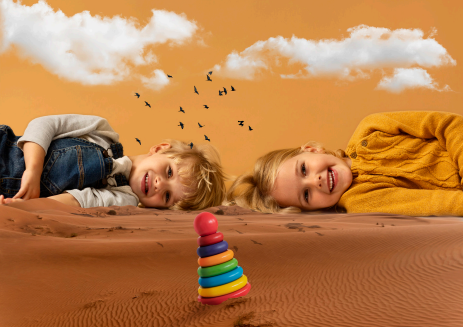
Children are ingeneous in the way they play and imagine
A child’s imagination is phenomenal! It is the seed source of creativity. Before our minds are boxed in by instructions and dos and don’ts, they are overflowing with creative energy. Whatever happens to us as we ‘grow up’!
Creativity as the Universal Force
Creativity is a form of yoga when a connection is made between the inner and the outer, the microcosm and the macrocosm. It is a real life influencing force—not a vague, dreamy, distant indulgence, even though the amorphous is a dimension of creativity. It is to be lived daily, tangibly, in real-time, in seemingly ordinary lives. And it has surprising gifts, like a blue rose on a red bush!
Creativity is about creating something new by combining two or more things or concepts
that already exist. That’s why I’m calling it a ‘yoga’ as it’s about union, about joining forces. Even when it’s about abstractions, theories, and art, there is a subtle confluence. The Wright Brothers created the airplane by studying existing gliders and data on aerodynamics. Shakespeare created those wonderful plays, but the stories in many of them were floating around in one form or the other before passing through his creative lens.
Philosophers like Plato speak of a “world of forms” where everything exists in subtle form before being made manifest in this tangible world. The psychiatrist Carl Gustav Jung leaned towards the theory held in Oriental traditions about the collective unconscious. It can be philosophised that we live surrounded by a creative life force and much depends on
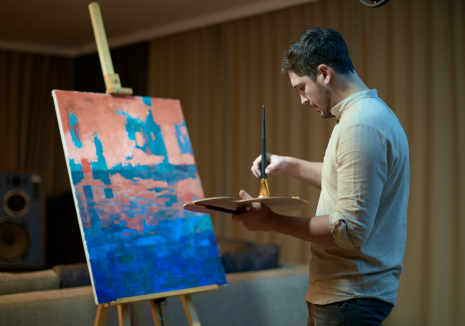
Creativity is a form of yoga where you form a bridge between your inner and outer world.
Creativity is about creating something new by combining two or more things or concepts that already exist. That’s why I’m calling it a ‘yoga’ as it’s about union, about joining forces. Even when it’s about abstractions, theories, and art, there is a subtle confluence.
our ability to plug into this, through our inner being, efforts, and our vibrational level. In that sense, every creator is a channel.
Mapless exploration
Creativity is flow and openness. It is not merely a method, though methods could be a part of the paradigm. It is an energy or force, as universal as air. But a lot depends on your capacity to absorb and hold. It is your courage that lets you embrace the unformed, the amorphous, the unborn that gives you the gift of the creative experience.
It means going beyond maps. A map has the routes fixed, the roads named, the paths chalked out, and everything measured. Your destination is pre-decided. Creativity involves walking into the fog. Sometimes, blindfolded. It’s fun, can be dangerous (if you do this literally), and a little unnerving, especially if you are used to following maps in life. The creative life requires a degree of courage, especially if you’re used to travelling along marked roads, railway lines, and well-trodden paths. It’s not about rebelling, it’s about exploring. It is not
a rejection of existing paths but going beyond them. There’s an uncertainty principle at work here; you don’t know exactly where it’s going to flow.
So, when you embody or express the creative energy, you don’t direct it. You let it direct you. Now what does that mean in tangible, human terms? It means you are ready to brainstorm, to look into the unusual, funny, and even crazy possibilities. It’s about blotches, the nebulous and amorphous, at least in the beginning.
I’ll give you a personal example. I recently started exploring visual art (painting and sketching) seriously. I’d always thought I had the seed in me but never got the chance to develop the visual artist in me in my growing years or even as an adult. Till now. Like many people, my life has been undergoing a massive transition post-corona, a metamorphosis of sorts (and it’s not over yet). Amidst the storm of loss, death, and disease that swept through so many lives, mine included, leading to change I wasn’t anticipating, I had to gather broken pieces together. That’s when I started taking art classes. I didn’t take the route of learning step by step. My colour explorations involved simply playing with colour the way children do, letting things unravel (or not). It was really the expression of poetry through colour. Even form didn’t matter. I had no purpose in the beginning but to simply flow and love the process. Crazy was fine.
BUT THEN, SOMETHING CLICKED!
Serendipity blessed me with a lovely gift in one of the art experiments. Playing with leftover coffee led to a unique perception. I began to see shapes in what just seemed like messy blotches. It was such an eye-opener, to be able to see unique characters who could tell a story from a piece of paper. A bit like a child pointing to a familiar shape in the clouds. I kept experimenting and developed this further. In fact, I have now made it a part of an online course on Imaginative Writing, which I’m teaching! Who could have imagined that a pinch of coffee powder could lead to such an amazing Eureka experience,
where your entire creative vision can be taken to the next level?
Embracing the new
As growth happens, our languages need to change, and by language, I mean all forms of expression. It’s not whether I speak Japanese or Hindi, French or Tamil, or something else. It is also what form my expression takes. Maybe I don’t want to use words at all, so I pick up a paintbrush or charcoal stick. I write, I paint, I create, I laugh, I rage, I become silent.
I’ve often been asked how or why I express myself in so many different ways. Once my publisher asked me why I write in varied genres, from tiny poems, long poetic satires, and free-verse to fiction and non-fiction, that too in more than one language. Then there’s photography and painting. Perhaps the most beautiful form is when I put them together to create a medley of experiences in the form of a mehfil, where people and hearts connect through a synthesis of these expressions.
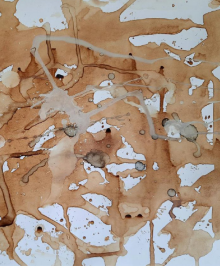
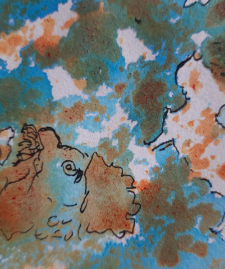
Harvinder’s creative outpourings involving coffee and colour on paper
How do varied languages for expressions come to us? We are not always aware of the seeds inside us. Sometimes it’s a soft gentle whisper floating in dreams, other times it’s an itch that makes you uncomfortable. Either way, a seed is a calling from hidden depths. It asks for nurturing and care. It has its season of blossoming, and when the flowering happens, it takes your breath away!
We need to be sensitive to the call of faraway, hidden spaces. They seem distant but are actually inside us, beneath the skin of forgetfulness or inattention. Opening to the unknown, daring to explore, being vulnerable, ready to fall, accepting that we will make mistakes, and walking on, take us through the creativity portals. The rest is practical details, methods, and how-to-do lists. They come easily and readily once we’ve taken the leap within.
Things to do—or not to do
Let me share a few practices and approaches I use to fuel creativity. These are by no means great methods, or exhaustive, but they have been lived, tested, and tried out, and have given a creative glow to my life. I am not concerned about being ‘good’ but simply expanding, exploring, and enjoying myself immensely in the process.
• When things spill and shatter I pause. I don’t rush to wipe clean or sweep away immediately, quietening the ‘out, damn spot, out!’ voice — literally and figuratively. I watch. The pattern, the flow, the brokenness. It speaks. Like when the glass jar holding yellow moong dal fell on the black granite, the seeds scattering all over. They looked so pretty, the seeds with their yellow laughter. Or when the thick filter coffee stored in the fridge spilt and spread like a dark secret over the white plastic.
• I make it a point to try to taste a new thing at
least once a month, something my tastebuds are not familiar with. It could be anything: a biscuit, ice cream, chocolate, or I cook something different from my regular dal, roti, sabzi.
• I wear an outfit I haven’t worn for a very long time. It makes you feel different. Or a colour I don’t usually wear. It gives you a novel awareness of your mind.
• I hang around with kids without trying to be a know-all adult. I play with them, discover, explore, chat. It’s an unparalleled learning experience.
• I practise various creativity exercises (they are not covered in this article).
• Travel. Whenever, wherever possible, either solo or in company. If you can’t go to a forest or mountain or remote far-off land, take a different route home or to the office or market.
• Talk to different kinds of people, online and offline. Talk to all the people you interact with beyond the task or work, once in a while. The auto or taxi driver, the vegetable vendor or delivery boy, your boss or teacher (if you dare).
• Have some kind of daily physical routine like exercise, walking, dancing, or yoga.
• Use your hands to build or create (typing doesn’t count) like gardening, carpentry, drawing, clay modelling, and embroidery.
• Music. Listen, sing, or even play an instrument if you can. Allow music to water your life and watch a new season awaken.
• Put together different things wherever you can.
May the Creative Spirit be with you!
Creativity Exercises
Here are some specific ‘to-do’ exercises that help the flow of creativity. These exercises can be done solo, though they are much more powerful and fun if done in a group.
• Choose any object around you. Speak about that object for one minute as fast as you possibly can, without stopping or thinking too much. You could look in the mirror if you like. And yes, it could be nonsense. Nobody needs to hear you, except perhaps your phone (yes, record it). After one minute of random speech, think about this object sensibly for a while. Now repeat the one minute speech about the same object, slowly and rationally.
• Choose a shape—circle, triangle, square, amoeba, etc. Draw this with anything but your dominant hand. If you are a right-handed person, use your left hand (or vice versa). Also, draw with your mouth and toes. Go on!
• Make a collage using pics that depict something from your childhood.
• Draw a landscape. Colour everything with a colour you would never use for that particular feature. For instance, your sky could be red, clouds blue, trees purple, and the river yellow. You don’t have to be a great artist. Just have fun.
• Spend a day noting only smells—foul or fair, faint or intense. We don’t give enough importance to smells, except when they are strong. It will be an eye-opener.
• Create an entirely new word using any or all
the languages you know and explain its meaning. • Imagine the last day of your life. Write a letter to your future self.
• Create a gibberish song and sing it (please record it on your phone).
• Close your eyes. Think of a familiar face. It could be a friend, a member of your family, or a well-known personality. You should know that person’s face well. Draw it. It doesn’t matter if you can’t draw well or at all. You could make a cartoon or an emoji, but make sure you highlight what you think are the main features. Now take a look at that person’s face and compare.
• Draw a tree. Hang different things on the branches (anything except leaves, flowers, and birds) You can’t repeat a thing; ten monkeys don’t count.
• Pick a random picture of a real person from the internet about whom you know nothing and write about that person. Use your imagination to spice up the profile. After that, do some research to find out facts about the person and compare your notes.
• Pick an object from around where you live, your home, or your office. Write a letter to that thing as if it were a real person.
• Think of a person you want to say “I love you” to. It need not be romantic. Say it in ten different ways without using the word ‘love.’
• Pick a movie you haven’t seen. Play a scene in mute mode where people are talking. Write dialogues of your own. You can compare them with the original ones afterwards.
Harvinder Kaur is a writer, poet, and educator. Her creative and impactful work spanning over three decades includes teaching, creating unique training courses/workshops, and building and running a school among other things. You can learn about her beautiful online course on IMAGINATIVE WRITING and other works @ www.harvinderkaur.com
Discussion (0)
No comments yet. Be the first to comment!
Leave a Comment
You need to login to post a comment.