
Cut the carbon
June 2023
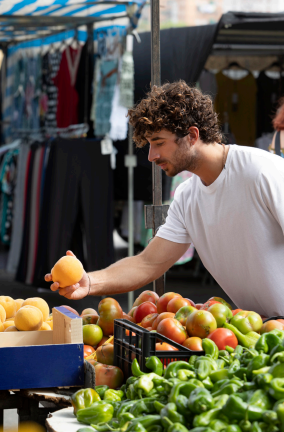
Naini Setalvad is more than happy to share ways in which you can alter your diet to keep the Earth greener
I started my nutrition practice in 2000 with the hope of spreading the lessons I learnt from my health journey. I wanted to give people sustainable solutions to their health problems.
In my early days of practice, I had a lot of clients who came to me for a weight loss plan and, after I guided them, they successfully kept the weight off. In the 2010’s I was seeing a lot more clients who came to regularise their blood param
eters and retard diseases like diabetes, hypertension, and hypothyroidism. In recent years, I have been getting clients with a different kind of health goal.
With the havoc created by climate change, many individuals are making a conscious ef fort to live more sustainably. Besides making appropriate lifestyle changes, they are also looking for a diet that will help reduce their carbon footprint.
So, what is meant by ‘carbon footprint’? It is the total amount of greenhouse gases (including carbon dioxide and methane) that are generat ed by our actions. These greenhouse gases are responsible for excessive heat getting trapped in the earth’s atmosphere, resulting in climate change. The food that we eat has an enormous impact on our collective carbon footprint, with estimates suggesting that a quarter of all global greenhouse emissions are linked to our ex isting consumption habits.
I am completely on board with the initiative taken by these altruistic individuals and am more than happy to share with you the tips I give them to reduce their carbon footprint.
• Skip the meat: We live in a crazy time, where people who make food choices that are healthy and compassionate are often considered odd, while those whose food choices promote diseases and environmen
tal degradation are considered normal. Did you know that lamb, beef, pork, and turkey production are one of the major contribu tors to our carbon footprint? Overall, cut ting outanimal products can significantly lower our carbon footprint.
• Lean on lentils: Are you worried that with out meat and dairy you won’t be able to get enough protein through the day? Worry not! Lentils and pulses are enough to meet your daily requirements. In fact, they have a much lower carbon emission than animal products. They do not need to be packaged in plastic, and that further reduces their impact on our carbon foot print.
• Munch the millet:
Our farmers have been growing al ternative grains and seed grains like millet for centuries. Millet requires the least amount of water from all grains and
is considered a superfood. What is more? These nutrient-packed grains have a much lower carbon footprint than the conven tional grains we are used to. No wonder millets are being promoted robustly this year!
• Eat local: One of the key aspects to re member is that it is not only the food that matters but also the way the food reaches you. A particular ingredient that is brought to you by road from a farm that is nearby as opposed to one far away will lower your carbon footprint. An ingredient being flown in an airplane as opposed to reaching you by road will increase your carbon foot print as the fuel burnt would be more. Imported foods like avocados have a larger impact on our car bon footprint. Due to their perishable na ture, a large amount of energy is required to transport them. A simple solution to this is to eat seasonal and local produce that travels lesser distances.
• Quit cane sugar: Processed sugar is as bad for the environment as it is for the body. Sugarcane production itself is a major con tributor to greenhouse gases. If one must need a sweetener, then dates and honey are better alternatives.
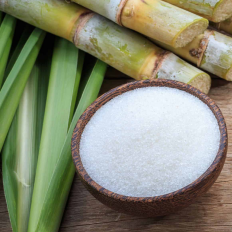
Avoid cane sugar
• Favour cook-easy options: Another sig nificant contributor to carbon emissions is the way we cook. The longer you cook on a stove, the more the fuel you burn and, hence, the larger the carbon footprint. Firstly, minimise reheating of food. Eat

choose cook-easy options freshly cooked food whenever possible. Soak grains and pulses before cooking, to reduce cooking time. Avoid fried and baked foods that require higher tempera tures for cooking. Additionally, eat season al vegetables that are tender and require less time on the stove. The lesser the time required in cooking, the more the nutri ents are preserved in the food.

• Change gradually: Reducing one’s car bon footprint through one’s diet is a personal choice. If you do opt for it, try to make small changes daily instead of making them all at once. Your mind and body will take time to adapt. Making slow and gradual changes has a better impact in the future than a sudden change that one will eventually give up on.
Many drops collectively make an ocean. Keeping this in mind, if each one of us adopts a more carbon-neutral lifestyle, then we will successfully save our planet for fu
ture generations.
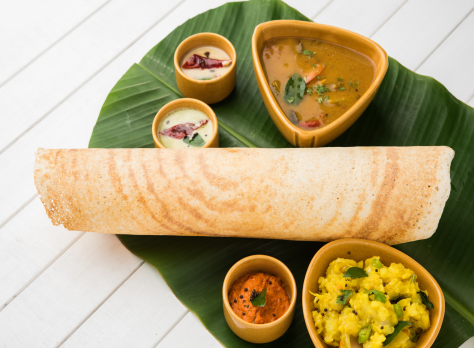
Recipe
MILLET DOSA
Ingredients
3 cups millet ( sama or vari) 1/2 cup tur dal (pigeon peas) 1 tbsp chana dal (split chickpeas) 1 tbsp methi (fenugreek) seeds 2 tbsp oil
Method
1. Soak the above ingredients overnight. 2. Grind them into a paste.
3. The batter should be of pouring consistency but not runny.
4. Take a ladle of batter and spread it onto a hot, greased pan.
5. Add a few drops of oil.
4. Roll it into a dosa once it’s crisp. 5. Enjoy hot with some green coconut chutney and vegetable sambar.
Naini Setalvad is a nutritionist, specialising in lifestyle and immunity disorders. Her foundation, Health For You, throws light on healthy food habits. Contact her at healthforyou@nainisetalvad. com

Discussion (0)
No comments yet. Be the first to comment!
Leave a Comment
You need to login to post a comment.