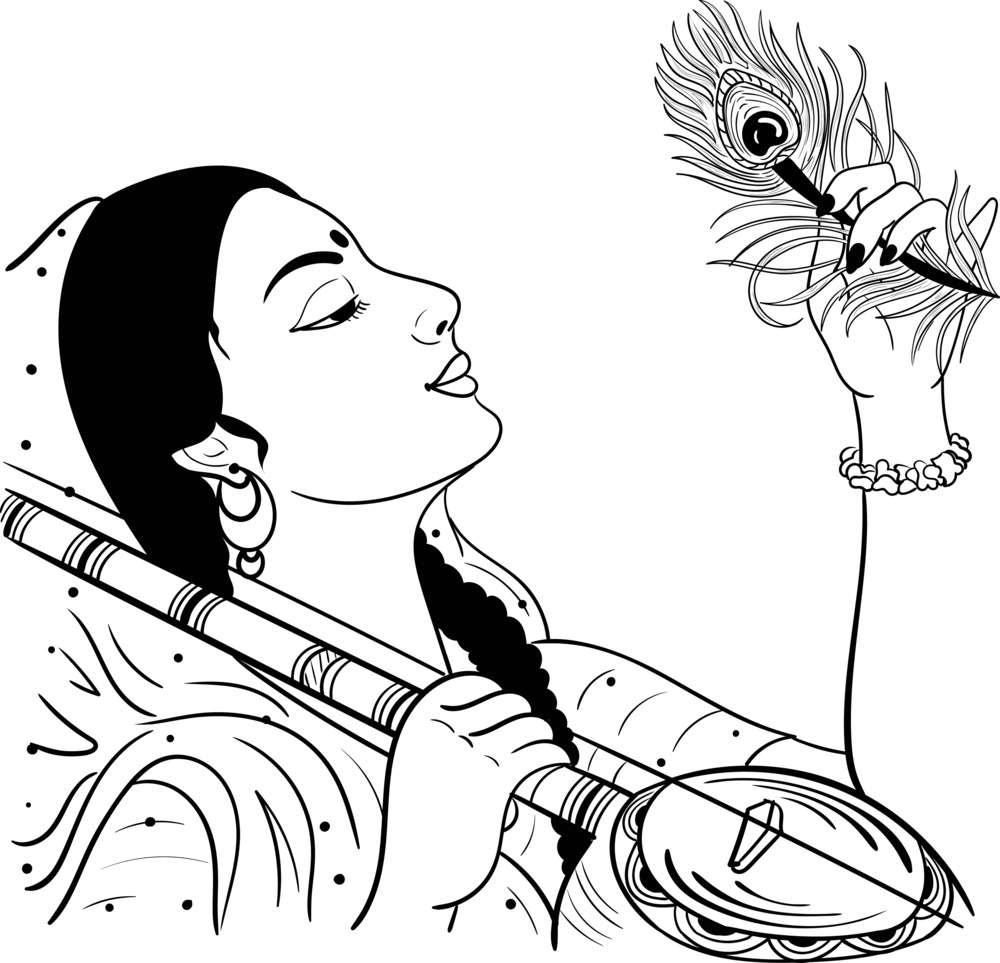
Devotion in motion
October 2022
Devotion in motion
The Bhakti movement in India has been a potent force in bringing people together through devotional worship and making us realise that all of us, in essence, are one. Jamuna Rangachari talks about the various forms that this movement has taken and its widespread influence in various parts of the country
Bhakti has also been metaphorically seen as spiritual love for the Lord where the bhakta (devotee) seeks the Lord, just like a woman seeks a man.
India has been the land of seekers since times immemorial, and this is evident from the Bhakti movements that have flourished in all regions, with their respective flavours and traditions, albeit always with fervour. India is known as the land of unity in diversity, and this can be seen more colourfully in the Bhakti movements than anywhere else.
My late mother-in-law used a rosary for chanting God’s name and believed that she would always be taken care of unconditionally. “Perumal en kai vidamatan,” loosely translated as “God will never let go of me,” was her firm belief till the end of her life. To everyone else too, be it us, our maids, or our friends, this was her way of counselling, as she was clear that God is always with his children. It is this trait of hers that endeared her deeply to me even before I became her daughter-in-law and was definitely one of the reasons I was happy to be part of the family.
It is said that people define societies and societies define nations. Ours has always been a land of seekers. So, lasting changes have taken place only through this potent force of spirituality. Historically, the Bhakti movement was a significant religious movement in the 15th and 16th centuries. It sought to bring religious reforms to all strata of society by adopting devotion to achieve salvation. In the South, it gained prominence through the poems and teachings of the Vaishnavite saints called Alvars and the Shaivite saints called Nayanars, and through Goddess worship called Shaktism, before it travelled northwards.
Bhakti has also been metaphorically seen as spiritual love for the Lord where the bhakta (devotee) seeks the Lord, just like a woman seeks a man. In this context, just as Meera is popular in the North for her bhakti to Krishna, Andal is very popular in the South, especially Tamil Nadu, for her bhakti, again to Krishna, whom she is believed to have married and merged into. The difference between the two is that while Meera’s devotion was not accepted by her family, Andal’s was, right from the beginning, as she was blessed to be born to an Alwar, a Vaishnavite saint. Till today, from December 15 to January 15, everyone sings Andal’s bhajans, as she composed one bhajan a day during the same month to convey her love for Krishna, whom she subsequently married. While unmarried girls are encouraged to pray for a husband like Krishna, others sing the bhajans primarily for Krishna’s bhakti. One can see people singing the bhajans early in the morning wherever they may be.
The Bhakti movement has been instrumental in bringing people together, especially when its principles are followed diligently.
This is one tradition that I shall always remember, for I was born in Delhi, and despite the extremely cold weather, my late grandfather, a Carnatic musician, used to go along with all his students while others would join in to take part in singing these bhajans. In fact, at that time, Andal became well-known in that part of Delhi, as everyone started looking forward to the bhajans. Even recently, when I met some old friends from Delhi, they asked me to sing those bhajans with them and said that they continued following this tradition both in Delhi and in America, where they were now based. So, yes, the tradition of Bhakti becomes a part of one’s identity when one does it sincerely.
The Bhakti movement has been instrumental in bringing people together, especially when its principles are followed diligently.
Principles of the Bhakti movement The Bhakti movement taught that God is one, and to worship God, man should serve humanity and treat all men as equals. Bhakti maintained and propagated that the worship of God with devotion and inner piety is better than external worship, like participating in various ceremonies and going on pilgrimages. It also eschewed caste distinctions and superstitious practices. All this may seem simple in theory but is difficult to practise in the journey of life.
Here too, I remember my late mother-in law who would not be that interested in pilgrimages but would insist that we perform an annadana (food donation) regularly for the underprivileged. Even during my late father in-law’s barsi (death anniversary), she would insist on feeding all the underprivileged in whichever area we stayed. It is indeed for this reason that she is fondly remembered in all the areas we lived in, and I am sure she has gathered a lot of spiritual blessings in the process.
As she loved music also, she kept singing the hymns of saints, of which Kanaka Das was her favourite for his songs and stories. There is a legend that talks about how Sri Krishna came from Dwarka to Udupi, a coastal town. Initially, his idol was placed in a temple, looking eastward, by the seer Lord Madhavacharya, as was the norm. At that time, an ardent devotee whose name was Kanaka Das came to Udupi to get the blessings of Sri Krishna. However, he was denied entry into the Udupi temple for he belonged to a lower caste. This again was the norm in those days.
The devotee sat in front of the temple and prayed with fervour to Sri Krishna, and then something miraculous happened. Pleased with his devotion, Sri Krishna decided to bless him with a glimpse. The Balakrishna idol, which was initially facing eastward, magically turned westward. The walls of the temple had a crack and this allowed Kanaka Das to see Sree Krishna. After this incident, a proper window was constructed in the place where the crack had appeared, and this window is known as Kanakana Kindi. To date, the idol of Udupi Krishna faces the west, and the window is my favourite place in the temple, for this reminds all that God never ever discriminates between his devotees and sees only pure devotion.
Bhakti movements across India
The Varkaris of Maharashtra
Among all the states that I have lived in, Maharashtra is my favourite for its egalitarian attitude in all areas. When I was in Mumbai, I remember the fervour with which the Varkaris (devotees of Lord Vithoba) went to Pandharpur. So much so that I was very intrigued and accompanied my maid to visit the place along with other Varkaris. It was an amazing trip where I could see solidarity and bhakti all around me; everyone kept chanting “Vithala” while some sang abhangs (devotional songs). There was absolutely no discrimination how Maharashtra has always been progressive in all aspects—they had a head start!
The tradition is that on Ashadhi Ekadashi every year, since the 13th century, lakhs of Varkaris gather in Pandharpur to seek the blessings of their beloved deity Vithoba, also called Vitthala. The movement was democratic from the beginning, as the great Bhakti saints Dnyaneshwar, Tukaram, and Namdev were from different castes and laid the foundation together. They were inspired by both
Bhakti and the Sufi saints, who were reacting to the religious orthodox practices in their respective religions.
These saints not only included all castes but also gave a special place to women much before women’s liberation was even discussed. The way they did this was by comparing Vitthal to a mother, calling her Vithu Mauli, and by including the contribution of female poets like Muktabai, Janabai, and Bahinabai. Essentially, they wished to highlight the fact that all are equal in the eyes of Vitthal, and were, indeed, extremely successful, as Maharashtra, to date, has in its fabric the ethos of unity in Bhakti.
It was then that I understood The Varkaris of Maharashtra gather in lakhs every year to seek the blessings of Lord Vithoba.
The Kanwars of North India
Another significant movement of Bhakti is in the North and is that of the Kanwars. They are devotees of Shiva who make an annual pilgrimage to temples in Haridwar, Gaumukh, and Gangotri in Uttarakhand, and Sultanganj in Bihar, where thousands of participants gather sacred water from the Ganga and carry
it across hundreds of miles to dispense it as offering in their local Shiva shrines or the temples in areas where they reside.
The pilgrims derive their name, ‘Kanwars,’ from the contraption they use for gathering the Ganga water, which is called ‘kanwar,’ and while the source of the water is often the Ganga, it can also be its local equivalents. The offering is dedicated to Lord Shiva, who is addressed as Bhola (innocent) or Bhole Baba (innocent guardian or god). This used to be a small affair earlier until the late 1980s. However, it is gaining in popularity now, with millions from many age groups joining in. I remember that when I was in Delhi, many of my friends used to take me to see the devotees’ fervour and also ask me to carry some water and a few snacks to serve them. I still remember hearing their chants and devotion, and everyone undertaking this journey together without ever stopping or giving up.
This year during the gathering, a son carried his elderly parents in a palanquin and was lauded by Uttarakhand’s DGP, Ashok Kumar, who shared a lovely video on Twitter calling the devotee a modern-day Shravana Kumar.
This practice of the Kanwars has travelled outside India too. There is an annual Maha Shivaratri pilgrimage in Mauritius, where around half a million Hindus go on a pilgrimage to Ganga Talao, a crater lake in that region, with many walking barefoot from their homes, carrying kanwars.
The Sabrimala yatra of Kerala
As most of us know, a very well-known Bhakti movement in the South is the Sabarimala Yatra in Kerala, which was recently in the news for the wrong reasons, unfortunately. The temple at Sabarimala, dedicated to Lord Ayyappa, is the most famous and prominent among all the Sastha (Dravidian) temples in Kerala. Most South Indian men plan a visit to this temple and undertake a forty-one-day fast before travelling there. People who wish to go there wear a garland made of tulsi or rudraksha, observe celibacy, and are clad in black, saffron, or dark blue. They also walk barefoot wherever they may be. This is done as Lord Ayyappa himself was a celibate. Though there have been some disputes over why women should not attend, the reality is that the territory is not too friendly for men and women to walk barefoot together. So I, for one, feel the tradition should be respected.
I know of many of my friends who diligently undertake this journey regularly and, I have also seen the transformation of many from debauchery to devotion, just with true bhakti. I personally would recommend this journey to all young men for understanding true bhakti and solidarity.
I remember a Christian friend of mine who undertook this yatra and went to the temple following all guidelines. This temple welcomes devotees of all castes, creeds, and religions. Even the famous singer Yesudas is said to be an ardent bhakta of this temple and often goes there. What’s more, the temple uses his voice every day to play the famous song Harivarasana that is recited before closing the temple.
Saints not only included all castes but also gave a special place to women much before women’s liberation was even discussed. The way they did this was by comparing Vitthal to a mother, calling her Vithu Mauli, and by including the contribution of female poets like Muktabai, Janabai, and Bahinabai.
Spirituality – an antidote to our challenges and sufferings of Life No matter how difficult your circumstances are, Spirituality will help you choose differently to thrive instead of simply surviving. fundamental beliefs about life.
This is what happened with Rachana, a corporate professional, whose life suddenly changed during the COVID-19 lockdown.She was asked not to come to the office again as her company was downsizing to cut costs.
Naturally, she felt profoundly hopeless as this job offered her security, identity, and most importantly the bread and butter for her family.
Like Rachana, most people were stuck in certain painful misery and dead ends in their life during COVID-19. People have still not recovered from the loss of their family members, their jobs, and the emotional distress of staying locked up in toxic family dynamics. Given the new normal post-pandemic, the threat of wars, and the looming global recession, what is the way out for people like Rachana, you, and me?
Over the years, I have seen that as individuals, we all have the power to rise above the most impossible of scenarios. Most things are beyond our control in situations like natural disasters, pandemics, wars, recessions, etc. but what we can control is how we respond to them. How we perceive a crisis as an opportunity to grow is what matters at the end of the day, and it is spirituality that helps us discover that ladder.
Nothing is certain in this World. The global consequences of COVID-19 and the ongoing wars have been a testament to that. All these events highlight that uncertainty can reach extreme levels and completely disrupt our typical ways of living and working. This not only exacerbates our fear, anxiety, panic, grief, and hopelessness but also forces us to question
Spirituality that helps us discover that ladder.
Gone are the days when the word “Spirituality” meant rising from the attachments of life and renouncing everything - your home, job, responsibilities, and children to pursue a Spiritual path. That way of pursuing Spirituality is history. In the modern world, pursuing the path of spirituality means creating a life around Spirituality in tandem with the practical realities of life which is a constant denominator.
When we talk about pursuing Spirituality, we talk about living a more conscious and mindful life. Spirituality helps us become aware of ourselves, our values, our purpose, and our life lessons, all of which are personal for each one of us. It helps us to get re-connected to that unlimited abundant source of power, knowledge, and love within ourselves waiting to be tapped.
When we integrate Spiritual practices into our lives, we realize that the intricately woven threads of emotions, circumstances, and relationships are led by that one powerful needle called the Universe. Embrace it and have unwavering faith that as it weaves through your past, present, and future, your life will beautifully come full-circle.
During COVID, more than ever, people realized through our transformative courses that it was indeed possible to remove fear and live by embracing their own truth. This sharpened their vision for future and gave them a new lease on life. Today, Rachana has a job in one of the large management consulting firms in a learning and development profile – a role that she always wanted to pursue but lacked the vision for.
Not just her, but many of our clients are working at positions that they could only have imagined before 2020. They are now leading balanced lives, which is one of the gifts of Spirituality.
It makes me feel elated to witness people changing their lives and being able to express who they are by embracing Spirituality in their life. To sail through any unprecedented times with courage, strength, and purpose, we must integrate Modern Spirituality into our daily lives.
She also advances Corporate Professionals to successfully adopt the business model of Spiritual Leadership to lead their organization with Purpose and Emotional Intelligence.
During COVID, more than ever, people realized through our transformative courses that it was indeed possible to remove fear and live by embracing their own truth. This sharpened their vision for future and gave them a new lease on life. Many of our clients are working at positions that they could only imagine before 2020, and are now leading balanced lives, which is one of the gifts of Spirituality.
Dr. Manmit Kumarr is a Psychic Medium, Spiritual Coach, Automatic Writing teacher, and an Akashic Records expert. She coaches people from all over the world to live their purpose and bring spiritual intelligence to their relationships, experiences, and challenges.
When someone with so much spiritual depth as Adi Shankara acknowledged the potent force of bhakti, everyone around him also started understanding and practising bhakti as a powerful way of accessing the Divine.
The temple is open only during certain months, and the pilgrimage undertaken here is a symbiotic combination of mind power, determination, physical stamina, and faith to reach the sanctum sanctorum!
The Bauls of Bengal
Bengal too has had many Bhakti movements. There is one movement called the Baul tradition, which has inspired many from all castes, religions, and nations (India and Bangladesh), and writers too, so much so that it has even been recognised by UNESCO. The origin of the word ‘baul’ is something that is often discussed. It could have been derived either from the Sanskrit word ‘vatula,’ which means ‘enlightened’ or someone who is eager to the point of being considered mad for the spiritual life, where they can realise their union with their beloved, who is the Divine.
The devotees sing a form of music called Baul Sangeet, which is folk music and part of a heritage of preaching mysticism through songs. They express their feelings through their songs but never bother to write them down. Their tradition is essentially an oral tradition. Seeing their spiritual strength, Rabindranath Tagore was deeply influenced by them, and his songs, too, often use their kind of music. He has also written about them and their mysticism.
Whether we have heard Baul Sangeet or not, most of us do know that music for Bengalis is almost like a religion and, hence, the Baul tradition does make sense as it has deep musical roots.
Impact on society
It is stated by many that the Bhakti movement’s rapid spread throughout India was, in part, due to the arrival of Islam with the invaders. This could be the case, as people wanted succour then, and we all do turn to the Divine for guidance, hope, and sustenance.
Revival of culture and literature: The fact is that the Bhakti movement did witness a great increase in Hindu literature in regional languages, particularly in the form of devotional poems and music. This movement also resulted in several spiritual works getting translated into various Indian languages. As we know, literature always reflects the times and, therefore, as everyone wished to move towards Bhakti, it did get many proponents in various forms.
This movement has two ways of accessing the Divine, known as Brahman— Nirguna and Saguna. Brahman as Nirguna is the concept of the Ultimate Reality as formless, without attributes or qualities. In contrast, Saguna Brahman was envisioned with form, attributes, and qualities. These concepts have parallels in the ancient pantheistic unmanifest and theistic manifest traditions, respectively, and are traceable to the Arjuna–Krishna conversation in the Bhagavad Gita. It is said that even Adi Shankara, the famous Advaita seer, wrote the famous verse, Bhaja Govindam, merging bhakti and philosophy to make people understand the Divine, as he found that Bhakti philosophy is accessible to all. When someone with so much spiritual depth as him acknowledged the potent force of bhakti, everyone around him also started understanding and practising bhakti as a powerful way of accessing the Divine.
I remember this song being played in all homes on most occasions, be they festive or sorrowful, with people saying it is bhakti to Govinda alone that will provide succour, sustenance, and connection with the Divine.
Service to humanity: The Bhakti movement also introduced many forms of social service such as anna dana (food charity). This practice has been embraced particularly by Sikhism, for it has been impacted a lot by the Bhakti movement, and many call it a kind of Bhakti movement. In fact, this movement has impacted everyone in India, for it was always meant to convey that the Divine is accessible to all. Even Islam found it easier to reach out to people through Sufism, which is also a variant of the Bhakti tradition.
Even today, Shirdi Sai Baba is visited by people of all faiths, who come together as one. “Baba ka bulava aya hai,” is a phrase that one often hears not just in Maharashtra but all over India. Sai temples are springing up everywhere, and people of all castes, creeds, and religions throng there. In my family, most people have an image of Shirdi Sai Baba and the book Sai Satcharitra, which talks about his miracles. Recently, an uncle of mine who was an atheist was asked to read this book for a health challenge he was facing and, to everyone’s surprise, he began doing this. Soon, his health improved, and he became an ardent Sai devotee. He goes to Shirdi whenever he can or at least to one of the Sai temples in Chennai. Both his children took their spouses also to Shirdi before their weddings, and it thus became a family tradition.
Yet another movement in the South is that of Muruga, who is believed to be the son of Shiva and Parvati, and the brother of Lord Ganesh. There are many songs in both folklore and classical music about him. In my husband’s maternal family, though they are Vaishnavites, all cousins were named with ‘Kumar’ added to their names as both, a kind of surname as well as obeisance to Muruga, who is also known as Kumar.
There are many ways of worshiping Muruga, but bhakti is known as one of the surest and easiest ways of realising the Supreme. Many people all around Tamil Nadu go to various Muruga temples, the primary one being the one
The Baul bhakti tradition of Bengal has been recognised even by UNESCO
Bhakti Teaching Story
Seeing God everywhere
There was a woman who prayed to God, desiring to meet Him personally. She thought continuously about him. One day, before sleeping, she thought of him intensely. The next day, she felt she heard His voice saying that He would come, and began preparations to welcome Him. She cooked delicious food and made the house look sparkling clean.
Just then, someone knocked at the door. She was excited but was disappointed to see a salesman selling some magazines. She turned him away and shut the door with irritation. After some time, someone else came. It turned out to be her daughter’s friend who had come to play with her. She was very disappointed again. That night she cried and asked God why He had not come. He replied, “You didn’t see me. I came twice, once as a salesman and then as a young girl, but you just turned me away.”
The woman understood her mistake and realised that God is present in everything and everyone. From then onwards, she understood the true meaning of bhakti.
Interpretation: We often treat people or other living creatures and things around us without respect and love, and keep waiting to ‘see’ divinity. We must use the learnings of Bhakti and see God everywhere and in all beings.
Including bhakti in our lives
1. Never discriminate between the highs and the lows
2. Remember God is always with us 3. Chant His name to bring Him closer to us 4. Serve humanity in whatever way possible 5. Never lose hope or faith
6. Don’t insult anyone’s way of worship
at Palani. They often undertake the pilgrimage barefoot to visit the Lord. In my own family, a relative who was not too well insisted on going to Palani barefoot and firmly believed that all would be well. He went despite protests from relatives and returned with his health restored, having made many new believer friends from all strata of society. To date, he and his friends travel to Palani together with a firm belief in the Divine and pray for all of humanity.
Removal of discrimination: Another important Bhakti movement worth noting is that of Lord Basaveswara of Karnataka, who was born a Brahmin but questioned traditions since the tender age of eight, throwing away his sacred thread, for he wished everything to be the same for all. He held many posts, including that of the Prime Minister of the kingdom of Kalyan, where he later went.
Though he reached a high level in his own life, Lord Basaveswara wished to do something for everyone around him. He was deeply interested in changing society and making everyone truly
understand the Divine as he knew it. He then guided many in bringing about social change. He wrote his practical experiences in a novel form of literature called Vachana (poetry), which is still very popular in Karnataka. His teachings were based on greater societal inclusion, removal of gender- and class-based bias, performing good karma, the importance of love and devotion, and the importance of bhakti as a means of liberation, or moksha. Hence, his teachings will always remain relevant.
Bhakti brings people together like nothing else can, for it is indeed while worshipping the Divine that we realise we all are children of the Divine and share each other’s experiences and journeys. This is why bhakti could be said to be the best glue to bind human beings together.
Bhakti is a force that can never die, for the Creator has blessed us with it. This is why I am certain that whatever the situation, India, being the land of seekers of the Divine, shall remain a fertile ground for the Bhakti movement eternally.
We welcome your comments and suggestions on this article. Mail us at editor@lifepositive.net


Discussion (0)
No comments yet. Be the first to comment!
Leave a Comment
You need to login to post a comment.