
Dreamers
November 2023

Dreamers Make a Better World
It is one thing to live in a dreamworld but quite another to live in the real world and make your dreams come true. Jamuna Rangachari takes us through the journeys of such passionate game changers, who, besides winning accolades (including Padma Shris), have won a place in the hearts of the people

The line “I have a dream” became popular after Martin Luther King’s iconic speech on abolishing slavery. It is something that most of us say verbally or internally to motivate ourselves. Dreams are, after all, the fuel that makes us more than just a lump of flesh; they provide the impetus for us to achieve something in life.
I saw a movie called True Spirits recently, about an Australian teenager who circumnavigated the world all alone, achieving something that even experienced sailors would find difficult. My husband, who was in the navy earlier, was highly impressed by her bravery. When lauded by the Australian prime minister for her heroism, she revealed that she was able to do it because she never gave up on her dream. This made me think about the power of dreams and their potential to change our lives and, yes, the world too.
Let us learn more about the dreams of some incredible dreamers who dreamt and achieved their dreams, no matter what others said. They all connected within to find their path, even if it happened to be out of the ordinary.
The power of dreams
Dreams pull you towards something bigger than you and motivate you toward it. They never let you relax till you do something about it, in one way or another. They are usually about challenges or obstacles, but you become stronger only by working on them. Just as the physical body needs food, your mind and spirit need dreams as nourishment for you to grow further.
My husband always wished to serve the nation to the best of his ability. Though not from a defence background, he joined the NCC, learnt swimming (as the sea was his calling), and kept working on this dream along with his studies. Though many people, including his parents, dissuaded him, he never gave up and kept at it till he was blessed both by his parents and the Universe. Today, he has achieved all that he
An Austrailian teenager navigated the world all by herself which was later documented in a movie called True Spirit Dreams pull you towards something bigger than you and motivate you toward it. They never let you relax till you do something about it, in one way or another. They are usually about challenges or obstacles, but you become stronger only by working on them. Just as the physical body needs food, your mind and spirit need dreams as nourishment for you to grow further. wished for and is a guide to aspirants, to whom he always says, “Never give up on your dreams even when the going gets tough.”
This is true for all true dreamers because their dreams come from the heart and are fuelled by passion, to take them through the struggles they may face. As a well-known aphorism says, “When the going gets tough, the tough get going.”
Dreams for the community and nation Mahatma Gandhi’s dream of a non-violent struggle for independence was considered incredibly foolish. But he proved everyone wrong by winning over the hearts of the nation, who joined him in his mission. Though things went terribly wrong during the independence movement that forgot his core message of ahimsa and satyagraha, his message remains relevant to all of us.
There are still some people who continue dreaming about such an India like 99-year old V P Appukutta Poduval from Payyanur, Kerala, who was recently awarded the Padma Shri in 2023. A meeting with Mahatma Gandhi
1934—during Gandhiji’s visit to Payyanur— changed Poduval’s life forever. Like Gandhi, he too dreamt of an independent India free of all biases. He joined many movements like the Bhoodan movement of Vinoba Bhave and remains a satyagrahi till today, making khadi a part of his life.
Poduval works for the upliftment of the underprivileged and has dedicated his life to khadi and Gandhism for many years while running a khadi centre in Payyanur. He says with faith, hope, and passion that he dreams of a united, vibrant, and just India, and that he did not expect this award.
Despite having many engineers in India, a lot of technically solvable issues persist. Most of us just ignore these issues and say this is something we have to live with.
Fortunately, there are some like Girish Bharadwaj from Mangalore who dream of making a difference with their technical skills. Though a mechanical engineer, he developed a passion for building bridges after realising that he could transform lives by doing so. His journey started after seeing the problem of the villagers in Aramburu, a remote village in the Sullia taluk of Southern Karnataka. They were dependent on a boat (the only one they had) to cross the river in their area to reach the mainland for all their work. So, the entire village used to come to a standstill when the boat needed repairs or a new boat had to be built. They approached Girish Bharadwaj, thinking he was the only ‘educated’ person who could do something for them. He did not want to let them down, so he took the help of his friends from other streams of engineering and referred to books on bridges. Eventually, he designed a plan for a low-cost hanging bridge.
Bharadwaj used a simplified model of San Francisco’s Golden Gate Bridge and Japan’s Akashi-Kaikyo Bridge, both suspension bridges that are considered marvels of modern engineering, to suit his terrain. It was a crowd pooling project, with some villagers even offering shramdaan, or their efforts, to help in his endeavour as they knew he intended to help them. This project cost less than two lakh rupees and completely transformed the lives of the villagers. He was recognised by the government and was awarded the Padma Shri in 2017 for rural empowerment. His work takes him all over India, and now his son, also an engineer, has joined him. This is truly a project that has made technical education worth it.
Another Indian, also from Mangalore, who is helping India become sustainable and green is Jeeth Milan Roche, who left his tech job to take up the task of greening his city by transforming its dump yards, creating food forests, and planting as many trees as he could. His journey began with depression and not with happiness. He remembers the time when he would not go out anywhere. Karnataka, on the whole, is very green, but Jeeth observed the lack of green cover in the area of a park nearby. So he obtained and planted some plants and continued doing so as he felt good about it.
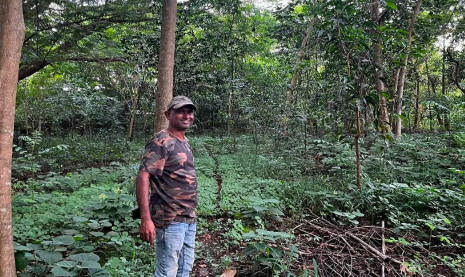
Jeeth Milan Roche has become the poster boy of tree planting in Mangalore
In Jeeth’s journey as an environmentalist, he learnt about Akira Miyawaki, a famed and globally acclaimed Japanese botanist who came up with a method of growing lush, thriving forests in areas of land where there was no greenery earlier. Jeeth learnt this and then implemented it in Mangalore by choosing appropriate varieties and species of trees, herbs, and shrubs. His Miyawaki forests are now well known
He continued his work, spending the last two decades making Mangalore green under his project ‘Mangalore Green Brigade,’ and is now a full-time environmentalist. He even visits cemeteries of all religions and has planted trees in many of them. Once, to motivate others, he planted 1,000 trees in a day, and this was even covered in the local mainstream media.
The Pachanady dumping ground in Karnataka’s Dakshina Kannada district is quite infamous. Tourism flourishes over here, but the dumping ground is a dark spot. Everyone complains of the stench, especially during the beginning of the rainy season. Knowing he could do something about it, Jeeth planted more than 1,000 saplings at the Pachanady dumping ground in 2020. The idea was for the area to be filled with greenery to minimise the stench.
Jeeth is also engaged in transferring trees that are coming in the way of development projects by keeping their roots intact without chopping them. These are replanted and then taken care of by his team for a year to ensure they are thriving.
In Jeeth’s journey as an environmentalist, he learnt about Akira Miyawaki, a famed and globally acclaimed Japanese botanist who came up with a method of growing lush, thriving forests in areas of land where there was no greenery earlier. Jeeth learnt this and then implemented it in Mangalore by choosing appropriate varieties and species of trees, herbs, and shrubs. His Miyawaki forests are now well known. He is clear that he is far from finished in his endeavour and will always keep going.
In my childhood, Mangalore was known as a great place for a wonderful holiday. Things have changed now, but, thankfully, we have green ambassadors like Jeeth who are doing some amazing work.
If depression motivated Jeeth, disability motivated another dreamer to become an environmental crusader. Uma Shankar Pandey of Jhakni village in Banda district of Uttar Pradesh was lame and had to suffer the insensitive insults of the villagers. This made him run away to his grandmother’s house, and he never entered a school ever again. Today, by a twist of fate, he is schooling others in preserving water using bunds or boundary mounds. Uma is well known in his district as a water protector, or pani ke pehredar, and was awarded the Padma Shri in 2023. He firmly believes that farmers need to do their bit to save water by making boundary mounds and planting saplings.
The 60-year-old is planning another campaign now; Uma has decided to start a Jal Andolan in villages with deficient water levels. He plans to start his awareness movement by riding a bicycle carrying a microphone and loudspeaker, joined by ten water warriors to make farmers aware of water conservation. He wishes to implement a boundary mound in every field and a tree on every boundary mound to help water retention. He gradually wishes to cover the whole of India with this much-needed practice that can be implemented easily.
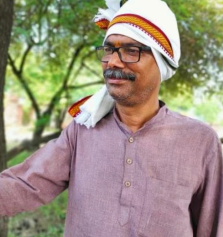
Another remarkable achiever is Bhavesh Bhatia from Mahabaleshwar in Maharashtra, who was born with retina muscular deterioration. He was well aware that his sight would only get worse with time, and this did happen when he was in his twenties. His mother, who later passed away because of cancer, however, told him to always dream and do something others would be inspired by. He used to be badly bullied in school, but she guided him to ignore the bullying and make friends with the perpetrators. This was the first life lesson he learnt that made him accept whatever challenges he faced. His is truly an incredible journey. He lost various jobs and then learnt how to make candles with the help of the national institute for the blind. He loved this art, so he stuck to it. Not one to give up easily, he would stand near a market in Mahabaleshwar all night long, selling these candles from a cart.
Love entered Bhavesh’s life when Neeta, who later became his wife, purchased his candles. They both were impressed with each other; he with her lively laughter and she with his ideas and thoughts. They met several times and decided to marry. She, of course, faced a lot of opposition from her family for her decision to marry a penniless, blind candlemaker, but she stuck to her decision. They initially struggled a lot but finally succeeded. Bhavesh’s life improved when he got a loan of fifteen thousand rupees from a bank in which the national institute for the blind had a special scheme for blind people. They then purchased fifteen kilos of wax, two dyes, and a hand cart with the money.
With clients from all over the country and the world, and a dedicated team of two hundred employees, all of whom are visually impaired, Bhavesh is extremely happy. He has received the prestigious National Award for the Empowerment for Persons with Disabilities under the best self-employed resident category. At one stage, he used to set aside less than a hundred rupees a day to purchase wax for the next day’s candle stock. Today, his company uses 25 tonnes of wax a day to manufacture nine thousand designs of many types of candles. They purchase their wax from the UK. Their clients are varied, and he is immensely proud that they continue buying his products due to the quality of his work.
On his decision to employ the visually challenged to run Sunrise Candles, Bhavesh says, “We train blind people not just so that they can understand the work and help us at our unit but, someday, go back home to set up their own business.” While he likes to concentrate on the creative aspects of the firm, Neeta takes care of the administrative duties of the enterprise.
Bhavesh has other dreams too. He says blindness does not mean inherent physical weakness, so he takes pride in his athleticism as he was active in sports from his childhood. After getting settled in the candle business, he once again started his sports practice by training regularly. Every day, he does 500 push ups, runs eight kilometres, and uses the gym he has installed in his factory. His running is done with the help of his wife who ties one end of a nylon rope to their van, giving him the other end to hold. Then, while he runs alongside the van, she drives it at a speed that he can manage to keep up with.
Bhavesh also wishes to make wax statues of people like Prime Minister Narendra Modi, Amitabh Bachchan, Sachin Tendulkar, and 25 other eminent personalities.
Having achieved all that he set out to, Bhavesh still has many dreams and many goals, the main one being that he wants to ensure that each and every blind person in India is independent and employed.
While moving ahead on the path of (so-called) development, we forget that there are nomadic people too who need to be aided. I remember the time I was asked by a Westerner if there still were snake charmers and nomadic people in India. I was offended and replied in the
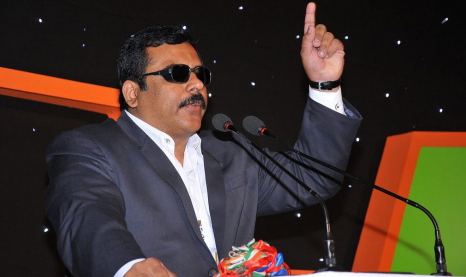
In his decision to employ the visually challenged to run Sunrise Candles, Bhavesh says, “We train blind people not just so that they can understand the work and help us at our unit but, someday, go back home to set up their own business.”
negative. After this incident, I thought she knew nothing about India, but now I realise that even I did not know they were still there.
Bhiku Ramji Idate, who started his career as a teacher, dreamt of a better life for poor nomadic and semi-nomadic tribes, which motivated him to leave his job. Since then, for the last 53 years, he has been working for these oppressed people who are not just of a lower caste but stigmatised too. In a sense, they could be called the lowest of the low as they don’t even have a permanent home. They are whom the British never understood and even classified as criminals. Even today, everyone, including the police, stigmatises them. The British did not understand our land or the various cultures here. Surely, we need to undo the wrongs that they have done.
Given these circumstances, Mr Idate worked for their education and has even requested the government of Maharashtra to do something for them, including recognising their difficult living conditions and their right to live with dignity.
Then there is the stigma attached to widows. “Why should Padma Aunty not come?” I asked my relatives as a teenager. Being a widow, the friendly Padma Aunty would never be taken to marriages, especially during puja time. I felt bad for her and did ensure she was there at my wedding but then forgot about this evil after that. Some people have dedicated their lives to making a change in those of widows.
India is a land that merges social work with spirituality. Baba Balia from Odisha feels we need to eradicate superstition and enable a life of dignity for widows. He was inspired by Raja Ram Mohan Roy, the founder of Brahmo Samaj. He organises events for widows every year to share their problems and experiences, and to also learn to assert their rights and create awareness on the issue in their circles.
Baba Balia has been able to bring about a considerable amount of positive change in people’s attitude towards widows although it was not easy in the beginning. Widows are slowly attending all religious functions in his ashram and outside. Other than this, he gives
free education to over 5,000 underprivileged children. I am certain that slowly but steadily, he shall indeed make a difference here, and I am truly glad he received the Padma Shri in 2023.
Dreamers in arts and crafts
I remember seeing the wonderful tribal art paintings in Delhi years ago and always felt that these should be actively promoted all over the world. It was therefore wonderful to learn about Jodhaiya Bai from Madhya Pradesh, a tribal mural painter, who spent five decades as a labourer and then got the opportunity to learn and showcase her paintings all over the world. She also shows us that one can learn anything at any age for she learnt this at the age of 70. Before that, she had spent her life working to survive and taking care of her family as she had lost her husband when she was just 40. Her tribe, the Baigas, revere nature, so all their paintings also depict nature in various forms. Having mastered her art, she has made a mark for herself and her tribe all over the world. She surely deserves the Padma Shri she got in 2023.
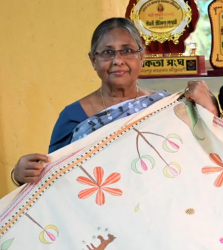
Another such artist reviving ancient art is Pritikana Goswami from West Bengal. Her story, too, is one of struggle in her early life. Embroidery and stitching is something she took up after her father’s death, to help run her family of five sisters. There was a lot of struggle initially, but she succeeded in making a mark for herself. She took up the technique called Kantha and has been pursuing it for over five decades. Kantha is an ancient method of recycling used saris, dhotis, and other household fabrics. These items are stacked on each other and hand-stitched to make a thin, cushioned layer with some artwork, usually embroidery. It is a craft that was practised by women of all rural classes. Pritikana dreamt of reviving it to support herself and her team. She attributes her success to hard work and the grace of God. Now, having won the Padma Shri in 2023, she will surely progress in her endeavour.
Dreamers in diverse fields
In another area, we have people like Kiran Mazumdar-Shaw, a billionaire entrepreneur, who forayed into brewery and the production of enzymes that are used medicinally. It was unusual for a woman then, but she achieved an unprecedented level of success. Initially, it was extremely difficult as both the field and her gender were a stumbling block. However, she stuck on, and under her leadership and vision, the company is now associated with the manufacturing of several path-breaking products for cancer, diabetes, and autoimmune diseases. She is very quality-conscious and has made sure that R&D and clinical trials never take a back seat. It is also the first Indian company to get US Food and Drug Administration (FDA) approval to develop a cholesterol-reducing molecule. Due to her massive contribution to the field of biopharmaceutical manufacturing, R&D, clinical advancement, and philanthropic
All of us cherish dreams, but the journey of life often makes us give them up. However, we should keep in mind that dreams are the beginning point of all endeavours, but they need our time and effort to further them. We need to remember that the Universe does indeed respond if our call is passionate and pure. activities, Shaw has received many awards and recognition. She considers the fulfilment of her dreams of making India recognised the world over for its work in biotechnology and making medicines effective and affordable for all as her main award.
We know of many sportsmen, but there are very few like Dhoni or MSD (Mahendra Singh Dhoni) as he is often called. In recent times, he has been the most popular sportsman of all. Once, my cousin came to Mumbai, and when she knew Dhoni was playing there, moved mountains to attend the match and took me along with her to see the Dhoni magic. Her mother kept talking of his humble beginnings.
Dhoni was always fond of sports and played football regularly in his home town of Ranchi. He entered cricket by accident as his football coach sent him to a local cricket club to be a wicketkeeper from 1995 to 1998. His talent was spotted, and he entered the international cricket scene soon. He won many awards and also donned the hat of team captain for many years. Very few cricketers have a movie made on them but Dhoni: The Untold Story (2016) was made and earned over Rs.400 crore worldwide. He is not just a cricketer but a great leader as well from whom many have got inspiration. Even people who are not great sports fans like me know about Dhoni for his inspiring story and great life skills, which motivate us to chase dreams with integrity and principles.
Dhoni believes that it takes a lot more than just talent to be successful and believes in hard work and continuous improvement. He also always gives credit to everyone in his team and is known to be a great captain who encourages everyone. In whatever else he does, he shall surely remain a role model and inspiration for all. This is why he is truly one of a kind.
Dream on
All of us cherish dreams, but the journey of life often makes us give them up. However, we should keep in mind that dreams are the beginning point of all endeavours, but they need our time and effort to further them. We need to remember that the Universe does indeed respond if our call is passionate and pure. We cannot make a timetable, but we should never give up on our dreams to make our lives wholesome and complete.
Things to do
• Note down your dream(s)
• Ask for guidance when required
• Explore other people in the same field
• Write down possible difficulties
• Make a plan of action both when things go right and when there are issues • Update your actions in all spheres of activity
• Revise your plan if required
Teaching story
Dream to transform schools through journalism
Sita, a student in a village school, had a dream to become a good teacher, a highly literate person, and an educationist so that she could promote quality education for children, especially girls, in her village and the surrounding area. The infrastructure in the schools was not good, so she wanted to do something about it.
As she was a good writer, her articles were published in the newspaper and interviews were telecast. In fact, she became famous in her circles and felt that she had found her purpose in life. She would write about transforming schools to help all girls get educated. Consequently, people started visiting her school, and the once-ignored school became a topic of discussion. The situation needed to be addressed, so the government made the necessary changes in her school. Her dream, therefore, improved the condition of her school and she thanked God for making her recognise her talent as a journalist.
Jamuna Rangachari, the former assistant editor of Life Positive, has authored two books for children, and compiled and interpreted Teaching Stories-I and II for Life Positive. Write to her at jamunarangachari@gmail.com.
Discussion (0)
No comments yet. Be the first to comment!
Leave a Comment
You need to login to post a comment.