
Find your gateway to happiness
February 2024
Find your gateway to happiness
Transformed by the grace of Nichiren Buddhism, Ashish Virmani stresses the importance of adopting a spiritual path on life’s journey When I was introduced to Buddhism 25 years ago, my life was at an all-time low. My journalistic career had gone off the rails, I was unhappy with my family life, and my health and mental stability were in question. In such circumstances, my mother, who was concerned about me, introduced me to Nichiren Buddhism practised by Soka Gakkai International (SGI). I must admit that I have not looked back in these last 25 years. Not only did I go on to build an above-average career in journalism for 18 years after that, but with the practice of spirituality, I was able to recover my health and mental stability, and build a harmonious family life. I discovered a spiritual mentor in Daisaku Ikeda, the president of SGI, who changed the trajectory of my life with the simple and practical teachings of Buddhism.
It was in the teachings of Buddhism that my Japanese mentor so lovingly imparted to me through his writings and videos (I never met him personally) over the course of the last quarter century that I truly found resonance. Many of them were teachings that had come down from the last 3,000 years in the orthodox lineage of the founder of Buddhism, Gautama Buddha, while others were the teachings of a 13th century Japanese monk Nichiren Daishonin, who preached Buddhism to the samurai as well as common people of Japan.
The way of Buddhism
So, what have I learnt that changed my life around? Here is a thumbnail sketch of what worked for me in the hope that it may be useful to you in some way:
According to Buddhism, the Law of Cause and Effect is the operational principle of the universe. If there is one law that is the fundamental principle of the universe, then this is it. Buddhism says that our present reality is the result of the causes we have created in the past with our thoughts, words, and actions, and our future is the result of the causes we create in the present. Therefore, if we want good effects to manifest in our lives then we must create good causes. On the other hand, if we create bad causes, then we will reap their negative effects in our lives.
Nevertheless, it is much easier said than done. As we are subject to the laws of karma, we are
all born with influences of our past lives— including the choice of our parents—that predispose us to certain ways of being and behaviour. This is why two children, even twins, born in the same family can be so different in their behaviour, aptitudes, and inclinations.
Some children are born with or develop disabilities in their lifetimes, while others can turn out to be prodigies or geniuses. Some children lose their parents or protectors early, while others live till the children have attained ripe maturity as adults. Some children are exposed to war and conflict zones early in life, while other children live out lives in relative peace their entire lifetimes. And then there are all sorts of combinations and degrees of these and other factors that make a person’s life happy or unhappy. Buddhism and the Eastern religions would attribute the differences to the good or bad causes these souls have created in previous lifetimes. As they say, where there is an effect, there must have been a cause, even if it was in a different lifetime.
There is hope The good news is that, as Nichiren Buddhism says, we can most certainly change our destiny by the actions we take in this lifetime. Since we are unaware of our previous lifetimes and the causes we have created therein, and only know the latter by the effects we experience in this lifetime, there are ways to alter one’s destiny from bad to good and vice-versa. And a genuine spiritual practice is the most effective way of converting a bad destiny to a good one. Because, in a true spiritual practice, one of the first things we learn to differentiate between are the thoughts, words, and actions that can result in happiness as against those that cause suffering; and we usually are taught a practical method to get to them. Buddhism is the pursuit of happiness. There is a story in the Buddhist canon, of Shakyamuni Buddha (as Gautama Buddha0 is also known) and his disciples that illustrates this, directly from the
founder’s mouth:
One day, Aniruddha,
one of Shakyamuni’s
ten major disciples,
who was partially
blind, attempted
to mend a tear
in his robe.
H o w e v e r ,
because he
could not see, he
was unable to thread the
sewing needle. In his frustration, he muttered: “Is there no one who will thread this needle for me and so gain good fortune [by helping a practitioner of Buddhism]?”
Someone approached him and said: “Allow me to accumulate good fortune.”
Aniruddha was stunned. For it was unmistakably the voice of Shakyamuni Buddha.
“I couldn’t possibly trouble you,” he protested, adding, “Surely, one such as yourself, World Honoured One, does not need to gain any benefit.”
“On the contrary, Aniruddha,” Shakyamuni Buddha responded, “there is no greater seeker of happiness in the world than myself.”
Shakyamuni Buddha went on to teach Aniruddha, who was still not convinced by his words, that the pursuit of happiness has no bounds. Shakyamuni told Aniruddha: “Of all the powers in the world, and in the realm of heaven and human beings, the power of good fortune is foremost. The Buddha way, too, is attained through the power of good fortune.”
It is also an undeniable reality that the world we live in seems to have too many obstructions and obstacles to good fortune. From a Buddhist
perspective, the earthly realm is considered to be a play or tussle between the forces of light and the forces of darkness, and negativity and unhappiness often seem more plentiful than good fortune and happiness. Yet there are ways to alter our karmic balance of good fortune, the foremost of which is seeking and maintaining a genuine spiritual practice which leads us to all kinds of methods to garner good fortune through awareness, right intentions as well as actions, and benefitting others. Speaking from personal experience, I have noticed that it is usually very difficult to benefit others without a strong spiritual framework to lean on for you will likely be misjudged, misunderstood, criticised, and at the extreme, even persecuted, if you attempt to do so in the world we live in. Yet it is an undeniable fact that a human being cannot gain genuine happiness without benefitting others, and that is a very different kind of happiness from the kind that stems from status, power, and wealth, which are considered fleeting forms of happiness in the spiritual paradigm.
I have noticed that it is usually very difficult to benefit others without a strong spiritual framework to lean on for you will likely be misjudged,
misunderstood, criticised, and at the extreme, even persecuted, if you attempt to do so in the world we live in.
Awakening 57
Changing the inner landscape
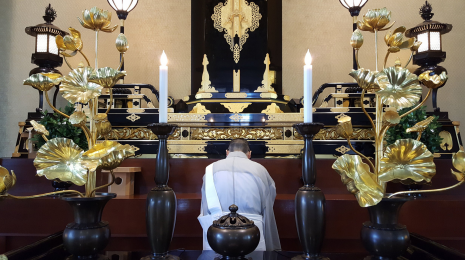
Two things have turned my life around in these last 25 years: the first is the concept of what we in Nichiren Buddhism call ‘human revolution’ which is common to practitioners of several differing faiths the world over. That is, the foremost aim of spiritual practice is for us to bring about a change in our inner reality— to elevate ourselves internally—and to consequently bring about a change in our conduct and behaviour, which will make us more considerate of others, more accountable for our actions, and responsible citizens of society, our country, and the world. We usually can’t do this without a spiritual practice, and it often takes years of scraping, buffing, polishing, and shining as we work through the differing levels of our beings—our thoughts, feelings and emotions—before we can begin to see ourselves more clearly. Then we can have the courage to take responsibility for our thoughts, words, and actions, and the consequences thereof. I have been able to polish myself to an average or above average level after days, weeks, months,
58 LifePositive | FEBRUARY 2024
and years of chanting a mantra addressed to the object of worship that is the mandala in Nichiren Buddhism. And then, of course, there is the vital influence of a mentor, in my case, Daisaku Ikeda, whose writings and explanations of Buddhist doctrine in contemporary terms have guided and comforted me on a daily basis, especially in both good times and bad. Having a mentor or guru is not a bad thing at all; on the contrary, a genuine mentor can speed up one’s progress on the spiritual path by several lifetimes that it might otherwise take to come to the spiritual truths solely through one’s own efforts.
Human beings are varied in their natures and personalities; no two people are exactly the same. Yet no matter how different or contrasting people may be, most spiritual disciplines concur that we must strive to look at their good points and downplay their weaknesses or shortcomings. However much a person may conflict with our world view, they have their own unique mission or life purpose to fulfil.
And we must respect that. That doesn’t mean that we have to see eye-to-eye with everybody or even like everybody—there might always be certain people we may not get along with in our environment—but we should not disrespect anybody or behave in a churlish manner. At least that is what spiritual disciplines say. And the truth is that, in reality, it may take years of refinement before we can achieve such equanimity. But that is precisely an aspect of the ‘human revolution’ that we talked about earlier, and we should strive towards it consistently.
Seek and you shall receive
I would say, if you are unhappy with your life, seek a genuine spiritual practice first and foremost—of any denomination—that resonates most thoroughly with you. If you have an avid seeking spirit, you are sure to find it. This can be done with some exploration of your environment—through your reading, the plentiful videos available on YouTube, or through trusted friends. It is also a truism that “When the disciple is ready, the Master appears.” In other words, when a genuine seeker has undergone a sufficient transformation, they will find a genuine teacher who is just right for them.
There are varied and often contrasting spiritual
paths because people have different personalities, aptitudes, and inclinations, and this is the way it should be. It can never be that ‘one size fits all’ and nor has it ever been so in human religious history. That being said, each spiritual path is an organic whole and has its own principles and precepts which may differ from other spiritual disciplines. However, once having chosen and embarked upon your particular spiritual path, you should ideally remain true to it to the end.
It is equally true that a sizeable section of the population may try different spiritual paths before they settle on one, or use elements of various spiritual disciplines to custom-craft their own unique path. There is no absolute right or wrong; it is all a matter of one’s unique path or dharma.
For spiritual seekers, spirituality is the ultimate aspiration of human life. Human life in its most essential form, for them, is not about status, fame, prestige, or wealth. It is about spiritual progress and attainment, which comes from dedication to a true spiritual path. Yet, only very few humans can come to this realisation in the course of their lifetimes. If you are one of the lucky few who can, then you are on the way to attaining the supreme treasures that a human being can possess.
Ashish Virmani, a mainstream journalist for over 18 y


Discussion (0)
No comments yet. Be the first to comment!
Leave a Comment
You need to login to post a comment.