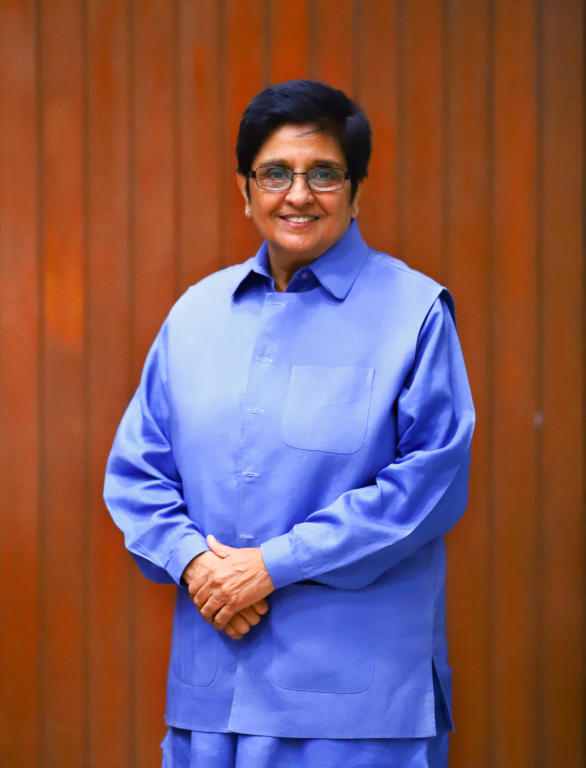
From Squalor to Splendour
May 2024
From Squalor to Splendour : Reviving Puducherry
An inspiring tale of a feisty woman’s fight to clean up a decaying city. Shivi Verma interviews Kiran Bedi, the formidable former IPS officer, who leaves an indelible impression wherever she goes
A few days ago, my chairman shared with e a video clip where Mrs Kiran Bedi, former lieutenant governor (LG) of Puducherry, Magsaysay awardee, and India’s first and most famous woman IPS officer, could be seen waving from the balcony of an imposing-looking building to two sanitation workers standing on the streets. It was a throwback video from 2021 when Kiran was the LG of Puducherry. As a mark of their love and fondness for her, the two ladies had come to say farewell to Kiran when she was leaving Puducherry.
Chairman Aditya Ahluwalia wanted me to speak to Kiranji and discover the background story of that video. I spoke to her on the phone, and she said that it was a highly positive and inspiring story of an administrator’s drive to clean up a dirty city and how she overcame the hurdles to achieve her goal. She asked me if I would like to meet her at her office to know the full story.
Meeting someone like Kiranji is a privilege, so I agreed to see her at her office in New Delhi. I was impressed by the power, conviction, and determination she exuded. She came across as someone whose heart is full of compassion and who is driven by the zeal to engender positive change in society. She was warm, affectionate, and highly energetic. Someone who doesn’t know how to give up and has nurtured the habit of winning against the odds. I asked her to shed some light on her relationship with the sanitation workers in the video and the story behind it. Kiranji said that when she was appointed as the Lieutenant Governor of Puducherry in 2016, she was dismayed at the filth and degradation overwhelming the union territory. The women waving to her were part of the sanitation workers group she had developed a warm relationship with, in her efforts to clean up the city. She says, “I used to stop my car, greet them, and gift them shawls and stoles. I would drape them around their shoulders and make them feel valued for doing what I couldn’t do—cleaning the city day and night. So, when my tenure ended in 2021, the women workers had come to Raj Niwas to bid me adieu. The video is of that moment. I felt that the work that happened during my time as the LG of Puducherry was a hallmark of what is possible if you decide to make a difference. When I left Puducherry in 2021, it had emerged as the best-governed union territory in the sixth edition of the Public Affairs Trust.”
What followed was a passionate interview with the dynamic administrator who scripted a saga of wringing positive changes through her grit and never-say-die attitude.
How did you manage to achieve the goal of cleaning up Puducherry?
When you are sent as an administrator and the lieutenant governor, it is all about who you are as a person. Are you comfortable with what you have, or do you wish to see an improvement? I am a person who is not comfortable when things are not right. So when I went there, the first thing I wanted to know was the state of affairs in Puducherry. My purpose was not to enjoy the trappings of the office but to work. I love work. Work is energy for me. I look for my energy places. So I began to travel the city. I saw filth, dirt, and garbage all around me. I felt that I could not sit in a clean Raj Niwas while the citizens lived in squalor and dirt. I would rather have a dirty Raj Niwas than dirty streets. So that became my immediate priority from the first week itself. I went to the main canal, which is the Grand Canal in Puducherry, and I found it rotting and stinking. It was as though I was living close to the Grand Canal and smelling the stench every day.
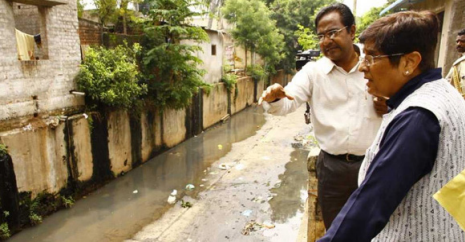
Mrs Kiran Bedi inspecting the decay that had set in Puducherry
I embraced the cause fervently because I simply cannot tolerate uncleanliness. By nature, I am very organised, clean, and tidy. How could I live comfortably in a dirty city? A city whose responsibility I was entrusted with? I refused to accept it. But the question was, How do I get it cleaned up? When the sanitation workers realised that the LG had inspected the canal, they felt embarrassed and began to clean it.
Did you create a plan of action or were the visits sufficient?
See the next question that came to my mind was, What should I do with them? Should I punish them, or should I ask for a report? And the report was nothing but one more paper—as if the problem was not known! Does it solve the problem of stench that was reaching even the Raj Niwas?
I felt guilty about enjoying luxuries when my neighbours lived in filth. And now I had the power to change it. But what kind of power did I have? I was an appointed LG, not an elected MLA. An elected politician can order municipal workers and government officials to do their work. But I had to work through obstacles like hierarchy, the public works department, secretaries, the municipal commissioner, and the deputy commissioner. On top of it, I had no friends I could pour my heart out to because I did not know Tamil, and all were Tamilians there. The officers knew English, but they did not know me and I didn’t know them. No Delhiite, Punjabi, or North Indian, whom I could confide in, was around. I was angry over the state of affairs, and I leveraged this anger on social media. I clicked pictures of the rotting and stinking canal, and put them up on Twitter. I created a WhatsApp group and added all the municipal officers, secretaries, and engineers to it. I shared the images of dirt and garbage strewn around and asked, Are we happy to see this? Friends, are you okay with this? It was the first time the officers were together on a WhatsApp group. This was breaking hierarchies. The chief secretary, secretaries, and junior engineers all came together. They felt embarrassed and had to admit that the problem needed a solution. I sometimes used to tweet about it. Since I had eight to nine million followers, it created much embarrassment for the administrators. It also created a lot of envy and discomfort amongst politicians. The problem also reached the government of India because even the PMO followed my Twitter (now X) handle.
These actions must have expedited the process of cleaning the city, I suppose? On the contrary, I began to face a lot of opposition from those in power. In the WhatsApp group, the chief secretary began to feel slighted because it was his job to fulfil, in the first place. I wasn’t asking anyone to explain the sad situation. I was asking them to see it and move their conscience. Can you stay like that? Do you like what you see? The chief secretary left the group, and he encouraged others to leave too. Many left despite my being the LG and the group administrator. I said, Jao. Koi baat nahi. (Leave the group. No problem.)
Many juniors told me separately that ma’am we will be with you one-on-one, but don’t mind us quitting the group because the chief secretary is watching us.
I said it doesn’t matter. I kept going to sites, and the juniors would accompany me as they were duty-bound to be there. The seniors, however defied and decided not to join me. I asked the politicians to join me, but they too refused to come. However, the junior engineers kept coming with me. The work, basically, had to be done by them, so it started to gain momentum. I began to post the updates on the cleaning drive on social media, and the local media began to take note and, subsequently, published the story. People started to read and appreciate our efforts.
But where do the sanitation workers and your warm relationship with them come into the picture?
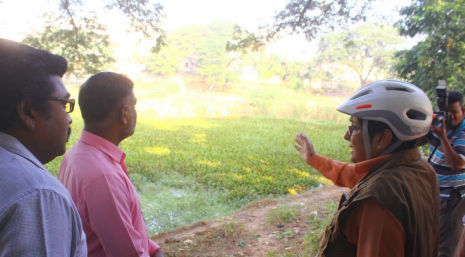
Kiranji picking up the cudgels to revive the dying water bodies of Puducherry
The main sanitation workers were 1500 very unhappy women. They were cleaning the streets twice every day, morning and evening. They were hired on contract by the government in power before the current government, which was unhappy with the heavy financial contract. The current government wanted to change it, but they could not dismiss it because it was a 10-year contract. They were unable to get their cuts from the financial contract and bring in a new one which benefitted them. So they dragged the sanitation workers to court. They accused them of not working, not showing up, and marking false attendance, and stopped their salaries on flimsy grounds. As a result, the sanitation workers threatened they wouldn’t clean the city if they were not paid their wages.
So, on the one hand, I was trying to clean up the city, and on the other hand, it was getting difficult to get workers to come to work as they were not getting paid. In the initial months, I had a confrontation with the authorities and asked people if they wanted a clean city or not. Because if I did not get the support of the masses in this drive, I would return home in three months. I would not preside over a dirt city. I had not come here to fail.
And then it shook them up. Somehow, I had the salaries of the sanitation workers released and prevented a strike. Meanwhile, I was able to win the hearts and minds of my sanitation workers. Whenever I would meet them, I would gift them colourful shawls and stoles. All the shawls I used to receive in Raj Niwas would be given by me to them. Why? Because they did something which I couldn’t do. They loved the fact that I would stop my car, get out of it, and place shawls on their shoulders as a mark of respect. They felt so valued and respected.
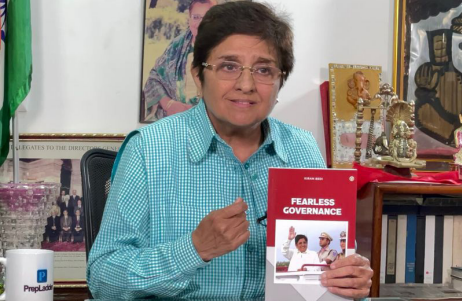
Kiran Bedi with her book : FEARLESS GOVERNANCE
Now they were working for me and with me. They cleaned better, and their attendance improved. Their supervisors worked better. They realised that I was with them even if the politicians were not. Somehow, day after day, week after week, inch by inch, street by street, things began to get better, and cleanliness started getting implemented. Public opinion began to turn in our favour; the media began to acknowledge our efforts and reported that the LG was cleaning Puducherry.
I used to stroll the beach, and when the workers saw that I visited the beaches too, they began to clean it up. When people walked on the beaches, they saw that there were no flies or mosquitoes around. The sanitation workers got recognition, and the public began to appreciate our efforts. The city acquired a new, fresh look. The winds began to change. We carried out swachchhata campaigns. We would wear gloves, ride bicycles, take school and college kids along, and clean the beaches to spread the message of cleanliness. I invited the politicians too to join me and take the credit for the cleanliness, but they didn’t turn up. Their egos came in the way because showing up with me would have been the admission of past failure and neglect. By the time I left, the city was much more organised and clean. The beaches were totally clean.
How did you manage to penetrate the thick wall of political and bureaucratic non cooperation?
I have this indomitable will to never give up. That is my character trait. I don’t care. I am not giving up, because I am doing the right thing. If I don’t do my duty, I fail myself. I am not doing it for you. I am doing it because I don’t want to fail. I grew up with willpower, and that willpower stood by me. I get motivated by good causes, and cleaning up Puducherry was a noble cause for me.
Did you not think of contesting elections since you were so popular?
I do not like asking for anything in return. Politics is transactional. You give me your vote, I will change your life. What is so remarkable about this deal? When I do something for you, it has to be selfless. I do it because of my love for you.
After my tenure was over, I got involved with reading, attending seminars, holding meetings, and giving talks and lectures. I like to solve problems and motivate people. My diary is always full, and I study before giving talks, interviews, and speeches.
I also feel that Life Positive is doing yeoman’s service in spreading goodness and positivity in society. I preserve every issue of the magazine because its articles have a long shelf life. They motivate people to convert the negative into the positive.

Discussion (0)
No comments yet. Be the first to comment!
Leave a Comment
You need to login to post a comment.