I am not the doer
Sri Dwaraknath, in conversation with Pradeep Krishnan, shares his views on Creation, karma, and God, influenced by the teachings of Sri Ramana Maharshi.
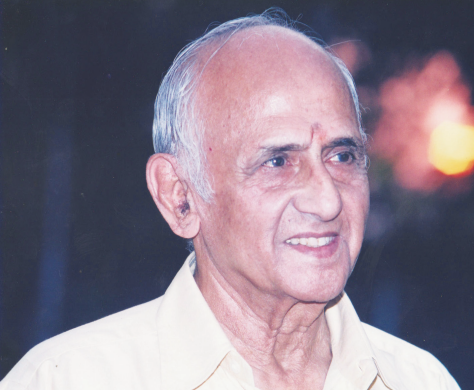
Sri V Dwaraknath Reddy, born in 1924, is a seeker, author, lover of nature, a humanist, and a poet. He is the former Chairman of the Nutrine Confectionery Company and, for decades, has been engaged in spreading the teachings of Sri Ramana Maharshi. After three decades at the helm of the company, he had relinquished the corporate reins and settled in the vicinity of Ramanasramam, the spot sanctified by the continued presence of Maharshi.
Author of a dozen books on spirituality, like including The Dicey Problem of New Age Science, Birth, Play and Finale of Mind, The Physics of Karma, Death was never born, Life never died, Sri Reddy, a postgraduate in Chemical Engineering from the USA, is an original thinker and has the ability to lucidly explain complex ideas to the reader.In his writings, he blends rational precision with a deep understanding of philosophy, focused on the core teachings of Sri Ramana Maharshi. Commenting on them, late M P Pandit, savant of Sri Aurobindo Ashram, says, “It is the authenticity of his experience - psychological and spiritual - that touches the reader and makes him as humble as the writer himself.”
Last year, during my annual pilgrimage to Sri Ramanasramam in Tamil Nadu, I had a chance to browse through his book Can God Improve my Balance Sheet? in the ashram library. “When you aspire to attain success like never before, your plan of action cannot be to conspire to make luck strike you and lightning strike your competitors! Though commendably simple and straightforward, the strategy is beyond your powers of manipulation. The success you desire must be won by invoking the inner potential in yourself. You must become the best you can be.”
The above passage prompted me to meet the author. My wife and I visited Dwaraknath Reddy at his residence, situated just across Sri Ramanasramam. He has been living there for the past 35 years with his adopted daughter Sandhya. At the height of success in business, he had handed over the family-owned company to the younger generation and set up the Ramanarpanam Trust, under the leadership of his daughter, Anita Reddy, to help the poor and needy. So far, the trust has donated nearly `35 crores in charity, benefitting about 20,000 people and 1,200 children.
About his writings, he said, “I write for consolidating my contemplations; I write for self education. This is my meditation.” To my question about what prompted him to settle near Ramanasramam, he said, “All that I have known and all that I seek to know is contained in the manifestation of Bhagavan Ramana Maharshi. So, I have come to reside where His bodily presence stayed almost a lifetime. His silent gaze dwells on me. Here is the focus that I must merge with.”
Tell us about your family background and the setting up of the Nutrine Company?
Ours was an agricultural family from Chittoor district of Andhra Pradesh, with a good cultural and ethical background. My parents were very pious and generous.
My father, late B V Reddy, had high values and ideals in life, thanks to his education, B A from Theosophical College, Madanapalle, founded by Annie Besant. Later, attracted by the vision of late Jiddu Krishnamurti, he had become a member of the executive committee of the Rishi Valley School, to which he sent his three sons Surendranath, Raghunath, and myself.
After completing education at the Rishi Valley School in 1940, I did my B.Sc. Tech course. Thereafter, with an aim to set up a sugar factory in our 100-acre land, my father sent me to study Chemical Engineering at the Louisiana State University, USA. Meanwhile, when Parry Company had the monopoly, the Nutrine Confectionery Company commenced its operations in 1951 from Chittoor. On my return, I was put in charge of the company, along with my elder brother. In the course of time, the ` five-lakh company became a giant with a turnover of `300 crores.
How did you develop an interest in spirituality? What was the turning point in your life?
As a student of science, I always had a rational and scientific mind and had no belief in God. But, when I was 35, the sudden death of my brother Surendranath (due to cerebral haemorrhage), who was very close to me, completely shattered me for several days. As there was no one else to manage the company, somehow or the other, I was pulling on. Soon, questions about life, death, and God., cropped up in my mind: If there is a God, why did my brother die at such a young age? Then one day, someone suggested listening to the talks of Swami Chinmayananda. When I came to know that Swamiji is taking classes on Mandukya Upanishad in Madras (Chennai), taking three days off, I went there. At the venue, hearing the melodious bhajans sung by Swamiji’s disciples, for no reason, tears started rolling down my eyes. I am sure it was not because of my brother’s death.
For three days, Swami Chinmayananda expounded the concepts of mind and matter, work and worship, creature and creator, love and lust, and shadow and substance to the huge gathering. His words, “The truth of that God is the truth of you,” explaining the concepts of Aham Brahmasmi and Tatvamasi, stirred something within me. I felt the teaching was amazing. He took absolutely contradictory aspects and equated them and proved that it was the absolute truth.
I listened to him with rapt attention and, slowly and steadily, the concepts of absolute and relative became clear to me. I understood that one functioning through consciousness is God, which is called Brahman or the totality of consciousness. That Brahman became many. Listening to Chinmayanandaji was the turning point in my life.
Then how did you develop an interest in Ramana Maharshi?
Chinmayanandaji was the one who put me on the track of spirituality. After listening to him, back in Nutrine, I started reading his books and contemplating on the ideas. Soon, he became my Gurudeva and the relationship grew to such an extent that I became one of the Trustees of Central Chinmaya Mission Trust, a position I held for about 15 years. In the meantime, I happened to read selected portions from Ramana Maharshi’s Who am I, Self Inquiry, and Talks that generated great interest. I felt that it contained the essence of the scriptures: the Gita, the Upanishads, and the Vedas. It was Chinmaya, the great teacher, who brought me to the teachings of Bhagavan Sri Ramana, the realised master. Before long, though I have not seen Ramana in person, his words started penetrating deep within. I was convinced that Ramana, the real Guru, helps one and all to realise the Vedantic truths of
Ayam Atma Brahma, Prajnanam Brahma, and Aham Brahmasmi.
How do you view the manifestation of Ramana Maharshi?
A self-realised sage like Ramana Maharshi is a rare event of supreme splendour, manifested in the cosmic play. The world sees him as an exquisite manifestation, an exemplary person, a rare gift of time. Such a one lived amidst us, for a duration of time, and is recognised by a body-form. In terms of our relative reality, we say Ramana ‘lived’ and ‘died’. History recorded that he was born in 1879 and attained samadhi
in 1950. But Ramana Maharshi ‘is’. In the silent depths of the ocean flow Mighty currents unseen, In the truth of this moment lie All the ages that have been.
You had written a book on the law of karma. Please explain its workings.
If any society has to function in an orderly fashion, there must be some methodology, establishing the order that we call God or Creator or Nature. The cosmos is governed by the laws of gravity, magnetism, nuclear forces, etc. Similar is the role of karma in one’s individual life. When the bulb that gives light suddenly gets fused, did the electricity die? It exists continuously. Likewise, when a conscious ego, a person, dies, the bundle of accumulated vasanas remains and gets carried over to another life, causing another birth. This continuity of cause and effect is called karma. Just as gravity is established by the intelligence of God or Nature, consciousness of a being works as karma. What remains unfulfilled at the time of death remains as incomplete and results in taking birth again—that’s how karma works.
Do you think the planets influence one’s life? How do you view astrological predictions?
Creation is holistic and in the web of causal interconnected strands of action, everything is the cause and effect of anything. Sage Nisargadatta Maharaj declared, “The stars influence you and you influence the stars too.” So, planetary
influences are not the intimidating one-way traffic that mortgages one’s future to astrology. It is probabilistic and not deterministic. The path, speed, directions, and destination of a ball placed on the ground can be predicted with accuracy by applying the laws of physics. However, the path of a human being cannot be determined as he is bestowed with a consciousness and will. So let us leave our worrying to the planets and live our lives with will, effort, and self-confidence.
The understanding of the Universe is baffling. Why are we born?
The Masters tell us to find out for oneself the reason for one’s birth. Understand that there is absolute reality and relative reality. The truth is ‘life’ never died and ‘death’ was never born. Like a dream, death is a falsehood. During a dream, though
Typhoid may sometimes
infect the body;
I-phoid is the constant
disease of the mind.
Chit aspect of Atman is what equates life with thought. The Ananda aspect of Atman
beckons to the confused mortal through all the layers of gloom and he strives for
lasting happiness. Ignorantly, man attempts completeness by material acquisition
and is fooled. The fact of Sat-Chit-Ananda in each individual, in whatever state he
may be, is the link that was never broken, the salvation that was never denied, the
perfection that was never removed, and the light that was never extinguished. It is
ever there, even now, not a thing to be gained hereafter. God is, even now, the Truth
in man. How beautiful, how heartening, how divinely merciful.
How do we solve problems in life?
Really, what is a problem? Obviously, as long as one’s desires are fulfilled, wants
satisfied, and nothing is happening contrary to one’s wishes, there is no problem.
Is there? For one, the present situation becomes a problem because it is not taking
shape the way one wanted it to. Understand that it is taking shape the only way it
can, given the compulsion of the law of causal manifestation, given the precedent
and prevailing forces that have produced the natural result. The fault is in one’s
faulty understanding of reality. It is only the mind of man that thinks that such an
error has taken place. So I say, man ‘has’ no problem; man himself is the problem.
What message would you like to give to the readers?
Understand ‘who am I’ and that the ego is not the doer. When doership goes, the
ego-sense transfers itself to becoming a devotee. The purpose of doership is only to
find out that one is not the doer. The highest achievement of the intellect is to learn
that God is self-revealing. You do not require a torchlight to see the sun. Whatever is
being done through the ego-sense is pervaded by Brahman.
We welcome your comments and suggestions on
this article. Mail us at editor@lifepositive.net


Discussion (0)
No comments yet. Be the first to comment!
Leave a Comment
You need to login to post a comment.