Intepreter of mythology
Popular mythologist Devdutt Pattanaik talks to Punya Srivastava about Sri Krishna and His various aspects, in the light of his latest book
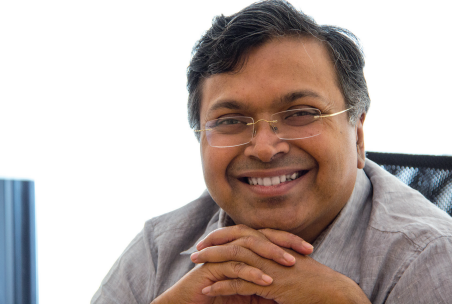
A doctor by training, he is India’s most popular mythologist today. Devdutt Pattanaik, critiqued by many and adored by many more, has been writing about mythology for the last 20 years. “I help leverage the power of myth in business , management, and life,” he has written on his website.
With more than 45 books and 600 articles under his belt, he features as an onboard
consultant for various mythological television programmes and has had three
successful seasons of a mythology-based television series for EPIC channel, Devlok
with Devdutt Pattanaik, that enjoyed humongous popularity.
Hailing from an Odia family, Pattanaik was born (in 1970) and brought up in Mumbai.
His fascination with mythology began in school after watching plays based on stories
from the Ramayana. Mythology remained his passion even as he studied medicine
at Grant Medical College, Mumbai. He then went on to work in the pharma and
healthcare industry for the next 15 years, while simultaneously writing articles and
books based on stories from Indian and world mythology. His first book, Shiva: An
Introduction, was published in 1997, after which opportunities came galore and he
never looked back. An interesting feature of his books and published articles are
his self-made illustrations—simple and bold strokes of black on white—which add
to his incredible storytelling skills. He is a man of many talents: a physician-turned
mythologist, former leadership consultant to Future Group, columnist, writer,
illustrator, speaker and, as his Twitter bio reads, management theorist.
Pattanaik has often been criticised by staunch right-wingers for classifying Indian
epics—Ramayana and Mahabharata—under mythology rather than history,
whereas left-wingers try to manipulate his commentary on these epics and tag
him as a rightist. Pattanaik, however, comes across as a champion of diversity
and spontaneity, as someone who is against any kind of political labelling, often
underscoring the need to let people ‘be,’ to be an observer. What I have deduced after reading his many books, columns, and articles is that the context is quite important while judging any situation or action and to let go of the need to exercise control on others’ thoughts by labelling them as right or wrong.

In Shyam, Pattanaik moves chronologically through Krishna’s lifespan, illustrating through various stories sourced from the Mahabharat, Harivamsa, Vishnu Purana, Srimad Bhagavad Purana, and Jayadeva’s Gita Govindam. He traces the Lord’s journey on earth that starts from the avatar form and moves on to the toddler, prankster, wrestler, and a householder to the charioteer and many in between.
As he writes in the prologue, “It (Bhagavata) is the story of God on earth, of the journey of the infinite through the finite world, in finite form, exploring every facet of humanity: taking, giving, receiving, sharing, connecting, disconnecting, listening, speaking, witnessing, and finally, letting go. Bhagavata is the story of Bhagavan who feeds the hungry, comforts the frightened, enlightens the ignorant, and is (both) father and mother. Bhagavan is Vishnu to sages, Govinda to cowherds, Krishna to kings, and Shyam to those who yearn for love.”
He highlights how Krishna relates differently with different people, individuals, and communities; how the infinite divine descends on Bhu loka (material realm) and goes through the whole spectrum of human experiences and emotions while remembering his divinity. And this is how Krishna inspires a mere mortal to become a detached householder by keeping sight of his divinity.
Following are some excerpts from the conversation with Pattanaik: In your latest book,
What distinguishes Shyam from Krishna or Hari or Narayana?
Narayana is the sleeping Vishnu whose waking up puts the world in motion. Krishna is the mortal form of Vishnu on earth. In one of the chapters, you write that unlike
Shiva who is a hermit, Krishna is an enlightened householder who is engaged in everything but possessive of nothing.
Which aspects of his life affirm this statement?
Shiva is a reluctant groom and husband. Krishna enjoys being a groom and husband and multiplies himself 16,108 times to make sure all 16,108 wives of his feel they have an attentive and loving husband. That is what makes Shiva the hermit who became a householder, and Krishna, an enlightened householder.
How is it that Krishna, Vishnu’s purnavatar, who is not considered an alpha male and is critiqued for being frivolous, has devotees across a world that is predominantly patriarchal in nature
Just as people separate their personal from their professional lives, they separate
their spiritual from their material lives. Most people worship Krishna for what they
want: happiness, liberation, and success. They don’t worship Krishna to develop
insight into, and empathy for the other. The alpha male state is natural for animals
and an indulgence for humans. Those who admonish patriarchy secretly admire
it, which is why they ‘admonish’ patriarchy, not realising that scolding does not
lead to spiritual growth.
What makes Krishna the most spiritually relatable of all of Vishnu’s avatars?
This hyperbolic title ‘most spiritually relatable’ is popular amongst those who see
Krishna as their ishta devata (personal deity). Every god satisfies the same need
as every god is designed to satisfy different types of people. Krishna relates to our
role when we are not in power, unlike Ram, the king, who is in power. Krishna is
cowherd and charioteer in public appearances, and that should tell us a lot about
what that form of God is trying to communicate.
How can we bring about a balance between sanskriti and prakriti in a world whose most favourite virtue is conformity?
Prakriti is the default nature of the world—wild and uncaring. Sanskriti is the
refined human world that is cultivated and caring—one that we aspire for. The
transition involves great violence, something that we do not talk about as we
glamourise non-violence without truly understanding what it actually involves
and means. We need to recognise the animal within us, that seeks to be dominant
and territorial and cleverly uses rules and values to domesticate and control
those around us. Awareness and understanding will help us better appreciate the
prakriti within and without so that we make the journey towards sanskriti within
and without.

In Hinduism, where do the lines blur between religion, mythology, and history?
In every religion, lines are blurred between religion (which essentially meant
monotheism to colonial scholars), mythology (which now means subjective
cultural truth to post-colonial scholars), and history (that is misunderstood as
the reality of the past, rather than information of the past limited by available
facts). Jesus may have been historical (limited and contested facts available).
He is certainly mythological when he is called Christ, the anointed messenger
of God, and his mother becomes Virgin Mother of God. The Church uses the
mythology of Jesus Christ to assert authority in human affairs which is the
nature of religion. Same happens in Hinduism. Celibate, bearded, saffron-robed
male monks seek power in human affairs and so are called ‘religious leaders,’
even though the concept of ‘God’s messenger’ is not found in Hindu mythology.
And Hindu mythology’s chronology of Ram and Krishna epochs just does not
match the history of India established by archaeology as well as textual and art
analysis.
Translation often distorts the actual meaning of any text.
Can this be a reason why religion is discussed facetiously amidst English-speaking urban youth and intellectuals?
That’s a Protestant way of thinking. There is a truth and it is captured in the ‘word,’ the written word. It privileges text over orality. This is a clever trick used to give power to those who know, to a set of literates. Religion is always perceived differently by different people. Non-English-speaking rural elders and non-intellectuals certainly don’t have a better understanding of Hinduism! That’s making Hinduism rather exotic and subscribing to a new kind of Orientalism.
You have been writing about mythology for more than two decades. What put you on this path?
I realised that Hinduism is explained very unfairly by people around the world, who were using, without realisation, Western templates to explain it. Even Indians were buying into this Western distortion. I wanted to show the lens of India, and by doing so, show the Western lens very clearly, as it seeks in foolhardiness to dominate the global village.
How did you transition from medicine to mythology?
I was trained in medicine, and I worked in the pharma industry with mythology as my hobby, which eventually became my passion and main path. The old parallel route was abandoned about 10 years ago.
Do you follow any spiritual practice?
Yes. I live.
What kind of response do you get for your retelling of mythology, especially from the youth?
Different kinds—from the ridiculous to the foul to the sublime. I only check if my ideas are being understood, or if they can be further refined and better framed. I don’t seek validation or approval.
We welcome your comments and suggestions on this article. Mail us at editor@lifepositive.net


Discussion (0)
No comments yet. Be the first to comment!
Leave a Comment
You need to login to post a comment.