
Keep your hormones hale and hearty
April 2023
Abhay Kumar Shah suggests mudras for balancing your endocrine system, which helps regulate the body’s complex functions
The endocrine system is a complex network of glands and organs. It uses hormones to control and coordinate our body’s metabolism, energy level, reproduction, growth and development, and response to injury, stress, and mood.
The following are integral parts of the endocrine system:
• Hypothalamus: The hypothalamus secretes hormones that stimulate or suppress the release of hormones in the pituitary gland, in addition to controlling water balance, sleep, temperature, appetite, and blood pressure.
• Pineal body, or pineal gland: It produces the hormone melatonin, which helps the body know when it’s time to sleep.
• Pituitary gland: This gland controls many functions of the other endocrine glands.
• Thyroid and parathyroid glands: The thyroid plays an important role in the body’s metabolism, and the parathyroid, in the regulation of the body’s calcium balance.
• Thymus: The thymus produces white blood cells that fight infections and destroy abnormal cells.
• Adrenal glands: The adrenal glands make and release corticosteroid hormones and epinephrine, which maintain blood pressure and regulate metabolism.
• Pancreas: The pancreas plays a role in digestion as well as hormone production. Hormones produced by the pancreas include insulin and glucagon, which regulate blood sugar levels.
• Ovaries: A woman’s ovaries, in addition to containing the egg cells necessary for reproduction, also produce oestrogen and progesterone, hormones that are important for sexual and reproductive development in women.
• Testes: A man’s testes produce testosterone, the male sex hormone that is important for normal male sexual development and functions, and sperm, the male reproductive cell.
Being a very sensitive system, the endocrine system can easily be affected even by mood fluctuations, which is not so unthinkable, given today’s complex life. We need to balance it to be healthy, and the following mudras will help you do so:
Mudras 63
Surabhi Mudra
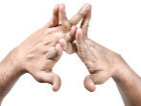
Connect the tips of your fingers in the following way: The right pinky
to the left ring finger and vice versa. The right middle finger to the left
index finger and vice versa.
Place your palms on the thighs, fingers pointing downwards, thumbs straight and free.
Start with 5 minutes on the first attempt and then extend the practice
up to 16 minutes by adding 2 minutes each time.
Jnaan Mudra
Connect the tips of the index finger and the thumb. Keep the remaining
three fingers comfortably straight.
Practise for 16 minutes, twice or thrice a day.
Shankh Mudra

Place the tip of the right thumb on the hill under the left thumb. Wrap
all four fingers of the left palm around the right thumb. Touch the tip
of the right index finger to the tip of the left thumb. Rest the remaining
three fingers of the right palm on the back of the left palm. (One can
sweep the hands.)
Practise for 16 minutes, twice a day.
Praan Mudra
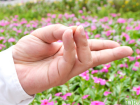
Touch the tips of the ring finger and the little finger to the tip of the
thumb. Keep the remaining two fingers comfortably straight and place
your palms on the thighs.
Practise for 16 minutes, twice a day.
Start practising this combination of mudras today, and let me know how you feel after a month.
Abhay Kumar Shah is a mechanical engineer, who has learnt Mudra Shastra from experts and established his own method of using this science correctly, and in the modern context. He can be reached at: abhayshah.kd@gmail.com
We welcome your comments and suggestions on this article. Mail us at editor@lifepositive.
Discussion (0)
No comments yet. Be the first to comment!
Leave a Comment
You need to login to post a comment.