
Listen to the body temple
Our physical, mental, emotional, and spiritual well-being depends on our ability to be in tune with our physical self, which is the vessel of our personal spirit and our connection to the Universe, says Rishi Rathod.
Mann Mathura dil Dwarka
kaaya Kashi jaan
Yeh das dwaare ka peenjra
ya mein jyot pichhaan”
“Know the mind to be Mathura, the heart, Dwarka
and the body, Kashi
This cage of ten doors
contains the light within”
Paraphrase: The body-mind complex is the most sacred pilgrimage of all and is the true Mathura (birthplace of Lord Krishna), Dwarka (kingdom of Lord Krishna), and Kashi. Know this cage (the body) to be the true temple which contains the light of the soul.
—Sant Kabir
Wonder why Albert Einstein said that his primary process of perceiving was muscular and visual, and Thomas Edison, one of the most prolific inventors known to mankind, said that great ideas originate in the muscles?
It appears that these great minds believed that what we call the brain, although located in the head, is spread throughout the physical body. This body intelligence is what Carl G Jung was pointing towards when he said, “The hands will solve a mystery that the intellect has struggled with in vain.”
The idea that the body talks, which is the topic for this article, is not a new one, and does not come to us from these relatively recent thinkers alone. It exists in poetry, in mythology, and in the form of ritual, which is but mythology enacted as drama or a series of actions. In recent times, the idea of listening to the body is closely connected to the insight into multiple intelligences, which was introduced by psychologist Howard Gardner in 1983. He, among other things, spoke about the spatial and kinaesthetic intelligence developed in athletes.
28 LifePositive | JANUARY 2023
Personally, I have been working on my breathing for a long time. What I have observed is that apart from a specific body part sending me subtle signals, my breath pattern also sends me signals. Sometimes it becomes shallow, and at other times, the breathing speed accelerates. Even the heat and cold in my breathing would signal something. And as I would sit down and act upon my breath, gradually, healing would take place. For me, now, it’s not just about taking medication when I am sick but also about addressing what’s happening inside my physical form. I understand that I am part of a living system that constantly exchanges information while I am eating, resting, or overdoing everything. This is probably what they call ‘Body intelligence.’
“Body intelligence (BQ) refers to the degree to which a person is aware of their body, what they know about themselves, and what they do for their good. Although body intelligence has only been a topic of discussion in the last two decades, it is not a new concept — in

fact, it has always been central to the work of health, wellness, and, a bit later, fitness professionals. So if you have apps like a plank for 30 days, pedometer, or meditation installed — congratulations, you are taking the first steps in developing your body intelligence, albeit perhaps unconsciously,” says Nadezhda Yushkevich, in her article on Body intelligence published in the ezine Startup Jedi, of which she is the managing editor. (https://startupjedi. vc/content/body-intelligence-what-it-and
how-it-affects-our-lives)
The danger of ignoring what the body has to say has serious ramifications, especially in situations that demand greater effort. Colonel Ranveer Singh Jamwal, a serving officer in the Indian Army and a mountaineer of international repute, with over 40 mountaineering expeditions across seven continents behind him and three successful climbs of Mount Everest, says that not listening to the body can prove to be fatal. Colonel Jamwal was a qualified instructor at the High Altitude Warfare in Gulmarg in 2006. “Both mountaineering and soldering call for uncommon calibration of diet, exercise, and rest that pushes the physique to a point that is breakthrough as well as breakdown, depending on how you look at it. In both cases, it is the mission that one seeks to accomplish, which has to be accomplished at all costs, and the body is only a means to that end. This, however, does not mean that one ignores the demands of the body and numbs the pain. The costs of ignoring what the body is saying go way beyond the loss of one’s life.”
He continues to explain body awareness: “The fall of a soldier or mountaineer increases the burden on his team and endangers the success of the mission itself. Therefore, it is important to heed the body’s cry for help on the battlefield
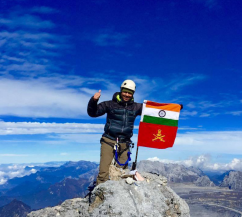
ltitude climbers need to develop the skill of listening to their bodies or high up in the mountains. The first sign of snow blindness, a lack of proper hydration, chilblains (small, itchy swellings on the skin that occur as a reaction to cold temperatures), and frostbite, which causes the skin or a limb to turn red followed by purple and then black, are all ever-present dangers that one has to watch out for. These are ever-present dangers that can surprise even experienced hands and push one towards serious injury or even death.” He further explains, “I know this because I lost the little finger of my left hand in one such Indian army mountaineering expedition to Mana in Uttarakhand. It breaks the heart to abort an expedition but the body has its limits, and one may only ignore it at one’s own risk. In mountaineering, in battle, and in life, it is important to know when a strategic retreat is called for. It took the entire team anywhere from three months to half a year to resume ordinary life after varying stays in military hospitals and a lot of quality time with loved ones.”
According to him, anything which helps one develop body wisdom should be welcomed as it
Lead story 29
can be a matter of life and death in battle as well as in life. “It is important to take heed of what the body is saying before it is too late,” says Jamwal, emphasising that developing body wisdom is as important as building muscles, endurance, and cardiovascular fitness.
Starting the journey
All conscious growth begins with self awareness. The ability to listen to the body —a superpower that one can develop—is no exception. It is only when the other noises are silenced and attention is trained single pointedly on the body that one begins to hear the whispers of the body’s workings. There are several methods for developing the awareness of our physical selves, but probably no method has aided people in this regard more than Vipassana.
Durgesh Gupta, the head of the department of BA in Multimedia and Mass Communication at Reena Mehta College in Mumbai, remembers his first experience with body awareness.
“In my younger days when I was curious to understand life and its purpose, a friend suggested that I do a 10-day Vipassana camp. After it was over, I knew that I had become a better person intellectually, physically, mentally, and morally. The experience led to a sharpening and deepening of my abilities. Vipassana, in my experience, is the exercise of watching yourself, your body, and your breath. It starts from the watching of breath. Slowly and gradually, you understand that your breath is telling you something about yourself. So when you are in a state of health you breathe in a particular way. When you are in a state of illness or are stressed or angry, you breathe in a different way. These are but responses like anger, sadness, sorrowfulness, or some other emotion reflected in your breath.”
According to Gupta, as your practice deepens, your concentration becomes more and more focussed, and you become more pointed in observing your body. Your body is constantly talking to you in a language of signs and symbols, in the language of stimuli.
Gupta shares, “I soon realised that you can respond to the stimulus in a way that is conducive to your well-being. As the practice deepens, you become aware of things that you have never noticed because your senses have become sharper, and every small change in the body is now noticeable.” He vividly describes an experience: “On the fourth or fifth day of the practice, when I opened the cap of the toothpaste, the fragrance of mint hit my nostrils with great force. I had been brushing all my life like everyone else since I was a child. I had never smelled mint as strong. There are a thousand such stimuli that our body is capable of receiving every moment but they are too subtle for our dull senses.”
It is true that we ignore many physical sensations in our daily lives. But as we become aware of them and start listening to them, we can notice not just the new sensation in response to an external stimulus but also note the patterns of waves and subsidiary waves. This could be the craving for food, or anger, or the desire for sex, etc. For anyone who wishes to listen to the body, the observation of the breath is a good place to start. Soon, the practice effortlessly expands and one begins noticing movements in the body like heartbeats and visual and other sensory stimuli that the body receives. The way forward is to practise becoming aware of the sensations in the body and not respond or succumb to them.
Different approaches
Spiritual masters say that our body speaks to us and that it is also possible to ask our body and its parts to accomplish important tasks, including asking it to heal itself. However, like all servants, we have to respect its limitations, consider its talents, and ensure that it is nourished, respected, and sufficiently rested. This is not important just for the body but the individual soul as well, seated inside our body.
“Just as the Patanjali Yoga System focusses on taking the mind to a state where it can assume complete command of bodily functions, the Hatha Yoga taught by Baba Gorakshanath places emphasis on cleaning the body and mastering it with a conscious effort to calm the mind. In both the systems, listening to the body is key as it is only with this human body that the four purusharthas—Dharma, Artha, Kama, and Moksha—can be achieved,” says Neelam Gupta a qualified yoga counsellor, founder of Integral Yogic Psychology and author of the forthcoming book Yoga Works! She continues to explain, “This, however, is easier said than done. Most of us have abused
our bodies to such an extent that the body has been sedated to the point where it speaks in faint whispers that are inaudible to our dull senses. The approaching footsteps of sickness, accidents, bad relationships, and death are not heard and, therefore, not heeded at all. By the time tragedy strikes, it is too late.”
According to Yushkevich, our body is always talking to us. She writes, “When you are healthy, you feel good inside. You feel happy, eat well, sleep well, and have a good cheerful disposition. You are able to exercise, travel, meet people, and continue your day-to-day life in the best possible way. But if there is something wrong with your body, even for a day, you will feel listless, uneasy, in pain or discomfort and will not be able to follow your daily routine. The only thing to remember is to stay alert always and listen to your body giving you signals in the form of symptoms.”
Truly, health is the greatest priority for a human being; everything else comes later. It is a privilege to be healthy, and we must always
Spiritual masters say that our body speaks to us and that it is also possible to ask our body and its parts to accomplish important tasks, including asking it to heal itself. However, like all servants, we have to respect its limitations, consider
its talents, and ensure that it is nourished, respected, and sufficiently rested.
32 LifePositive | JANUARY 2023

be grateful to God for it.
Yushkevich says there are three routes to gathering body intelligence or understanding what the body has to say:
• Breath: Pay attention to how you breathe— quickly or slowly, softly, or is it stiff? • Muscle tension: Bring your attention to one part of your body (for example, your neck, shoulders, jaw, or forearm) and notice how relaxed or tense your muscles are.
• Hunger: Next time you’re about to eat, notice if you feel physically hungry. Understand whether this desire to eat is physical (for example, rumbling in the stomach, loss of energy) or emotional.
• Posture: How are you sitting or standing now? Is your posture comfortable? Are there any sensations in the body, such as depression, stiffness, or pain, that would indicate that you need to correct your posture?
“Our body speaks to us at every moment, every day. If you are in touch with your body, you will know as soon as there is anything going wrong with it. The first thing when something goes wrong is a symptom. So, what is a symptom? When you have some condition, you will experience something out of the ordinary. For example, if you are going to have a common cold, your nose will start running, you will sneeze a couple of times, and your throat will feel scratchy. We all have experienced that uncomfortable feeling when a cold is about to hit us,” says Dr Anuradha Iyer, a professor and HOD of Physiology at SHKM Govt Medical College, Mewat, India, and the author of five books. Similarly, she explains, “If your stomach is feeling queasy and you don’t feel like eating anything, or if you start passing loose motions, then you know that there is something wrong with your digestive system. More serious disorders like heart disease will present with some serious symptoms like chest
Lead story 33

pain, discomfort in breathing and sweating, or a weird feeling that something is not right. Pain of any kind is a definite indication of damage to the tissue. We are unable to comprehend when we have a condition since we are not aware of the signs of illnesses. One thing to keep in mind is that our bodies will constantly communicate with us; we will undoubtedly sense that something is wrong with us.”
According to Dr Iyer, the breakdown of communication happens only from our side; our body is always giving us signals. If we just remain alert and realise that our body is sending us SOS (save our souls) signals, we will be able to catch the smallest disease and the gravest disorder. So the question of a breakdown of communication arises only if we
34 LifePositive | JANUARY 2023
are not alert to our body. If we are preoccupied, we will not be able to receive the signals coming from our body. Then the situation may worsen. But if we are alert at that time, we will have an opportunity to respond to our body’s signals. Just reaching out to a medical professional will help things come back on track soon. All these are warning signals and should be heeded immediately.
Naad Yoga Method
Speaking on the subject, Nada Yogi Vibhushri Rivesh Vade, who follows the Nath tradition as expounded by Sant Dnyaneshwar of the Warkari tradition, recommends focussing one’s attention on the sensations in the navel for gathering wisdom not just of the body but just about anything in life. “The navel is the seat of speech, in the sense that it is the most eloquent organ in the body. It is the place of the soul seated in the body and of God. The language of the body is sensation. You can sense what is happening in the body, the mind, and even in the world when you need to take important decisions by merely focussing on the

The breakdown of communication happens only from our side; our body is always giving us signals. If we just remain alert and realise that our body is sending us SOS (save our souls) signals, we will be able to catch the smallest disease and the gravest disorder.
navel and asking it as you would ask a person to guide you.” According to him the navel senses danger, positivity, and negativity, and reads the energies of people you are dealing with. It also keeps a tab of overall mind-body
spirit wellness. He explains that one can also focus on the navel and seek healing. The navel is our umbilical cord to the individual soul, which is inseparable from the universal soul, for which nothing is impossible. Vibhushri’s own spiritual awakening occurred with the forceful activation of the navel:
“Armed with a degree in software engineering, a master’s in management studies from IIT Mumbai, and years of running the corporate rat race, I was a country manager in a reputed company. I was happily married with a child and free from ailments of any sort. Then in 2011, on an official trip, I had a horrible car accident and everything changed. I felt the maximum impact of the crash in my navel. It felt as if a ton of explosives had been set alight in my navel. I learned later that such injuries also tend to stimulate or activate the navel. My shoulder was crushed, and I was admitted to
the ICU. I felt dangerously close to losing my life. I was unconscious for several hours, and the doctors could not predict how it would turn out for me after I was discharged. My company decided that it did not owe me anything. I lost my job, my only source of income. It took me nearly a year to get back on my feet. My wife sold all the family gold. My savings had been exhausted. I was in debt, and my physical condition no longer allowed me to take on a full-time job even if it meant sitting behind a desk.
“However, very strangely, as I was recovering, I felt something shift within me. I not only felt calm and centred, but I also felt something opening up. I now know that it was divine grace, or kripa, that was guiding me. The accident had slowed me down and forced me to cut down on a lot of activity that was part of my normal routine. Somehow, my mind began to veer towards the potential of sound to inspire, uplift, and transform,” says Vibhushree, who clarifies that while he teaches navel activation, body intelligence can also be accessed through other centres in the body.
Lead story 35
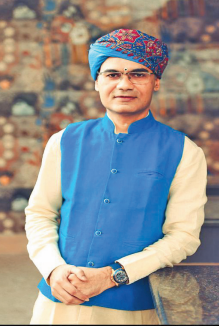
“The spiritual navel centre, or nabhimula, is situated three finger-spans below the navel scar. The Shaiva and Siddha philosophies of yoga talk about removing impurities (mal) from the three main centres of the body, namely, the mind, the heart, and the navel, which hold back humans from reaching their greatest potential. Mayiya mal (connected to the mind) deludes the perception by keeping it away from the ultimate truth and ensuring that it remains stuck in duality. Anva mal (in the heart) causes feelings of unhappiness and unworthiness. Such a person likes to complain and get stuck in gossip and is convinced that the world is a bad place to live. Karma mal (in the navel centre) leads to decision-making delays and the inability to act, a lack of clarity, instability, fear, and scarcity. The person
36 LifePositive | JANUARY 2023
remains stuck in pleasure and pain. Marma theory speaks of three centres: Sthipati, Hriday, and Basti. Basti is considered a place where deep thinking takes place. It has the power to carry our awareness from the material world to the very source of creation. Siddha experts work on this centre without touching it,” Vibhushri adds.
Talking back to the body
As one becomes more aware of the body and also grasps what the body is saying, it is also important to talk back to the body and let it know what you want from it.
Shivi Verma, the editor of Life Positive, described an intriguing experience where she was able to converse with her body in addition to listening to it. She had eczema on her forehand for a number of years, and despite taking drugs and undergoing various tests, it would not go away. It would subside for a few months, only to flare up with greater intensity after a considerable gap. When nothing worked, one fine day, she sat down and pondered about her eczema. “I dug further inside myself and understood there was a message it wanted to send me regarding certain issues I was dealing with. I realised that it was my body’s fearful response to a difficult situation I was undergoing. The ailment wasn’t an enemy, but a friend, trying to communicate its concern for my well-being.”
Shivi continues, “I started stroking the area with my other hand very lovingly and, looking at it, said, “I’m alright and safe. There is no reason to be concerned. I am well cared for.” Immediately, the redness vanished. I continued doing this for a few days, and the eczema eventually began to disappear. Finally, it vanished in a month, never to return.”
Shivi concludes, “Listening to the body might be a terrific method to cure it. It will assist you in comprehending what your body requires, but communicating back to your body to recover is a remarkable experience that most people are unaware of.”
Talking back can also be done in the form of mudras, as was done by many ancient masters. The science of mudras involves hand gestures, systemic breathing, and certain body movements to obtain certain outcomes, like healing a particular part of the body. Mudras are a part of tantric devotional worship too. Mudras use the body to address the body and prepare it for higher purposes. In ritualistic worship, the body is used to transcend the body. Sri Ramakrishna described the devotional process as using the water of the Ganga to worship the Ganga.
Abhay Kumar Shah, an expert on mudras and also a researcher on the subject, explains how an excruciating spinal ache in 1998 brought him to the science of mudras. “I ignored the medical advice to get spinal surgery done
because the procedure was risky. I first tried acupressure with Ketan Shah, which gave me some relief. This opened my eyes to healing systems beyond conventional medicine, and I began to research therapies that would provide me relief. This is how I stumbled upon Mudra Therapy and started reading up on the subject. I tried Mudra Therapy and also attempted to address health issues in my family with my new-found knowledge. In both cases, I saw encouraging progress. I was also fortunate to learn from a tantric who invited me to his WhatsApp group. This is where I first started providing mudra solutions for health problems and went on to start a group on my own, which I stopped after some years to focus on my research.
“I have discovered that the complexity of modern life has impacted the efficacy of some mudras described in traditional texts and that they need a more nuanced approach. The modifications I arrived at proved to be more effective. With time, I have established my own methodology of prescribing mudra solutions for almost every health and psychological
The spiritual navel centre, or nabhimula, is situated three finger spans below the navel scar. The Shaiva and Siddha philosophies of yoga talk about removing impurities (mal) from the three main centres of the body, namely, the mind, the heart, and the navel, which hold back humans from reaching their greatest potential
Lead story 37
issue, and my research is far from over,” says Shah, who has documented over 500 mudras, which has been acknowledged as the largest compilation in this field so far. Shah reports that patients with very severe conditions have benefitted from Mudra Therapy.
SL Purohit, an 82-year-old air force retiree based in Mumbai, was in acute pain due to an enlarged prostate. He had great difficulty in passing urine, and the flow was slow, repeated, and excruciatingly painful. Doctors advised surgery but also warned that the situation could worsen further after surgery. Within two weeks of practising the recommended mudras thrice a day, his urine, which had been opaque, became clear, the pain subsided, and his incontinence stopped. He no longer has to wake up at night to visit the bathroom, and he thinks he is almost healed completely. Even as this article is being written, Purohit is practising his mudras and becoming better by the day.
In the Majjhima Nikaya (Sutta 36), the Buddha speaks on the importance of listening to the body:
“If the body is not mastered [by meditation], the mind cannot be mastered. If the body is mastered, the mind is mastered.” In practising mindfulness of the body, it’s your direct experience that’s important, not your judgments about your body, your wishes for what it might be, or your stories about how it came to be as it is.
The last word on the necessity of becoming aware of the body comes from the Armenian master G I Gurdjieff, the author of Meetings with Remarkable Men: “Without self
knowledge, without understanding the working and functions of his machine, man cannot be free, he cannot govern himself, and he will always remain a slave.”
The living and the non-living are sustained by universal energy that nourishes everything and all beings. Mudras are signs to the universal energy to flow into certain parts of the body and pervade the cellular level to begin the healing process. Mudras are like nourishing mothers who do not just feed us but love us, care for us, and pray that we are nourished thoroughly.
38 LifePositive | JANUARY 2023
Body Conversations Through Mudras
• In what way does our body speak to us?
Abhay Shah: The body never forgets and it is in continuous conversation with us. It tells us to behold that it is happy. It also tells us that it is unhappy. We need to be in a state of relaxed motionlessness to hear its faint voice. The few moments before going to sleep is a good time to listen to the body.
• Why can’t most of us not hear anything our bodies tell us till it is too late? Abhay Shah: The reason for this is we have neither the inclination nor the desire to pause enough to hear what the body has to say. To be in a state of compassion, love, forgiveness, and mercy is to be aligned with universal consciousness, and to live in opposition to these values is to be divorced from these values. The ones who commit crimes against these universal values lose the capacity to listen to the body and the ones who are aligned with these values in thought, word, and deed find it easy to listen to the body and its messages. It is easy to empty an aligned mind because it is in a state of relaxation. In this state of relaxation, the body speaks. This is also called meditation, which is a state of alignment with universal energies.
• In what way can mudras be considered as our message to the body to address some issues, and how do you explain their efficacy?
Abhay Shah: In my opinion, mudras are the biggest gift to suffering humanity. The knowledge of mudras was revealed to our rishis in elevated states of consciousness, in which the hands, feet, and entire body assume mudras and asanas that deliver what is needed for the progress on a particular path. Many such mudras were recorded, and their effect on the body, mind, and emotional states was shared with suffering humanity at large so that they could elevate themselves. Assuming a mudra is your telling your body that you have noted that it requires support and that you are willing to provide it. This puts the body at rest and gives it the required encouragement and energy to heal itself.
The living and the non-living are sustained by universal energy that nourishes everything and all beings. Mudras are signs to the universal energy to flow into certain parts of the body and pervade the cellular level to begin the healing process. Mudras are like nourishing mothers who do not just feed us but love us, care for us, and pray that we are nourished thoroughly. Mudras are like diamonds that are used for cutting glass. They are priceless because their usefulness is not limited to healing, just like the value of a diamond goes beyond its ability to cut glass. Mudras bring great gifts to the mind, intelligence, and emotions, and they also advance our spiritual growth in ways that are too many to list here.
We welcome your comments and suggestions on this article.
Mail us at editor@lifepositive.net

Discussion (0)
No comments yet. Be the first to comment!
Leave a Comment
You need to login to post a comment.