Mandala
MANDALA
Women’s Empowerment Comes to the Fore(st)
Atrained ecologist,
Manju Vasudevan always loved nature and wildlife. Like most
researchers, she was often accompanied by indigenous people on surveys, which helped her in knowing them better. She also spent time in organisations like the Keystone Foundation where community centred conservation was undertaken. Her desire to help indigenous people, preserve their incredible knowledge, and popularise their low-carbon footprint lifestyle made her form the NGO, Forest Post.
Manju knows that forest dependent communities in India harvest a range of wild resources and products.
A large part of Minor Forest Products (MFP) collections contributes to the income of these tribals. Forest Post helps them by adding value to the products made by tribals through women’s groups trained in value addition.
Her indigenous women’s enterprises are scattered in six villages in the Chalakudy and Karuvannur river basins
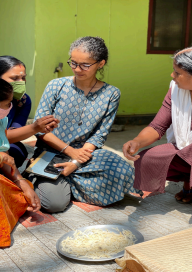
Manju empowering women to make forest products
in central Kerala’s Western Ghats. They produce beeswax skincare, bamboo craft, and value-added traditional foods. The raw material comes from seasonal harvests of Kerala’s forests as well as other parts of India. People in these regions
know where to find such resources and what time of the year to find them.
Manju hopes that as a brand, Forest Post is able to convey the essence of this enterprise and more and more conscious buyers come to appreciate it. Her biggest support comes from her women’s group— they are the core energy. Financially, it all started with an annual grant from Global Alliance for Gender and Green Action (GAGGA) through the Keystone Foundation in the Nilgiris. In 2021, they received support from the UNDP (United Nations Development Programme) to strengthen the market links of these businesses, enable expansion to new
villages, and do their branding and business registration. Manju is extremely happy to have done her bit in reviving their livelihood in small steps by giving them dignified livelihoods and a sense of pride and ownership.
- By Jamuna Rangachari
10 LifePositive | DECEMBER 2022
Soaps
For
Cleaning Mother Earth
Harsh Chandra, a native
of Uttrakhand, came
to Auroville to study
textiles and handlooms as part of an exchange programme in 1993 but, instead, found his calling in making organic soaps. It wasn’t something he thought he would get into, but it piqued his interest, and he started experimenting with different formulations, using natural materials like herbs, flowers, and cold-pressed oils. His products are plastic-free and made of biodegradable material.
Harsh’s biggest challenge was finding alternatives to plastic packaging. After various experiments and changes in formulation, he came up with the banana paper and butter paper packaging methods. Now, his company is 100 per cent plastic-free.
Moments that are very touching for Harsh are when people appreciate his natural method of making cold-pressed soaps. It is a 30-
day process, which entails a lot of hard work. So he feels acknowledged when people take the time to appreciate his work and tell him how he has positively impacted their lives
and made them eco-friendly.
Although his handmade products take a bit longer to make, he has no qualms as his mission has always been to remain environmentally friendly. With this in mind, he makes soaps for different companies in India that share his vision of producing nature friendly products.
It is said that the universe does connect us to what inspires us and often, one then becomes an inspiration to others. This certainly has happened with Harsh as he has indeed understood how to be of service to the planet while building his brand. Seeing the way he is moving forward, I for one, certainly feel we all will hear more about him very soon and incorporate his soap in our lifestyle. After all, with this step, we could play a minor role in serving mother earth too.
Harsh has indeed understood how to be of service to the planet while building his brand. Seeing the way he is forging ahead, it looks like we will share more about him very soon, thereby playing a minor role in serving Mother Earth
too. Harsh Chandra: the joy of running a 100 percent plastic free company- By Jamuna Rangachari
Mandala 11
Visionary Care for the Blind
Based in Hoskote,
Karnataka, the GEF
Hospital serves as
central base from where
a team of specialists and
ophthalmologists conduct
a range of programmes
to reach out to patients
in need. Their outreach
programme is designed
to bring eye care to those
who would normally have
no access to high-end
medical treatments.
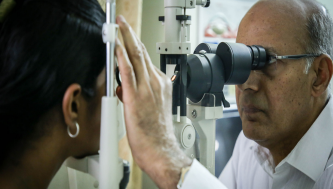
The Global Eye Foundation provides free eye care to the underpriveleged
I recently had the privilege of directing an underprivileged
person towards quality eye care even though he could not afford to pay for his cataract surgery. This was possible as I knew of Global Eye Care Foundation, an organisation that has been doing this yeoman service for years.
Statistically, there are 12 million classified blind patients in India. 80 per cent of these cases could have been entirely prevented, had they been diagnosed and treated in time. Unfortunately, most eye care clinics and specialists are big-city-based. This leaves the largely uninformed rural populations ignored, unscreened, and untreated, with no access to quality eye care. Most often, they don’t even know that their condition is correctible and treatable. Consequently, their sight begins to weaken and blur, their world gets hazy, and they continue to struggle to make ends meet. The Global Eye Foundation (GEF) was founded in 1995 by Dr Sundar Ram Shetty and eight of his colleagues. It is a non-profit organisation with a mission to provide all underprivileged Indians access to free and quality eye care.
Their teams work closely with the National Programme of Control of Blindness (NPCB) to scout four districts of Karnataka— Chikkaballapura, Kolar, Bangalore Rural, and Tumkur—looking for patients with cataract, glaucoma, diabetic retinopathy, and refractive errors at their frequent eye camps. They also provide free lodging and meals for every patient who arrives at GEF. They have organised 51,174 outreach camps, screened 262,132 patients, and performed 105,401 sight-saving surgeries for free.
The GEF has a plan for implementing a three-tier eye care programme, which will take eye care to the doorstep of every poor in rural and urban Karnataka.
- By Jamuna Rangachari

Discussion (0)
No comments yet. Be the first to comment!
Leave a Comment
You need to login to post a comment.