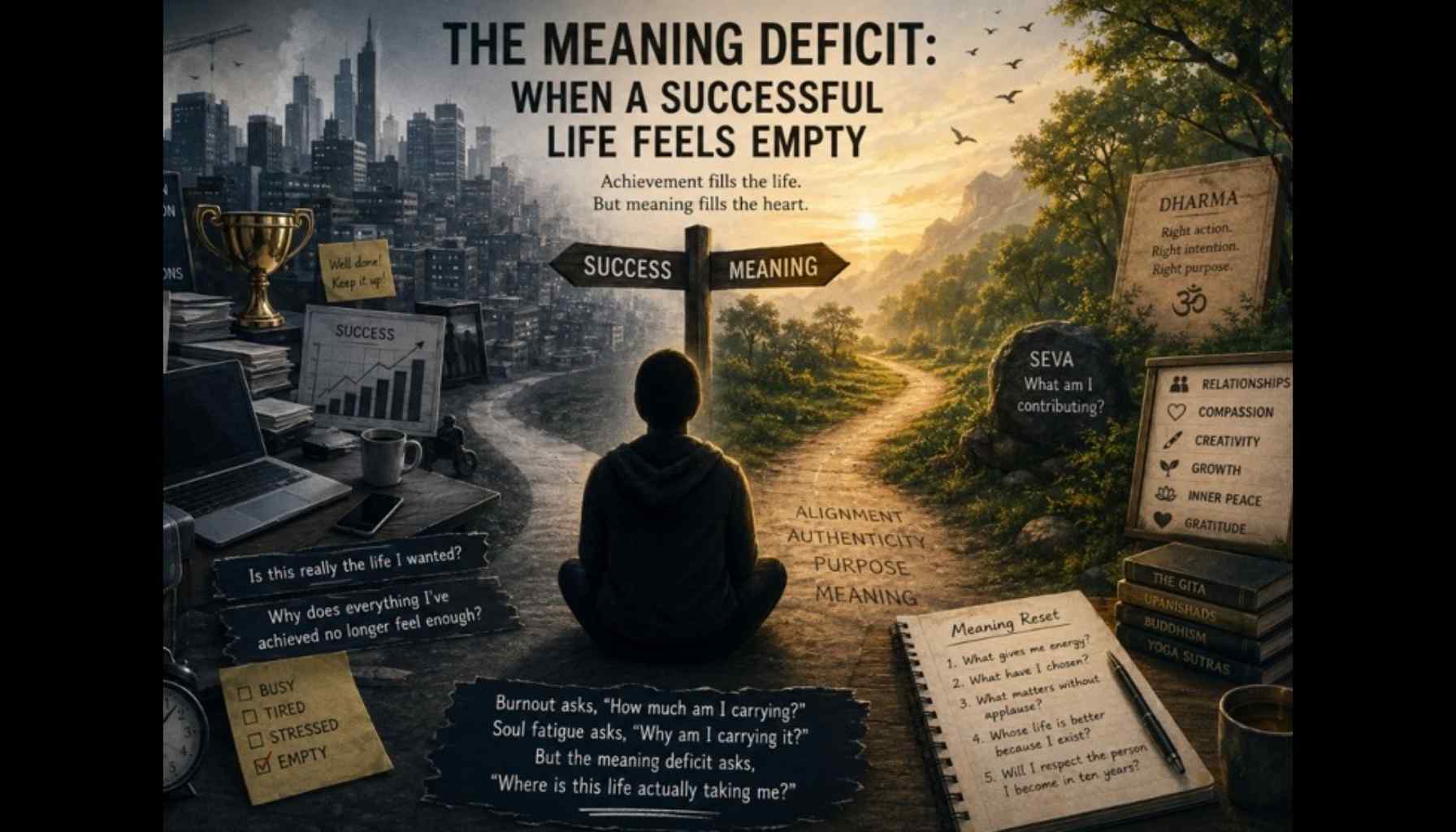
Why successful lives feel empty
We've learned how to build successful lives. But amid achievement, responsibility, and constant striving, have we forgotten to ask what truly makes life meaningful?
Sometimes, a surprising question arises—not when life is falling apart, but when everything seems to be going well. The promotion is in hand. The children are settled. The mortgage is being paid. The photos show happy moments. The annual vacation is planned. From the outside, there’s little to complain about. Yet, in a quiet, unguarded moment, a question surfaces from within: “Is this really the life I wanted?” Or more softly, “Why does everything I’ve achieved no longer feel enough?”
In my earlier article on soul fatigue, I described a type of exhaustion that rest alone can’t seem to fix. But maybe we need to look deeper. What if some of our fatigue isn’t from having too much to do, but from having too little that truly feels meaningful? I call this the Meaning Deficit—not a diagnosis or disorder, but a psychological and existential gap between the life we successfully perform and the life that genuinely feels worth living.
The Indian Success Story—and Its Quiet Question
Picture a familiar Indian household. A father works tirelessly for thirty years, driven by a simple goal: to give his children opportunities he never had. The children grow up, study abroad, and become independent. Then comes retirement. Suddenly, the man who was always needed finds himself unsure of who he is without that need.
Now consider a woman who has spent two decades balancing her career, children, aging parents, marriage, and household duties. She’s been dependable to everyone. Yet in her forties or fifties, she faces a quietly unsettling question: “Beyond all the roles I perform, who am I?”
A younger version of this experience is also emerging. A 28-year-old professional might have the salary, smartphone, weekend café visits, gym membership, and international holidays that once symbolized “making it.” Yet Sunday evening brings a strange emptiness. Monday arrives, and the cycle repeats. Nothing feels dramatically wrong, but something important is missing.
Philosophy long ago asked about meaning, and now psychology is beginning to measure it. While meaning may seem philosophical, its link to mental well-being is increasingly clear. A 2023 meta-analysis of 108 studies involving 76,892 participants found that having meaning in life is associated with lower psychological distress. Notably, researchers also observed cultural differences in how people experience the search for meaning.
Another meta-analysis of 66,468 participants showed that a stronger sense of purpose correlates with lower levels of depression and anxiety. Additionally, a study of over 108,000 people across 16 samples found that a greater sense of purpose is tied to reduced subjective stress.
This doesn’t mean that “finding purpose” cures mental health conditions. Depression, anxiety, and trauma require proper assessment and care. However, the evidence highlights something important: meaning is not just a spiritual luxury—it has real psychological significance.
India once had a different way of understanding purpose. Instead of asking “What is your passion?” Indian traditions asked deeper questions about dharma. Dharma is much more than a job; it involves right action, responsibility, values, and how one participates meaningfully in life. The Bhagavad Gita begins not with a calm Arjuna, but with one who is confused. He has ability, training, and status, yet temporarily loses clarity of meaning. Krishna’s role isn’t just to motivate him to perform better; their dialogue explores identity, attachment, action, responsibility, and a broader understanding of the self.
This distinction is important today. We often try to solve a meaning problem with an achievement fix. Feeling inadequate? Achieve more. Feeling invisible? Become more successful. Feeling empty? Buy something. Feeling behind? Compare yourself harder. Feeling exhausted? Take a holiday—only to return to the same life that drained you. Eventually, the inner self asks for something achievement can’t provide.
When Identity Becomes Resume - One reason the meaning deficit feels so powerful is that we increasingly answer “Who are you?” with what should answer “What do you do?” I am a doctor. I am a CEO. I am a mother. I am a professor. I am successful. These identities matter. But what happens when the job ends, the children leave, relationships change, businesses fail, or retirement arrives? If our entire identity is built around roles, losing one can feel like losing ourselves. A transpersonal perspective invites us to look beneath these roles. Who remains when the title disappears?
Vedanta transformed this into a profound exploration of the nature of self, while Buddhist traditions examined attachment to a fixed identity. Yoga focused on observing the restless mind. Though these traditions took different paths, each challenged the assumption that our surface identity represents the entirety of who we are.
Purpose Does Not Have to Be Grand - The word "purpose" can feel intimidating, often making us believe we need to uncover a grand, magnificent mission. But purpose can be simple—raising a child consciously, teaching honestly, caring for an aging parent without losing oneself, creating something beautiful, mentoring someone, protecting a river, serving those who cannot repay us, learning deeply, or healing old wounds to prevent passing them on. This is where the Indian concept of seva becomes psychologically insightful. Meaning often becomes clearer when life shifts from asking "What am I getting?" to "What am I contributing?" Purpose is not always discovered; sometimes it is built through repeated meaningful actions.
The Five-Question Meaning Reset - If life feels full yet somehow empty, another productivity plan may not be what you need. Instead, take twenty quiet minutes—no phone, no performance, no pressure to find the “correct” answer. Ask yourself:
- What in my life gives me energy—and what repeatedly drains it? Avoid judgment; simply observe.
- Which parts of my current life have I consciously chosen, and which have I inherited from expectations? Family, society, and culture shape us, but inherited expectations don’t have to define us permanently.
- If no one could applaud, compare, “like,” or reward me, what would still feel worth doing? This question distinguishes true values from external validation.
- Whose life is a little better because I exist? Meaning often resides in contribution—through relationships, teaching, caregiving, creativity, community, and seva.
- If I continue living exactly as I do today for the next ten years, will I respect the person I become? This may be the hardest question, but often the uncomfortable ones spark change.
Success and meaning do not have to compete—the answer is not to reject ambition. India needs ambition. Young people need careers. Families need financial security. Women deserve independence. Achievement can be deeply meaningful. The problem arises when success becomes the only way we measure a life.
India's Economic Survey 2024–25 placed unusual emphasis on youth mental well-being, highlighting lifestyle, workplace culture, family relationships, social media use, and their impact on mental health. Perhaps our next conversation should go further—not just, “How productive are we? But also, what are we becoming while being productive?
The Meaning Deficit does not necessarily ask us to resign from our jobs, leave our families, renounce material life, or disappear into the Himalayas. Sometimes the change is much quieter. We continue working but stop worshipping achievement. We continue caring—but learn not to disappear while caring. We continue earning—but remember that income and identity are not the same. We spend less time proving that our life looks successful and more time asking whether it feels truthful. Because perhaps the opposite of an empty life is not a more exciting life.
It is an aligned life. And alignment begins when what we do, what we value, and who we are trying to become finally start speaking the same language.
Reflection: Burnout may ask, “How much am I carrying?” Soul fatigue asks, “Why am I carrying it?” But the meaning deficit asks the question beneath them both: “Where is this life actually taking me?”
— Ms. Anjali Bhadola
Indian Transpersonal Psychology Researcher


Discussion (0)
No comments yet. Be the first to comment!
Leave a Comment
You need to login to post a comment.