
Organize your life
June 2013
by Vaibhav Sharma
Vaibhav Sharma shows how to keep stress at bay and increase your productivity by organizing your life
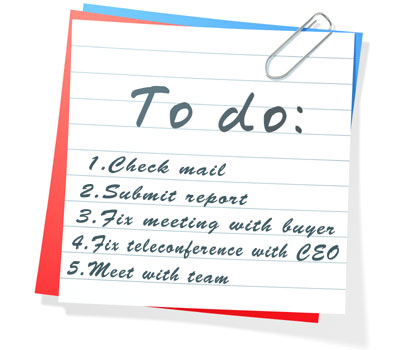
• Good old pen and paper: Smartphone and computer note-taking apps might seem very attractive, but there are few things as handy as a notepad and a pen! Draw up your day’s tasks, keep a note of people you have to call, your shopping list, and anything else. Simple, cheap, and very effective.
 |
It might be a cliché to say that modern lifestyles are full of stress, but that doesn’t make it any less true. Caught between the competing demands of home and work, we often overreach ourselves, and get overwhelmed by all that we need to do. Many of us fall prey to it at one point or another. We find ourselves drowning under a pile of responsibilities that just keep on increasing, and soon, missed deadlines, and broken commitments, become a common occurrence. This is not just a recipe for stress and worry – let it fester too long and it will become a ticket to chaos, confusion, and inefficiency.
Taking the time out to simplify and organize your life might seem to be yet another of those tasks competing for your limited time. However, putting in the effort to come up with a streamlined workflow will pay off dividends in the long term. Here are some ways of cleaning up the clutter in your life.
Reducing physical clutter
That is where the journey really starts. Not only does physical clutter – whether at home or at the workplace – reduce our efficiency by making us hunt around for what we really need, but it also adds an element of mental fatigue. Our surroundings rub off on us and while a walk through a misty mountain road puts us in a relaxed frame of mind, working in a dusty, cluttered office will overwhelm your mental faculties after a while.
If you have ever found yourself digging through piles of paper or frantically rummaging through your desk, do yourself a favor and clean up your workplace or home. An act as simple as sorting out your bank statements or organizing your library won’t just reduce the physical clutter and make you more efficient – it will put you in a more productive state of mind.
Prioritize
Now you are getting into top gear. Prioritizing your duties, responsibilities, and chores, is essential to your overall productivity regimen. Unless you know what is important, how will you ensure you have set aside enough time for it?
You can get started on it by carrying out an ‘audit’ of your day. For around a week to 10 days, keep track of what you are doing, and how you are spending your time. You can use a pen and paper to do it, or draw up an Excel sheet, or even use a time-tracking phone app. Once you have figured out how much time you are spending on each activity, you can see whether it matches your priorities. Is it that important to watch funny videos on YouTube for three or four hours each week, only to find there is no time to read that pile of books gathering dust? Assess your priorities – work, exercise, spending time with your family – whatever they might be, and see whether your actual schedule matches.
Stick to a routine
We all fancy ourselves as free spirits, who cannot be tied down by something as mundane as a routine. Think again. By not structuring at least some of your activities, you do yourself a disservice. No one likes to be stuck with a highly regimented or restricted schedule, but that does not mean you do not plan – look at a routine as a framework for your day, something that will lay the foundations for becoming more productive.
A structured day will also increase your sense of accomplishment and give you something to look forward to – notice how the day goes by better when you anticipate your regular post-dinner badminton game? You can also think – if you are already reeling under a lot of pressure, what is going to be more useful – the uncertainty of an unstructured routine, or the peace of mind of knowing what you will be doing? Best of all, you are free to make it as restricted or relaxed as you wish.
Clean up your inbox
Technology has been something of a mixed bag when it comes to simplifying our lives. It was supposed to free us from our daily chores or repetitive tasks, giving us more time to spend on really ‘living.’ However, we seem to forget that technology is merely a tool, not the aim or target itself – and become slaves to our machines.
Here is what you can do to regain control of your electronic kingdom.
Reduce device fatigue
The office desktop, a laptop for home, a fancy new smartphone, and perhaps even a handy tablet. Do not look surprised, for many of us, this is reality. Unfortunately, all these devices do not really increase our productivity. On the other hand, they can even induce a ‘fear-of-being-disconnected’ panic. It is especially true when on vacation – do you really need to lug that laptop along to the beach? On the other hand, must you spend every lunch break at work browsing Facebook on your smartphone? Common sense is the key here – use only what you need, and only use it as much as you need to!
Tackle your mailbox
Surprising as it might seem, e-mail, once heralded as the ultimate in business communication, is actually being blamed for reducing productivity at workplaces across the globe. Actually, we cannot blame e-mail for this – the real culprit is our abuse of the technology.
Do you really need to reply to every mail the minute it arrives? Alternatively, for those of us who go the other way, must you let unread messages pile up in your inbox? Moreover, answer honestly – don’t you find it hard to regain focus after being disturbed by yet another mail notification?
The truth is that most mail is actually never that urgent or ‘actionable.’ For some people, logging into their mailbox at predetermined times – perhaps as few as two or three a day – works wonders. By adopting this method, you not only reduce any disruption in your workflow, but can also set aside enough time to properly deal with your incoming messages.
Formalized productivity techniques
Once you have the basics sorted out, you are ready to move into formalized productivity techniques.
Pomodoro
If you frequently find your concentration flagging after a while, Pomodoro might be the right strategy for you. Less of a formalized productivity regimen and more of a concentration-enhancing tool, the Pomodoro technique is perfect for those of us with a wandering focus. Developed by management and IT consultant Francesco Cirillo, the Pomodoro technique capitalizes on the human brain’s preference for working in intense-but-short spells, and recommends that you try out 25-minute intervals of work. Each of these 25-minute ‘Pomodoros’ is supposed to be punctuated by a five-minute break, with a longer, 25-minute rest period coming up every 3-4 Pomodoros. According to the Pomodoro website (www.pomodorotechnique.com), this technique doesn’t just help make the best use of your time and keep you fresh, but can also aid you in assessing the time you spend on each activity.
Getting things done
The Getting Things Done (GTD) method is perhaps the best-known productivity technique. Developed by productivity guru David Allen (www.davidco.com), the GTD philosophy is built around the fact that most of us are poor multitaskers. According to adherents of this method, assigning priorities, deadlines, and contexts for our duties frees up our minds from having to worry constantly about our targets and aims. Instead, we are free to focus on the task at hand.
However, the GTD philosophy requires some amount of self-discipline, and for that reason, might not be perfect for everyone. What you can do, of course, is combine the GTD method with Pomodoro, which may add the element of flexibility to the routine.

Discussion (0)
No comments yet. Be the first to comment!
Leave a Comment
You need to login to post a comment.