
Pathways
October 2023
Brainpower
Satish Dhar explains the concept of neuroplasticity and ways we can adopt to benefit from this marvellous ability of the brain to rewire and restructure itself
In the early years, scientists assumed that
the brain was a ‘non-renewable organ’ and that brain cells were limited in number and died slowly as we aged. But, over the last decade, continuous research has revealed methods for regenerating nerve cells. This is referred to as ‘neurogenesis.’
Neuroplasticity is a related yet different concept: it’s the brain’s ability to establish new connections and pathways and modify how its circuits are linked. The term neuronal plasticity was used by the pioneer of neuroscience, Santiago Cajal, in the early 1900s to characterise non-pathological changes in the structure of adult brains.
Mind and brain
Most people consider the terms ‘mind’ and ‘brain’ interchangeable. However, the mind and brain are actually two very different— but interconnected—entities. The mind works through the brain but is s e p a r a t e from the b r a i n .
T h e m i n d uses the brain, a n d t h e brain responds to the mind. The mind also changes the brain. People choose their actions— their brains do not force them to do anything. Yes, there would be no conscious experience without the brain, but experience cannot be reduced to the brain’s actions.
The mind is energy, and it generates energy through thinking, feeling, and choosing. It is our aliveness, without which the physical brain and body would be useless. That means we are our mind, and mind-in-action is how we generate energy in the brain.
When we generate this mind energy through thinking, feeling, and choosing, we build thoughts, which are physical structures in our brain, made of proteins. This building of thoughts creates structural changes in the brain, called ‘neuroplasticity.’
Dr Leaf ’s clinical trial (2021) saw how energy in the brain changed as the subject was thinking, stimulating neuroplasticity in the process. The brain was responding to the person’s stream-of consciousness and nonconscious activity.
The mind is a stream of nonconscious and conscious activity when we are awake, and a stream of nonconscious activity when we are asleep. It is characterised by a triad of thinking, feeling, and choosing. When you think, you will feel, and when you think and feel, you will choose. These three aspects always work together.
Types of neuroplasticity
There are around 100 trillion connections in the brain. The word ‘neuro’ is derived from the word ‘neuron.’ Neurons are made up of many distinct cells specialised in transmitting what is happening in and around your body, with your brain serving as the command centre.
Two kinds of neuroplasticity are frequently discussed: Structural Neuroplasticity and Functional Neuroplasticity.
Structural Neuroplasticity: The ability of the brain to modify its neural connections is commonly characterised as structural plasticity. Based on this sort of neuroplasticity, new neurons are continually created and incorporated into the central nervous system throughout one’s life.
Functional Neuroplasticity: This is related to past activity (activity-dependent plasticity)
to acquire memory or, as a result of neuron dysfunction or injury (maladaptive plasticity), to adjust for a pathological occurrence.The brain’s adaptive mechanisms in young children are more potent, allowing them to heal from damage more effectively than most adults. In children, four forms of neuroplasticity have been observed:
•Adaptive: Changes that occur as children practise a particular skill, allowing the brain to adapt to functional or anatomical changes in the brain (such as injuries).
•Impaired: Changes that arise as a result of hereditary or acquired illnesses.
•Excessive: The formation of novel, inappropriate pathways can result in impairment or diseases.
•Plasticity that makes the brain sensitive to damage: The formation of damaging neural circuits that make injury more likely or more severe.
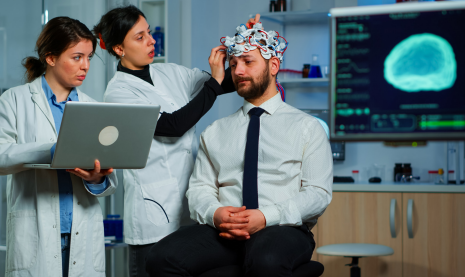
The brain being studied by neuroscientists wis a process in which the brain undergoes adaptive structural and functional changes. It is described as the nervous system’s capacity to reorganise its structure, functions, or connections in response to intrinsic (minds led stimulants) or external stimuli, such as a stroke or traumatic brain injury (TBI). The brain is an extremely complex neuroplastic responder. This essentially means that each time it is stimulated by your mind, it responds in various ways including neurochemical, genetic, and electromagnetic changes.
Stages of neuroplasticity
Neuroplasticity is a complex process and is currently under study. Neuroplasticity has historically been assumed to occur in three stages.
• The first 48 hours: Depending on the nature of the injury (stroke), early damage leads to cell death and the loss of specific cortical circuits connected with the lost neurons. To preserve function, the brain strives to use secondary neural networks.
• In the coming weeks: The cortical circuits switch from inhibitory to excitatory, synaptic plasticity, and new connections are formed. • Weeks to months later: The brain continues reorganising itself via axonal regeneration.
So, how does this affect us?
The brain is an extremely complex neuroplastic responder. This essentially means that each time it is stimulated by your mind, it responds in various ways including neurochemical, genetic, and electromagnetic changes. This, in turn, grows and changes structures in the brain, building or wiring new physical thoughts.
The brain is never the same because it changes
with every experience you have, every moment of every day. In sum: Your mind is how you, uniquely, experience life. It is responsible for how you think, feel, and choose. And your physical brain merely responds to these unique experiences.
Significance of neuroplasticity in therapy When we learn something new, our neurons form new connections. To adapt to new situations, we rewire our brains. This happens continuously, and it has many benefits in medical therapy.
• As we learn new things, like a new song or playing a new instrument, we form new brain pathways. We create the potential to connect neurons within the brain by activating the neuroplastic mechanism.
• Deep brain stimulation and non-invasive brain stimulation. Something we do in meditation.
• A greater knowledge of the processes driving neuroplasticity following brain injury or nerve lesion might aim to improve the patient’s quality of life.
• Recovery from brain strokes, brain cancer, Brain power 57
and memory loss are all related to the brain’s neuroplastic behaviour.
• Obsessive-compulsive disorder (OCD), attention deficit hyperactivity disorder (ADHD), and autism can be managed by applying the principles of neuroplasticity.
• According to research, the brains of people suffering from depression have issues with plasticity. Lifestyle modifications (healthy diet, physical activity, and enough sleep), according to experts, may increase neuroplasticity. Furthermore, several antidepressants are thought to be effective because they improve neuroplasticity.
Ways to rewire your brain using neuroplasticity Let us take a look at some ways by which you can get the benefits of neuroplasticity. • Travelling exposes your brain to novel stimuli and situations, forming new neural connections and activity.
•Intermittent fasting boosts neuron proliferation, improves general cognitive performance, and lowers the risk of neurodegenerative illness.
•Learning to play a musical instrument may

strengthen the connection between brain areas and aid in the formation of new neural networks.
•Memory training with mnemonic devices can improve connection in the prefrontal and parietal networks and prevent some age-related memory decline
•Yoga, mild to moderate regular exercise, and challenging brain activities like crosswords or sudoku help develop new brain pathways and improve neuron connection.
•Reading fiction boosts and improves brain connections.
•Vocabulary expansion engages the visual and auditory processes and memory processing. •Creating art improves brain connections during rest.
•Dancing lowers the risk of Alzheimer’s disease and improves cerebral connections. •Sleeping promotes learning retention by enabling the creation of dendritic spines, which connect neurons and aid in transferring information between cells.
Is neuroplasticity possible at any age? Scientists have long known that the brain is robust, thanks mainly to neuroplasticity, which allows it to remodel itself and change connections. Previously, experts believed that neuroplasticity ceased after childhood. According to new studies, it persists even as we age.
Is it possible to learn without neuroplasticity? The brain is constantly rebuilding and altering its connections due to neuroplasticity. It can restructure its structure as well as how it works. This encompasses learning, development, and memory formation. Neuroplasticity is a key element when it comes to learning.
What effect does neuroplasticity have on
Travelling gives a boost to your brain cells behaviour? 58 LifePositive | OCTOBER 2023
Making or breaking a habit includes neuroplastic brain change. People desire something because their plastic brains have been tuned to and crave the substance or experience. Thus, neuroplasticity has a great effect on behaviour.
What would happen if neuroplasticity did not exist?
Neuroplasticity, also known as brain plasticity, is the brain’s ability to change its connections or rewire itself. Any brain, not only the human brain, would be unable to develop from infancy to adulthood or heal from brain damage without this capacity.
Yoga and neuroplasticity
Patanjali uses the term Chitta as an entity which encompasses much more than what the depth psychologists consider as ‘unconscious’ or ‘subconscious’ and ‘conscious ego’ and also acts as a bridge between all these and the ‘superconscious core,’ the Purusha. Purusha is the master of Chitta and is never changing. Chitta vrittis are the waves or the angularities occurring in the Chitta just like waves in a lake. These disturbances or the waves bring to existence the conscious world as we see it. Thinking, feeling, memory, and behaviour are all different vrittis. Patanjali further describes
various states of Chitta, called Chitta Bhumis, which can be equated with various mental states. The following are the five states or Chitta Bhumis:
• Kshipta
• Mudha
• Viskhipta
• Ekagra
• Niruddha
It is a hierarchy, and attaining a state of Niruddha is essential to experience the state of super consciousness. Most of us, ordinary people, remain in the first three states, which only increases the bondage with the phenomenal world, and this shifting of stages is the best example of neuroplasticity.
Yoga was worked out to be the solution to this dichotomy of one’s reality versus hundreds of realities that our mind creates, the underlying rule being “100 illusions that are contrary to one truth will have to lose and that sense of loss is the cause of misery.”
Yoga started as a solution and developed into several full-fledged schools. The Buddha said there would be 1,000 ways to the goal, but I travelled one road, so I can talk best of that road.
Satish Dhar is masters in economics and psychology from IIFT B School. He was a global commodity trader for 13 years and headed one of the largests farmers group in medicinal and aromatics farming. His subject of interest is alternative healing using mind and essential oils.

Discussion (0)
No comments yet. Be the first to comment!
Leave a Comment
You need to login to post a comment.