Revelations
Soul mirrors for scientists
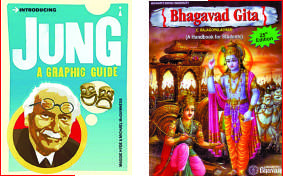
A graphic guide to the work of psychologist Carl Gustav Jung
Introducing Jung
A graphic guide
Author: Deep Trivedi
Publisher: Icon Books
Pages: 190
Rs 299
– Satish Purohit
Carl Gustav Jung, the psychologist, is our guide to new worlds of the mind. These worlds, being new, have beings that cannot be explained by our language. They are the stuff of magic, of charm and incredible magnetism, and because they are within us, they often escape out of us into the world and colonise our world with their craziness.
I heard first of Jung in college. He came immediately after Freud and made even less sense than Freud. For me, Jung is like Freud, Eric Fromm, the psychologist, Joseph Campbell, the mythologist, Sri Aurobindo, David Frawley, and Kavyakantha Ganapati Muni. I cannot make complete sense of what they have to say, in part because the mere expanse of their thought makes me breathless and in part because, despite the abstruseness of their subjects, the light of what they are saying only comes to me in short bursts.
That said, every ray of light thus coaxed from their writing is worth the years of knocking at their door, which is something that brings us to why the book being reviewed deserves to be read. One, it is a graphic guide, which means there is little to read and a lot to see. The entire book unfolds before the eyes like a film. Two, the book introduces us first to Jung as a Swiss child, back in the 1870s, sitting on his own ‘secret rock’ and had thoughts like “Am I the one sitting on the stone? Or am I the stone on which ‘He’ is sitting?”
The story chronicles Jung’s engagement with Christianity, with Christ, and the Jesuits. It also mentions his maternal grandfather who conversed with the spirits, as did his mother, and how his mental life was shaped by his attitudes towards Paganism and Christianity.
When he died in 1955, Jung had become a force that, to this day, continues to uproot, illuminate, and disrupt minds in disparate fields like cinema, psychology, literature, theatre, art, and product design. His work leads us to discover our light and also notice the shadow cast by the very same light and the darkness surrounding the area illuminated by that light. We understand that we are not just the subject of the illumination but also the light trained on it, as well as the shadow and the darkness with its fairies, goblins, demons, and devils. To accept this and embrace it, is the way to wholeness, says Jung.
What does this mean?
You tell me.
Little Arjuna, awake!
Lord Krishna speaks to the contemporary child battling in his personal Kurukshetra
Bhagavad Gita
A handbook for students
Author: C. Rajagopalachari
Publisher: Bharatiya Vidya Bhavan
Pages: 128
Rs 90/-
Satish Purohit
Mahatma Gandhi called C. Rajagopalachari, who was fondly called Rajaji by his admirers, his ‘conscience keeper.’ Rajaji was a freedom fighter, politician, administrator, spiritualist, social reformer, and prolific writer on a wide variety of subjects in English as well as Tamil. The book being reviewed has been written for students who Rajaji felt (in 1963) were too enamoured of Western ways and knew too little about Indian wisdom traditions. This handbook for students was his contribution to the combined effort required by all right-thinking Indians according to him. Of the 700 shlokas in 18 chapters of the Gita, the book highlights 226, which, the author says, are enough to convey the essence of the instructions given by Lord Krishna to Arjuna as he lay down his arms and refused to fight.
Rajaji says the Bhagavad Gita should be read as a manual for training the mind to choose a path aligned with righteousness without fear of the consequences. He points out that our ancestors speak to us through the Gita, which is not novel in what it says; the teaching synthesised in the Gita have their roots in the Upanishads. The Gita merely restates the old truths because Arjuna, who represents the human being in dilemma, has forgotten his duty under the crushing influence of his love for his relatives, guru, friends, and elders.
Without preliminaries, Rajaji begins with the words of Sri Krishna who declares that Arjuna’s grief at having to fight, subdue, and kill in a battle that has been foisted upon him is unfounded. Life in the body is temporary, says the Lord. The Self is eternal. There never was a time and never shall be when the fighter and the fought in any battle did not exist. The Lord says that knowing this, one should never shy away from a good fight. One must perform one’s dharma (duties) righteously without a care for the fruits (consequences) because it is the nature of all karmas to bear fruit.
Written almost in a conversational tone, the language of the book is simple and unadorned with heavy figures of speech. This is a book worth giving away in bulk as a birthday ‘return gift’ or a giveaway at a housing society function. So much awesomeness!

Discussion (0)
No comments yet. Be the first to comment!
Leave a Comment
You need to login to post a comment.