
Staying as I am
Pradeep Krishnan has an interesting and enlightening conversation with Shri Rajiv Kapur, a master who is carrying forward the legacy of Bhagavan Sri Ramana Maharshi
Reading some of the articles and listening to several talks on the internet of Shri Rajiv Kapur, a businessman turned enlightened master, prompted me to contact him in Hyderabad, where he lives with his wife, Smt Anita Kapur, and two children, Akansha Kapur and Aniruddha Kapur. Though lovingly addressed as Guruji by his students, he doesn’t like to be called a jnani, yogi, or guru. He prefers to be recognised as only a fellow sadhaka (seeker), divine friend, or simply as Rajivji or Rajiv. The 50-year-old master regularly conducts live and online satsangs (spiritual gatherings) and retreats, writes articles and books, and grants private sessions to seekers all over India and abroad.
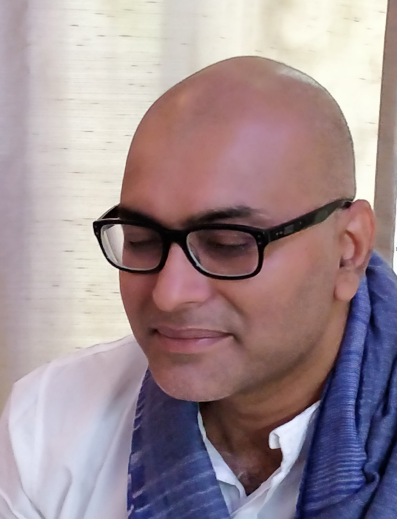
When contacted, Rajivji at once consented to an online interview. The presence of an enlightened master and his humble manners and joyful face lifted my mood.
Sir, please describe your mystic journey. Let me first acknowledge with deep reverence, all the great masters, my gurus, and specifically Bhagavan Sri Ramana Maharshi, all of whom have blessed me with abundant love, so that I am able to bring forth the teachings to those who are interested. With a deep sense of humility, I bow to each one of them.
As a schoolboy, at the age of 12 or 13, I used to sit with my eyes closed in my room, pondering what lay within this dark space inside my head. I had noticed that thoughts and stories appear and disappear from this inner space, but I wasn’t convinced that thoughts, images, and ideas were the only thing this darkness held within itself. So, I used to sit for hours on end, pondering over what lay beyond this darkness.
As a teenager, I noticed that my motivation to inquire deeper into the void (the darkness between my eyebrows in my third eye) was now intermittent, in that I felt drawn to the void but also to the world of attraction (due to maya). Around the age of 22, I was introduced to the book Autobiography of a Yogi and was deeply drawn, almost pulled into the path, and wholeheartedly decided to pursue the path of Kriya Yoga. I sat for hours in the morning and evening, often neglecting work, but somehow things automatically fell into place and were taken care of. I was convinced that all is provided for if we seek God alone and that He will look after everything. I had many mystical experiences too—related to the breath, the mind, energies, and the astral body—which no one could explain to me.
Without a personal guru, I felt lost at times, with my heart craving to connect with God. This was a very frustrating period, and yearning deeply for a personal guru, I often cried, feeling a great sense of abandonment and loss. Day by day, I felt so separated or cut off from divinity.
• How did your interactions with Shri Edward Muzikaji, a disciple of Robert Adams, happen?
Though a novice to Kriya Yoga sadhana (spiritual practice), by then, I had realised that a guru and shishya (disciple) must have personal interactions to meet the latter’s specific sadhana requirements. For several years, I searched for a personal guru who could guide me in the mystical world of Kriya Yoga and who could devote time and energy on a one-on-one basis, just like in the traditional guru-shishya relationship. Unfortunately, wherever I went, I could only see impersonal initiations and instructions.
Close Encounter 20
Finally, I met my Kriya Yoga guru, Sri Maheshwari Prasad Dubeyji, belonging to the lineage of Shri Panachanan Bhattacharyaji, the first disciple of Shri Lahiri Mahasaya. When I sought permission to host Him at my home in Mumbai, after some initial hesitation, He agreed to visit me. Then followed the most enriching and exciting one and a half months of my life. In His presence, I felt like a vast space engulfing both of us. Thoughts were hardly present, and they had no impact on me. I was blissed out most of the time, and my Kriya deepened. I had many experiences of spontaneous awakenings of cosmic light and inner sound, astral experiences, lucid dreams, etc. Unfortunately, Sri Dubeyji left his body soon, and I felt lost once again..
For a few years, though I continued the Kriya practices, seeking guidance from a few advanced disciples of Dubeyji, I felt incomplete. One day, while performing Kriya, I heard a voice inside my head saying, “Stop all this. Just BE.” I kept ignoring the voice, but the voice got louder and louder. Once I dropped all effort, an effortless state of pure joy and bliss enveloped me from within and without. My breath became totally still, and my heart almost stopped beating. I was in a state of indescribable ease and ecstasy. A friend and fellow sadhaka told me about Sri Ramana Maharshi’s teachings and said that I may be experiencing a non-dual state.
As I was not aware of Sri Ramana, someone suggested that I write to Mr Ed Muzika, a disciple of Shri Robert Adams, who was a direct disciple of Sri Ramana. Edji introduced me to the whole new world of Atma-vichara (Self
enquiry) and, ultimately, we co-authored the book Autobiography of a Jnani, describing the experiences of my three-month-long sadhana of being guided on how to abide in the Self everlastingly.
21 LifePositive | FEBRUARY 2023
• On your spiritual journey, you have met many masters, studied several techniques, and finally come to the path of Self-enquiry. How do you now consider your experiences on the different paths?
No form of sadhana is ever futile. All lead to God. The one who is earnest and dedicated will get whatever is needed at a particular time. Techniques don’t lead to the truth, but they may help break the deep-rooted patterns of the mind, which is habituated to flowing outwards. Once obstacles are removed, techniques too are to be dropped. As they say, one needs the boat only to cross the lake. Once it is crossed, there is no need to carry the boat along with you. It is the same with techniques.
• Why should one know the Self? Several books, talks, and techniques confuse the reader.
Sri Krishna described this world as ‘Dukhalayam Asasvatam’ (a temporary place full of miseries). Sri Robert Adams described this world as the lowest form of hell. Many masters and gurus have described the world to be so too. So, either take their word to be true or find out for yourself; the choice is yours. If you honestly and objectively look around, you will see it for yourself. Watch those who are only interested in the world, and watch those who are interested in the Self (while engaged in the world without attachment) and see the quality of their life.
The worldly man goes in pursuit of providing comfort and pleasures to the body, amassing wealth, and acquiring name and fame. In his case, he is surrounded by worries, anxieties, and troubles. That doesn’t mean one should become a recluse. Rather, one must definitely spend time daily withdrawing into the Self to enjoy the best of both worlds in a balanced way.
Then life can be a beautiful experience, not identifying with or attaching to anything other than Self or God.
Seekers are confused because instead of sitting quietly and dealing with the real issue within, they’re looking for answers in spiritual books, listening to talks, discussions, and debates. It is just more chatter and entertainment, feeding the mind with more ideas and concepts. Some may want to escape their pain and misery hoping that a guru or master will provide a quick fix to all their problems. As long as one doesn’t realise that all solutions lie within oneself and one doesn’t make the supreme effort to connect with ‘I-amness,’ the puzzle will remain unsolved.
• Is this connecting with the ‘I-amness’ called the process of Self-enquiry? According to Sri Ramana, the mind is nothing but a bundle of thoughts. Thoughts are considered obstacles to Self-realisation as they result in agitating one emotionally. He, therefore, advised that thoughts must be silenced or given up as soon as they arise and that one must not get carried away by them. And this has to be done by watching with a keen sense of alertness whenever a thought arises and by pondering To whom does this thought arise? This is the process of Self enquiry or Atma-vichara. In short, exclusively holding on to the sense of ‘I’ or ‘I am’ while ignoring thoughts is Self-enquiry.
Initially, the mind will resist moving inwards as it has a habitual tendency to indulge in thoughts concerning the world, but later on, it begins to ease itself within and isolate the ‘I am’ feeling. Once that is accomplished, then the practitioner needs to pause several times during the day to look at or feel the ‘I am’ to
maintain a connection with his sense of being. As one continues to hold onto this ‘I am’ state, the bliss deepens and all thoughts lose their hold and grip on the sadhaka. It’s all about how deep your practice is. An intoxicating blissful state will begin to be felt at the Heart centre, and one is effortlessly pulled back into the Self. A time arrives when one remains unaffected by anything happening in the world. The world is then known to be only a dream.
• Please describe the technique devised by you, the Advaita Soma Kriya Shakti (ASK), that is described as a systematic, scientific, and structured way of abiding in the Self permanently.
The ASK program comprises three processes: Churning, Burning, and Affirming. The Churning process is the act of separating the Self from the non-Self (world of objects.) Just as water mixed with milk still appears to be milk but is actually adulterated, similarly, the mixing of the Self with the non-Self creates mixed feelings about ourselves and the objects we come in contact with. Due to this mixed awareness, one is not able to express divine joy and happiness at all times. The Churning process, therefore, is to keep the life force, or prana, away from the mental attachment to sense objects and move it inwards towards the ‘I am’ feeling. In the Churning process, old habitual patterns resurface from the subconscious and begin to bubble up in the form of fear of losing out, anger, frustration, sadness, or old memories of lack. These emotions that are suppressed within our subconscious play a very big role in our lives.
The pure ‘I am’ sense often gets obscured due to these emotions hidden within us, and hence, we need to release them. That is done through the Burning process where we allow the emotions to arise and then embrace them
Close Encounter 22
without trying to get rid of them or wanting to modify or manipulate them in any way. We allow every emotion to run its course, without paying any attention to the thoughts that may simultaneously arise too. If we don’t resist the sensation or tension that the emotion creates within, we will be able to relax within a short time, and that emotion will ‘burn’ and get released. If we don’t burn our emotions, they will keep agitating our minds through thoughts. Notice how thoughts begin to race in our minds when we are emotionally overwhelmed. To effectively remove the obstacle of thoughts, we need to first burn these emotions and learn how to neutralise them. Once emotions settle, thoughts will automatically settle down too, and we can begin to feel the pure sense of ‘I am’ again. This is done through the Burning process.
Continuing with the Churning and Burning process, Affirming happens on its own. The fluctuations of the mind are greatly reduced and attention begins to stay centred around the area of the chest. An inner, intoxicating bliss and joy begin to surface, replacing ordinary emotions like fear and anxiety. Moreover, a natural state of love and trust for God or the Unknown begins to open one’s Heart. The Crown (top of the head), the third eye, and the Heart, all feel wide open, and one can feel very expansive, like space itself, desiring and wanting nothing. There is total contentment.’
• Is ASK, vis-à-vis Self-enquiry, preached by several masters, including Bhagavan Sri Ramana Maharshi?
How can I or anyone else dare to develop anything other than Sri Ramana’s teachings? Sri Ramana’s teachings are absolutely complete in and of themselves. The path of Self-enquiry, as advocated by Sri Ramana, is direct and
23 LifePositive | FEBRUARY 2023
simple to understand but it is not that easy to apply. You are asking the mind to remain absorbed in something called the Self which, for most, would remain an abstract concept, as most would just feel the body sensation or emotional state and nothing other than that unless one has the patience to persevere and make continuous efforts in that direction. Even Nisargadatta Maharaj kept holding the sense of ‘I am’ for three years before he was able to finally ‘get it.’
However, throughout the years of my teaching, I realised that not many can just ignore their thoughts and simply BE. There is so much rajas and tamas which keeps one wanting to do, do, do, seek, seek, seek, react, react, react! It’s difficult to ignore these tendencies due to past established patterns, and hence, these tendencies need to be exhausted. Emotions too need to be released as they stand between the mind and the ‘I am’ like a wall. One needs to break through that wall and reach the pure ‘I am’ feeling, or else they will keep piling up.
Today, everyone wants quick results and the market is flooded with New Age teachers promising instant Self-realisation. The fact is that the Self can’t be known unless one is committed to remaining silent and using all the tools to pull the mind inwards. The mind has to be repeatedly brought towards the Self, and unless one has trained the mind (disciplined it) or one is vigilant enough, how will that be possible? To be totally disinterested in thoughts will require vairagya (dispassion) and practice as well. They will need a programme that will motivate them to stay on course. The ASK program provides a systematic process by breaking down the Self-enquiry method of Sri Ramana into small steps so that it is easier to follow. In this programme, I have incorporated
breath work, positive affirmations, and letting go techniques, going deeper through the sitting meditations, so that the coverings around the Self get dropped and we can feel the ‘I am’ in its purest form.
• Why do you say that the teachings or practices of contemporary neo-Advaita teachers of remaining in the Self or being in the Now are neither intense enough nor deep enough?
Being in the Now, probably the only valid instruction or pointer given by neo-Advaitins, does indeed provide a glimpse of our true nature as it keeps the mind away from dwelling in the past and going into the future. By being in the present, the seeker experiences a limited sense of peace and freedom as it provides instant relief in some way due to the temporary stillness experienced by the mind. A state of Oneness and expansiveness with everything around us is experienced. However, this is just the starting point of the journey, a mini awakening. Neo-Advaita teaching is necessary and valid, much like the way kindergarten is to one who has started schooling. It is a good way to begin, but one needs to go deeper than the waking state experience of Oneness. Oneness keeps the illusion of the world as real. It is still within time.
The New Age teachers have no answer to the question “What happens to the Self post death?” Their understanding of the Self is restricted to the Now. If the Now disappears, should the Self also dissolve? That’s not accurate because every scripture has described the Self as Akshara, which means ‘indestructible.’
Nisargadatta Maharaj had repeatedly pointed out that “prior to consciousness,” or the Absolute stateless state, cannot be known in the Now. Turiya, the fourth state beyond the deep sleep state, can be realised only by withdrawing the
life force to go beyond the five senses, through meditation or by keeping the body still in one place. The neo-Advaitins do not mention the need for meditation, putting in effort, following disciplines, moderation in sense enjoyment, and the spiritual qualifications laid down in traditional Vedanta, such as viveka (discrimination), vairagya (dispassion), mumukshutvam (burning desire for freedom), and Shad Sampatti (the six disciplines.) That’s why I am of the view that the neo-Advaita teachings are not deep enough.
• How do you view different types of practices such as Japa (meditative repetition of a mantra), dhyana (meditation), and Karma Yoga prescribed in several texts?
All such preparations are valid as each helps the mind to go within. I am fine with mixing different forms of sadhana, so long as the goal is to remain in the Self. Just as a worldly man procures different objects to please his senses, one should be open to adopting different methods for the soul.
• As you wrote, today’s spirituality has almost become a marketplace with so many teachers offering different things, often contradicting each other and absolutely confusing the seeker. What is the way out?
The market is flooded with teachers because there is a great demand for seeking to awaken from this dream world, manifesting wealth, improving one’s health or relationships, or indulging in entertainment. A real guru points out that the source of all seeking lies within one. When life becomes difficult, the inner search begins. The way in is the only way out to realise God, the Self, or the Divine Intelligence, the ultimate solution to all problems.
• Your message to the readers?
God loves you.
Discussion (0)
No comments yet. Be the first to comment!
Leave a Comment
You need to login to post a comment.