
The high priest of pirposeful living
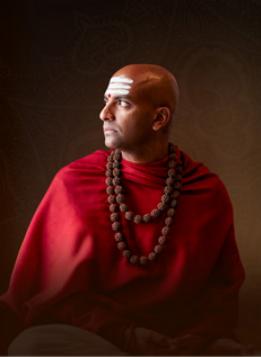
Dandapaniji talks with Navni Chawla about finding meaning and purpose to life and living in alignment with it to make the most of our time here on this planet
As I entered the hotel lobby where
Dandapaniji was staying, I saw him coming out. He told me he had just finished another interview. Seeing his enthusiasm, we straight away started looking for a place to conduct his second interview for the day, which was with Life Positive. We went to an outdoor area
with less noise. He politely asked if I wouldn’t mind doing it on the staircase since it was in the shade and away from people; hence, quieter. I instantly agreed, my heart filled with joy and gratitude to be with this humble yet renowned man who trains world-class athletes, sitting beside me on the staircase, eager to answer my questions.
• What do you do
Dandapaniji?
I was a monk for 10 years after which I left the monastery I was in. I am a Hindu priest now. The biggest difference between a monk and a priest is that as a monk one practises Bhramacharya and does not earn money, but as a Hindu priest, one can get married—which I did. And I have a four-year-old daughter.
\
All answers are inside you
I work as an advisor to entrepreneurs and athletes. I train them to understand how the mind works, how to leverage that understanding, and to focus their mind to get better at what they do.
[I read his book The Power of Unwavering Focus, in which he emphasises the importance of living a purpose-focussed life. Since I was so interested in that subject myself and also thought talking about purpose will resonate with a lot of people, I asked him about it.]
• How does one find their purpose in life, especially if they are lost or clueless? I would say spend five minutes every day in a
conversation with yourself. Most people don’t know what they want in life because they don’t know themselves. Most people don’t sit down with themselves and ask questions like ‘Am I happy?’ ‘What do I want?’ ‘What am I passionate about?’
Every day, you can set up a meeting with yourself and have a conversation of enquiry (not a meditation). Eventually, you will begin to realise what is important to you, and that will lead you to your purpose in life. Spend five minutes every morning and reflect on ‘Am I really happy where I am today in my life?’ ‘Am I going where I want to go?’ You may not have all the answers right away, but when you ask yourself the same questions every day, more answers will come from within you. No answers are outside you; all answers are inside you. It is a matter of really trying to extract that information. Businesses do this, for instance, when branding companies are hired to brand a company. They go to the company and ask them tons of questions: ‘What is the company culture?’ ‘How do you upgrade?’ ‘What’s your vision?’ ‘What are your core values?’ They keep asking these questions over and over and then they take all this information, distil it down, and come up with a brand, a colour, a font style and size, a logo, and a whole depiction of the company. All this comes after so much enquiry. Essentially, we are branding ourselves when we are trying to find our purpose in life. We need to go through the same process. Some people are patient enough, but most people don’t care enough to take the time to do it.
[As I was super impressed by Dandapaniji’s book, I referred to it again in the form of my next question. I told him that he mentions in his book that intuition comes from the superconscious part of the mind, and it must pass through the subconscious mind for us to perceive it. But a cluttered subconscious would
make it difficult for intuition to get through.]
• How can we de-clutter our subconscious so that intuitive information can be downloaded easily into our conscious, sensory, intellectual mind?
I would say that one of the first things is to be very conscious of what we consume. A conscious mind is like a memory bank. Let’s take an analogy: Imagine you have a room in your house that you want to turn into a library. Every day, you put 10 books in the library. You don’t organise, label, or index them. You are just stuffing information in there, and after a year, 3,650 books will be accumulated in your library. Will it be easy to find anything there? In today’s world where we consume so much information,
our subconscious is like that room. Instead 
LifePositive | JANUARY 2023
of putting high-value books, we are putting a thousand books, podcasts, Instagram reels, YouTube videos, TikTok videos, and whatnot in our subconscious mind, and we think we are learning. But actually, we are not! All we are doing is gathering information. Books and information are useless unless practically applied. After a few years, 4
what happens is that you have a huge amount of clutter in your subconscious and you don’t even know where to begin. So how can you make a decision?
So, from that pile, you have to organise everything one by one. And that’s why when you ask every 18-year-old or 35-year-old “What do you want to do with your life?” they say they have absolutely no idea because their subconscious is so cluttered. We consume content indiscriminately regardless of whether it is harmful to us or serving us. If you keep accumulating trash in your mind throughout the years, there will be no room left for something of value. We think information or knowledge is wisdom, but it is not. The timely application of knowledge is wisdom. If I can apply my knowledge to do something at the right time, then it is useful. People just fill their heads by going to YouTube and listening to what others are saying. While they assume that by doing this they are learning something new, they are doing nothing but just confusing their subconscious. And therefore, it is critical to know what you really want in life. By knowing what you want, you know how to say no and what to say no to! Once you know what you want, you can focus more easily and also see clearly the things that you don’t want.
[This answer shook me and made me introspect: But what if someone doesn’t know what they want; what about them? How will they find their purpose? How will they come out of the meaningless meandering? Which led to my next question.]
• How does someone who lacks focus and Close-encounter 21
The characteristic of intuition is that it tells you only one time; it never repeats itself. It is always concise and precise, brief and clear. It will never tell you again that now you need to be obedient and listen to it. Another indication that you are functioning in the superconscious area of the mind is that you have really good timing; timing is immaculate. Obedience is needed with intuition. When you clearly hear a precise voice in your head just follow it. That’s the rule.
has a hyperactive mind recognise their own voice from all the noise in their head?
I would say two things here: One has to have the desire to know oneself. And this is where 99.999 per cent of people fail. Since they don’t want it badly enough, they never pursue it. Secondly, if someone has too much clutter inside their mind, then I would say find a mentor or a teacher who will help you go from A to B. But how do you identify a real guru from a fake teacher? The right type of teacher should be able to clearly define for you a goal and the steps to reach that goal. A true leader can paint a very clear picture of the vision of your goal or target. The hallmark of a good teacher is that they do not intend to inspire you; they just outline the steps for you to reach your goal and help you whenever you are stuck. [In his book Dandapaniji often refers to the superconscious part of the mind being the purest. I wondered if we could ever tap into that part of us. Wouldn’t that make our lives more illuminated? And so I asked my next question.]
• How can one train their subconscious mind for it to work in harmony with the superconscious mind?
Our superconscious mind is like a wise person. A wise person will go to a library, look at the right resource, consume it, and use that knowledge to create something. If the superconscious mind has a messy library or subconscious how will it extract the right information to guide us? It can’t. So, for us to be able to access the superconscious mind, it is very important to cleanse our subconscious first. When the subconscious is organised, it is very easy for the superconscious to go in there and say that it needs such-and-such information, grab that information, and then create.
Ultimately, in the deeper understanding, the superconscious doesn’t really need the subconscious to work. When your subconscious is disorganised, you ignore even a flash of intuition. Children should be trained from an early age not to clutter their subconscious mind by stuffing it with unnecessary information.
In ancient India, they would not cultivate intellectual learning for women; they would give them basic education, and beyond a certain point, the women would not develop their intellect. Instead, they would send the girls to learn the arts because this discipline works more with the superconscious and intuitive mind. For women, it was important to be in touch with their intuitive self because if they were more intuitive, they could guide the family. If the intellect is overdeveloped, reason
Close-encounter 22
takes over everything else, and one ignores intuition and never listens to it. In ancient culture, women guided society although men were at the forefront. But women would tell men what to do at home when they fed them. They would tell men some great ideas. The shakti (energy) and stability of a woman bind the household together. The right thing to do flows from the intuitive side of the mind.
And so it is important to cultivate intuition. Reason will not always guide you correctly.
• What would you suggest to, say, a four year-old to help them develop their intuition early on?
I will teach them about the awareness of their mind. I will tell them about moving the awareness to different areas of the mind, like I tell my own three-year-old daughter. Once her mother was upset about something, and she said “Amma, take your awareness to the happy area of the mind.” And now I am teaching her about the superconscious and how to identify it. Cultivating an interest in the arts also helps, like music and dance. These two are close to
the superconscious but this doesn’t hold true for all music. The first step is to understand how the mind works and know the difference between intuition and intellect. The latter is always reasoning ‘If I do this, this will happen and that will happen’ and so on and so forth.
The characteristic of intuition is that it tells you only one time; it never repeats itself. It is always concise and precise, brief and clear. It will never tell you again that now you need to be obedient and listen to it. Another indication that you are functioning in the superconscious area of the mind is that you have really good timing; timing is immaculate. Obedience is needed with intuition. When you clearly hear a precise voice in your head just follow it. That’s the rule. Shut up and do what it says. It will never ever guide you wrongly.
• What is your view of God?
Hinduism believes there is only one God. There are many angels and great angels, (devas and mahadevas). We have millions of them, but only one God. God is one pure energy (Divinity) permeating everything. How do you get to know God? Have a shrine at home or go to the temple, make an appointment with God, and spend time with him. Every day, spend some time with God, offer a flower, and say “Thank you.” Go to him when everything is fine, not only when you need something. Build a relationship with God. It’s a two-way street. You come half way and God comes half way; you both meet in the middle and that’s where the magic takes place. Talk to your God like you talk to a friend. For me, God is so much of a friend that I want to go to see him.
Once in a while, ask Him, “What can I do for you? How can I serve you?” And then a relationship starts to build between you and God. But you should not have a lazy, passive, and non-responsive approach towards God. Take ownership for your life. God is there to assist you, not to live your life. Open yourself to the possibility of failure or success. Don’t be afraid to fail. Only when you fail, will you succeed. You have to fail many times before you succeed.
• Is there a personal practice that you recommend to someone who seeks your advice?
I always ask “What do you want to achieve?” Your goal defines what practice is good for you.
• What is that one piece of advice for young people who are so distracted by social media and are consuming information off the web?
Consume information only from the people who have real-world success, for example, somebody who has built a company from zero to two billion dollars; the best people in their professions, like the best actors in Bollywood; national cricket team players; best of the athletes; etc. Get rid of all that is not aligned
24 LifePositive | JANUARY 2023
with your dream. Put all your energy into what you want to create. What inspires you, write it down and remember it over and over again until it becomes your core value.
• How can decision-making be simplified? Decision-making should be driven by purpose. Once you know your purpose in life, decision making becomes easy. And also de-cluttering the subconscious mind helps, which we have spoken about earlier.
• How can one enhance their creativity? Creativity comes by managing your energy appropriately and not allowing it to leak. When you channel your energy and redirect it to the things you want to do, then your creativity will blossom. Don’t waste your time on things that are inconsistent with your goals in life
• How can one improve consistency? Consistency lies in small steps. Taking small and doable steps every day is the key here. That is the power of a small and sustainable approach in life. Consistency is also driven by love.
On a personal note, this was by far the sweetest interview I conducted. Dandapaniji was patient, kind, and gracious with all his answers. He gave simple answers to all my questions, and I am sure they will be useful and easy to grasp by anyone who reads them. His humility made me realise that it was one of the highest virtues and the hallmark of a high value man. My personal takeaway was to have a laser-beam focus in life to achieve my goals. Danadpaniji’s gentle demeanour can warm the cockles of anyone’s heart. We hope that our readers benefit the most from his wonderful insights and beautify their lives.
Discussion (0)
No comments yet. Be the first to comment!
Leave a Comment
You need to login to post a comment.