
The saint reformer
Jamuna Ragachari introduces us to Sri Ramanuja, who propounded one of the three main schools of Vedanta. He broke away from the prevalent Advaita tradition to promote Vaishnavite bhakti in a big way
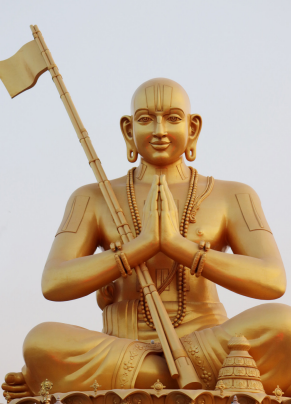
On April 25, 1077 CE, in Sriperumbudur (in today’s Tamil Nadu) to Keshavasomayaji and Kantimethi Devi.ssri Ramanuja was born. He founded Vishishtadvaita Vedanta, which is a non-dualistic school of Vedanta philosophy.
According to him, it is the non dualism of the qualified whole, in which Brahman alone is seen as the Supreme Reality but is characterised by multiplicity. It is a philosophy taken from ancient wisdom which believes in all diversity reaching an underlying unity. In other words, he averred
that the Upanishads, the Bhagavad Gita, and the Brahma Sutras are to be interpreted in a way that shows this unity in diversity, for any other way would violate this consistency. He wrote nine literary texts in Sanskrit including Vedartha Samgraha, Sri Bhasya, and Gita Bhasya, and was considered a king of sanyasis.
Sri Ramanuja founded the non-dualistic school of philosophy
Sri Ramanuja accepted that any Vedanta system must base itself on the Upanishads, the Brahma Sutras (a brief exposition of the major tenets of the Upanishads), and the Bhagavad Gita. He has explained in detail the method of understanding the Upanishads in his Vedartha Samgraha (Summary of the Meaning of the Veda). He also wrote a commentary on the Brahma Sutras, the Sri Bhasya, which presents his fully developed views, and a commentary on the Bhagavad Gita, the Gita Bhasya.
Sri Ramanuja’s influence on the course of Sanatana Dharma has been great. By talking about devotional worship in his doctrine on salvation, he aligned popular religion with the pursuits of philosophy and gave bhakti (devotion) an intellectual basis. The devotional poems and songs of the 7th–10th century poet-mystics of southern India, called Alwars, became incorporated into temple worship. This kind of devotionalism, guided by Sri Ramanuja, made its way to northern India, where its influence on religious thought and practice has been profound.
Sri Ramanuja accepted the reality of three distinct orders: matter, soul, and God. Central to this philosophy—the organic view of the universe— is the analogy of the body and soul: just as the body modifies the soul, has no separate existence from it, and yet is different from it, so does the order of matter and soul make God’s ‘body,’ modifying it, yet having no separate existence from it. He always maintained that the goal of the human soul is to serve God as it is part of the divine cosmos.
Ramanuja embraced devotion towards Lord Vishnu as the real path even though he was brought up on Advaita philosphy
Sri Ramanuja transformed the practice of ritual action into the practice of divine worship and the way of meditation into a continuous process of loving and thinking of God. Recently, a statue honouring him was installed in Telangana to let everyone know the power of Sanatana Dharma as propounded by him. Even the former chief minister of Tamil Nadu, the late Karunanidhi, though an atheist, wrote a script on him and stated, “Ramanuja showed through his life that the oppressed and backward communities are not to be hated or sidelined and accepted as brothers.” The television serial based on this script was viewed by all, especially Tamilians, who reconnected to the great seer.
Essentially, bhakti towards God is required for all is the message of Sri Ramanuja, which is eternally relevant.
A bhakti-oriented social reformer
Sri Ramanuja was a social reformer long before (in 1017) the term was used to signify the empowerment of all. Sri Ramanuja overcame many challenges to protect his Vaishnavite beliefs. He was born in the south in what is now known as Tamil Nadu. He was taught in the Advaita tradition, but his profoundly religious nature was soon at odds with a doctrine that offered no room for a personal god. He embraced bhakti towards Vishnu as the real path to seek God and asked people of all castes and creeds to do the same. A significant follower was King Bittideva of the Hoysala empire
It is said that Sri Ramanuja, being a Vaishnavite, was not supported but traumatised by King Kulottunga of the Chola dynasty, who was a staunch Shaivite. This made him go to Mysore in the west of Tamil Nadu. There were many people, especially Jains, who took to his path. A significant follower was King Bittideva of the Hoysala empire who founded Melukote (Melkote, present Karnataka state) and dedicated a temple to Shelva Pillai (in Sanskrit, Sampatkumara, the name of a form of Vishnu). This is still a common pilgrimage spot for all Vaishnavites.
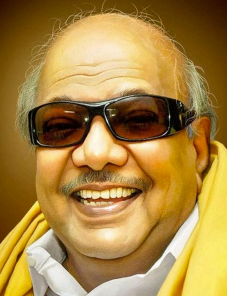
The late M Karunanidhi, even though an atheist, praised Ramanujam
Sri Ramanuja did not want to be outside Tamil Nadu always. He returned to Srirangam in Tamil Nadu after 20 years, where he organised temple worship, and founded 74 centres to disseminate his doctrine. A classic story of the temple in Srirangam is a shrine devoted to a Muslim devotee called Tullakka Nachiyar for her devotion, where prasad (offering) is served by the priests, for, as per Sri Ramanuja, bhakti is the best service we can perform for God, and all bhakts (devotees) are to be accepted into the fold.
Vaishnavite bhakts today The late Sriram Bharati, who was Harvard-educated and lived in the USA for some time, left everything, came to Rohini Sriram is dedicatedly following the footprints of her late husband
This has resulted in many India, and dedicated his life to the service of God by building a temple on the outskirts of Chennai and by following the Bhakti Marg with his wife Rohini. He could sing melodiously many devotional songs with full bhakti. Though he passed away at a fairly young age, his legacy lives on, showing others that walking the path of bhakti and treating mankind as the Lord’s children according to the principle of Vasudeva Kutumbakam, as taught by Sri Ramanuja, could well be the shortest route to salvation.
This was a clear example in my life where someone who was extremely intelligent, highly educated, and lived in the USA, finally found complete solace in bhakti and service to the lord and humanity.
Sriram’s wife continues to live the same life today and believes that there is no greater joy than being in the service of the lord and humanity. She is showing the way to all, the Vaishnavite way. While singing the hymns, she also explains the attending her classes from all over the world. They have found direction and solace through the teachings.
Bhakti is a tremendous force that we can dip into to become more powerful to change ourselves and, in the process, the whole world, as many masters have shown us. This is the way all positive change happens; so we can certainly take at least one step forward by taking a leaf from the wisdom of modern seekers like Mr. and Mrs. Bharati and aiming to be like them.
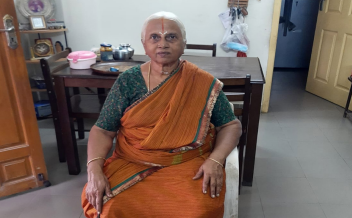
I was blessed to visit the temple when it was consecrated and was amazed by the devotion that Rohini Sriram showed while doing their chores. spiritual truths that all the saints conveyed through their hymns and lives. “We all have the divine in us but need to identify a saint as our God, for just like we need a mother and father, we need a God too, else we may go on the wrong path,” she says, while quoting examples from the Ramayana and those of saints.
Rohini says that we always face challenges in life and that is why we need to adopt the right values and principles to tread the right path. It is possible when we look around, as well as within, and connect with our scriptures.

Discussion (0)
No comments yet. Be the first to comment!
Leave a Comment
You need to login to post a comment.