
Together we can
March 2010
By Sharukh Vazifdar
How important is society and conforming to its norms? Can there exist a community based on different values and goals? Alternative communes give you something to think about
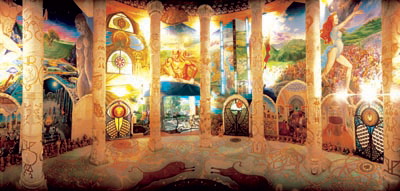 Masterpiece: The Temples of Humankind at Damanhur Masterpiece: The Temples of Humankind at Damanhur |
Right from Biblical times, and even before that, the concept of paradise has intrigued our minds. Utopia, Shangri-La and paradise have engaged scholars, explorers, theologians and literary figures alike. Utopia, coined by Thomas Moore in the 16th century, signifies a perfect society living in complete harmony with itself and its surroundings. Ironically, the word means having no known location, an impossible ideal that can only be dreamt of.
Disillusioned by the shallowness of their everyday lives, or in search for the deeper truths, many have attempted to form communes, which break away from conventional life, and allow an individual to live on their own terms. These communes, also called intentional communities, consist of people living together sharing common interests, property, possessions, resources, work and income. A world away from the free love, aimless and haphazard hippie communities that we might associate with the term, these communes are well planned, peaceful and with a strong sense of purpose.
Different communes align themselves in different directions. Some are religious communes, such as monasteries, or ashrams, some are spiritual communes, some are ecological communes or ecovillages, while some are just a breakaway from the fast-paced lifestyle. The members are united by shared ecological, social-economic, and cultural-spiritual values.
Ecovillages are intentional communities, with the goal of becoming more sustainable, socially, economically, and ecologically. Generally, of a small size of up to a hundred members, larger communities may exist as networks of smaller ones. An ecovillage is often composed of people who have chosen an alternative to centralised electrical, water, and sewage systems. Many see the breakdown of traditional forms of community, wasteful lifestyles, destruction of natural habitat, large scale farming, and over-reliance on fossil fuels, as trends that must be changed to avert ecological disaster. They see small-scale communities with minimal ecological impact as an alternative.
Auroville
Located just outside Pondicherry, a quiet little town on the south-western coast, Auroville upholds the spiritual tenets of Sri Aurobindo and the Mother. The Mother conceived Auroville, the ‘city of dawn’, in 1968 as a place of research into the ideal of human unity.
The idea is to build a futuristic city where people with goodwill can live together in peace and progressive harmony, rising above all creeds, politics and nationalities. It is endorsed by UNESCO and supported by the Government of India.
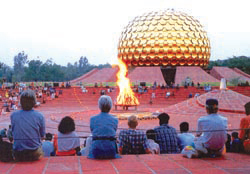 Gathering at the Matrimandir Gathering at the Matrimandir |
Today, the Auorvillans number over 2,100 from over 40 countries, and reside in more than a hundred settlements, spread over 20 square kilometres. The plan for the township is based on a spiral galaxy shape and incorporates four radial sectors – international, cultural, industrial and residential, and a surrounding green belt. The four zones have as their focus, a huge 29-metre high and 36-metre diameter globe-shaped structure at the centre of the township called the Matrimandir. It is regarded as the soul of the city, is a place for silent concentration, surrounded by an expanse of beautiful gardens. During the inauguration ceremony of Auroville, soil from 124 countries was placed in a lotus-shaped urn and mixed to symbolise universal oneness. This urn sits today at the centre of an amphitheatre in the Matrimandir gardens.
Around 125 commercial units and 70 service units now operate in Auroville. The activities include handicrafts, graphic design and printing, food processing, electronics and engineering, metalworking, windmill production, clothing and fashion, computer services, building construction and architecture. These units are expected to contribute a third of their profits to the ongoing development of the township, and have an important role to play in achieving eventual self-sufficiency for Auroville. Meanwhile, besides generating funds to assist the community in maintaining its basic services and infrastructure, the units also provide employment and training for large numbers of local villagers, enabling them to improve their standards of living and acquire valuable skills. At present, more than 4,000 local people are employed in Auroville, with considerable financial benefits to the surrounding area.
Timbaktu
Timbaktu Collective began in 1990, when a small group of development activists located themselves in a 32-acre plot of dry, degraded land in the Anantapur district of Andhra Pradesh, India. They gave it the name Timbaktu (Sarihaddu Rekha in Telugu – where the earth meets the sky). They wanted to find ways to heal and regenerate this ravaged land and create an agro forest habitat. Slowly over the years, not only Timbaktu, but also the surrounding hills, have greened, while insects, birds, and animals have reappeared. A small community of volunteers, committed to developmental and ecological regeneration, has settled here.
Navadarshanam
A decade of study, introspection and discussion among members of a study circle that used to meet at the Gandhi Peace Foundation, and the Indian Institute of Technology in Delhi, during the ’70s and ’80s, led them to the conviction that the urban-industrial way of life was leading to alienation of the individual from self, nature and the Creative Power. This was resulting in ecological destruction, increasing poverty, unemployment and unmanageable levels of social disintegration and violence. To get away from this vicious cycle, they felt the need to explore alternatives to the modern way of living and thinking. In particular, they felt the need to explore the possibility of a new kind of science and technology – a science that would recognise the realities of the spiritual dimensions, and concomitant technologies that would enhance rather than destroy ecology.
To give these ideas practical shape, the Navadarshanam Trust was created with 115 acres of land next to a small hamlet about 50 kilometres from Bangalore. This land was completely degraded and unproductive at that time. Through their efforts, they have revived the land and enforced a sustainable lifestyle.
By preventing grazing, the land has been converted from wasteland to a nascent forest, allowing thousands of trees to blossom. On the improved soil, in limited and carefully selected areas, fruit saplings and a few vegetables and cereals/pulses have been planted with minimum disturbance to those trees and bushes, which have come up naturally. Diseases are seen as ‘absence of ease’, caused by undigested food, which disturb the ecology of the body. The subtler (‘pranic’) forces responsible for restoring this ecology are encouraged to play their role more effectively by changing our food patterns such that digestion is easy and effective. Shunning the state’s grid supply, all power requirements, including that for pumping water and for lighting, is generated through solar panels and systems, wind power and also from oil made from the seeds of honge, one of the trees that nature has brought up in a big way during the regeneration process. Gobar gas (methane from cow dung), charcoal made on the land and wood stoves are used for cooking needs.
All dwellings at Navadarshanam have been constructed with the help of alternative technologies, using eco-friendly concepts (such as compressed mud blocks). The philosophy adopted has been to combine ecology with economy. The house designs maximise the use of nature’s bounties – the breeze is such that no fans are needed even in the summer months, and no artificial lighting is required during daytime.
Damanhur
Damanhur is an eco-society based on ethical and spiritual values, recognised by an agency of the United Nations, as a model for a sustainable future. Founded in 1975, it has about 1,000 citizens and extends over 500 hectares of territory at the foothills of the Piedmont Alps in Italy.
Damanhur offers courses and events all year round. It is possible to visit for short periods, as well as longer periods, for study, vacation or regeneration. Damanhur promotes a culture of peace and equitable development through solidarity, volunteerism, respect for the environment, art, and social and political engagements.
It has a constitution, a complementary currency system, a daily newspaper, a magazine, art studios, a centre for research and practice of medicine and science, an open university, and schools for children through middle school.
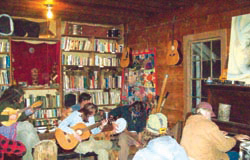 Musical session at Black Bear Ranch Musical session at Black Bear Ranch |
The Federation of Damanhur is also known throughout the world because its citizens have created the Temples of Humankind, an extraordinary underground work of art dedicated to the reawakening of the divine essence in every human being. The art studios that made the Temples are located at Damanhur Crea, a centre for innovation, wellness and research, open to the public every day of the year. The Temples have been built at a meeting point of the synchronic lines, the rivers of energy that link the Earth to the cosmos. The Temples – the Hall of Water, of the Earth, of the Spheres, of Metals, the Blue Temple and the Labyrinth – are like a large book of knowledge dedicated to universal spirituality.
Damanhurian medicine is preventive and synergetic as it makes use of numerous techniques suited to the person and the pathology, which are inseparably linked to the model of life practised. From home births to organic foods to pranatherapy to ‘Selfica’ to hypnosis to art in all its forms as therapy, to research into the divine essence within oneself, Damanhurians embrace a holistic model of health.
The citizens who chose the community formula live in large houses where nucleo-families are formed of around 20 people. In the same house, there are couples, couples with children, single people, young and old people living in the communities. This permits an exchange of experiences among all the different age groups.
Gaviotas
Gaviotas is an ecovillage of about 200 people located in the llanos, tropical grassland, of Colombia. It was founded in 1971 by Paolo Lugari who assembled a group of engineers and scientists in an attempt to create a model of sustainable living in one of the least hospitable political and geographical climates in South America.
It is estimated that, in pre-Colombian times, the llanos were an extension of the Amazonian rainforest, but the rainforest border has been receding from the area for centuries. The Gaviotas village is noted for the planting of over 1.5 million trees in the area. While the trees were originally part of an experiment to see if any significant growth could occur in the desiccated soil of the llanos, they have become a significant feature of the grasslands. Because of the shade these trees provide and the tropical climate of the area, the groundcover began hosting tropical rainforest species, which were once native to the region. Over the years, the pine trees have provided a shady understory for other plants and animals to thrive. Some of these species may be dormant seeds of ancient rainforest that once covered the region. The pines are slowly being crowded out by the regeneration of indigenous species. The presence of the forest has altered the local climate by generating an additional 10 per cent rainfall.
Resin harvested from the planted trees has provided Gaviotas with a sustainable source of income. While the village is largely self-sufficient, it regularly uses diesel fuel during certain seasons. Currently, a bio-diesel project is under way for market and local use. The community is generating power with turbine engines fuelled by the aging pines in their forest.
Black Bear Ranch
A group of people, who wanted to get out of the city, go back to the land and start a new life together in the mountains founded the Black Bear Ranch commune in 1968 in California.
Black Bear Ranch is a place for people to live together and share the joys, work and hardships of mountain homesteading. Day-to-day tasks include cooking, cleaning, gardening, gathering wood, building and maintaining structures and systems, caring for trees and natural features, welcoming visitors, attending meetings and participating in the communal process. Each year the ever-growing Black Bear family gathers at the ranch three times – at the summer solstice, for the Women’s Gathering and for Thanksgiving. It is a place for people to live together and share the joys, work and hardships of mountain homesteading. A spring supplies the ranch with year-round cool water, and organic gardens, fruit and nut trees help provide some of the food.
“Each individual is as diverse and different as night from day. The transition from a major city like New Orleans to mountains and forest was dramatic. I felt closer to my God and with nature immediately. I slowed down. I found a comfort zone to exist in, which was not available to me in the city. I have learnt many skills, both physical and social, from folks half my age,” says Thatch, a resident at the ranch.



Discussion (0)
No comments yet. Be the first to comment!
Leave a Comment
You need to login to post a comment.