
UTTHITA TRIKONASANA
May 2000
By B K S Iyengar
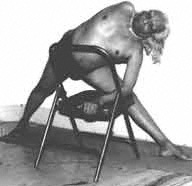
This is a well-known standing pose and can be practiced safely by one and all (except by women during menstruation) and always on an empty stomach. ‘Utthita‘ means extended and ‘trikona‘ is a triangle; the pose literally is the extended triangle pose. In the classical pose, you will see that the body makes three triangles.
 |
The classical pose
1. Stand with the feet, ankles and toes together as in Tadasana.
2. Jump and spread your feet about three to three-and-a-half feet wide, with the feet pointing forward. The arms should be stretched in line with the shoulders.
3. To perform the pose on, say, the right side first, take the right foot out sideways (90°) and the left foot slightly in.
4. Exhale and bend the trunk sideways, bringing the right palm to rest on the ankle or near the outer ankle on the floor. Ensure that the knee (and the entire leg) remains firm and stretched.
5. Stretch the left arm straight up, in line with the right shoulder, and revolve the spine and chest well. The head, the back of the chest and hips, and the back of the legs should be in one plane.
6. Stay for half-a-minute to a minute with normal breathing. Then come up and repeat the pose on the other side.
Technique with props
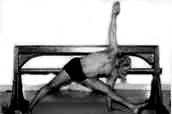 |
All classical poses demand tremendous discipline and practice. It is difficult for many with stiffness to reach the final pose. They need not lose heart. There are various steps and supports which can aid the practitioner to achieve the pose. One of the ways in which utthita trikonasana can be done is with the support of a trestle (as shown). One can also do the same pose against a wall or window (with bars). When doing it against the window or a trestle, ensure that you hold the window or the trestle and revolve the chest well. For those with stiff hamstring or leg muscles and severe back problems, do not try to reach for the floor directly, but place the hand on either the shinbone, or a brick or small stool.
Benefits
• Utthita trikonasana is a very effective pose for hip and leg deformities, groin injuries, sciatica and spinal compression.
• It tones the legs (especially the hamstrings), the trunk and chest, and strengthens the pelvic region and the organic body.
With sufficient practice, the practitioner can begin to access the inner tissues and cells, thus transforming stiffness into fluidity. Gradually and with time, utthita trikonasana becomes a metaphor to achieve the trine of body, mind and soul and merge it with the trine of satyam (truth), shivam (purity) and sundaram (beauty).
Discussion (0)
No comments yet. Be the first to comment!
Leave a Comment
You need to login to post a comment.