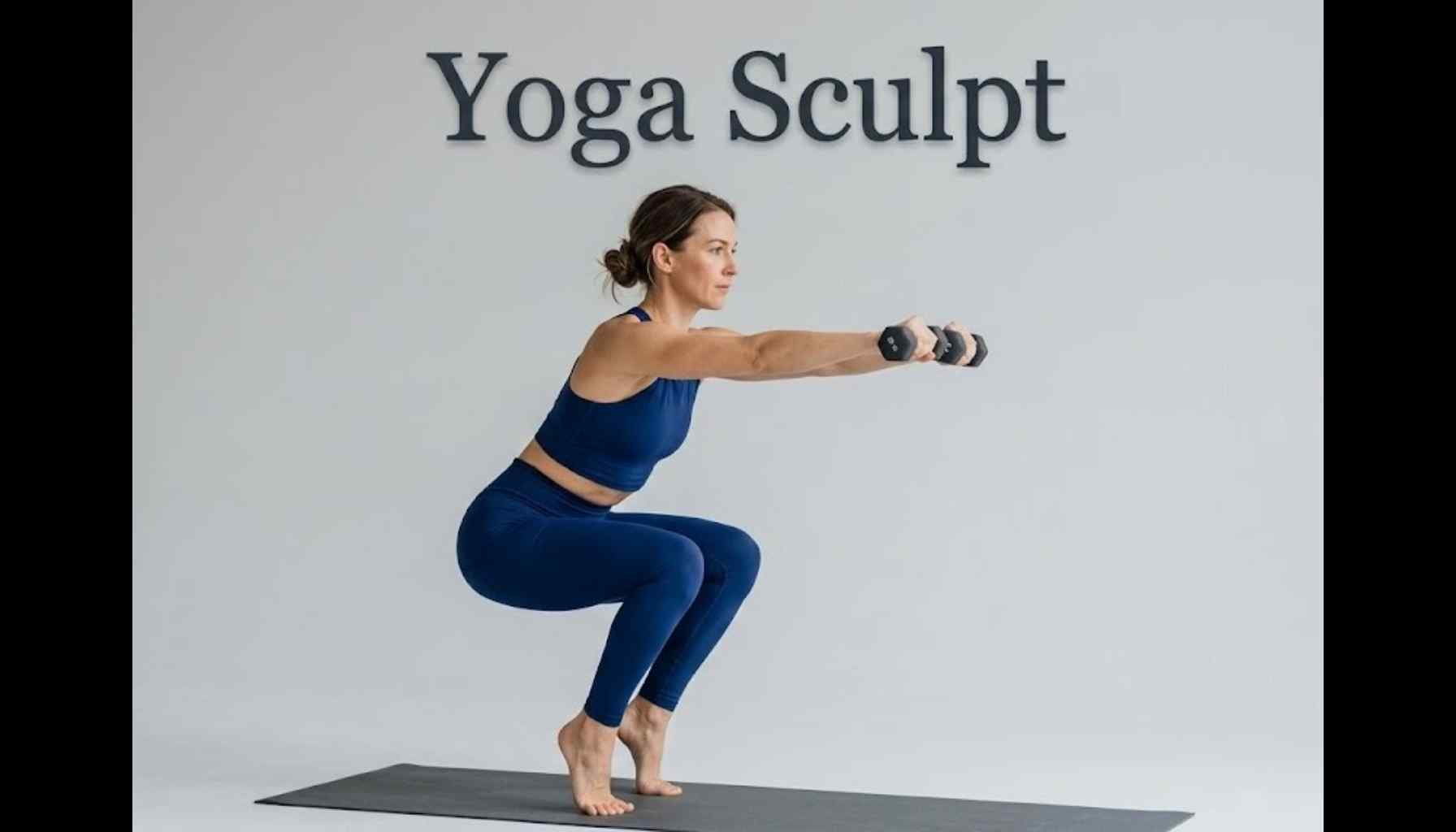
What Is Yoga Sculpt? Powerful Benefits and What to Expect
You have probably seen it on a studio timetable, wedged between vinyasa and a spin class: yoga sculpt. So, what is yoga sculpt, and is it really yoga? The short answer is that it is a yoga-based workout with light weights and cardio bursts added, usually set to music.
This guide explains how a class runs, how it differs from the styles you already know, what the research can and cannot promise, and who should take extra care. No hype, only what helps you decide whether to roll out a mat.
Key Takeaways
- What is yoga sculpt? A flowing class that mixes yoga poses, hand weights, and short cardio bursts, sometimes in a warm room.
- It builds muscular endurance and fitness more than raw strength, because the weights are light.
- Claims about boosting metabolism or burning fat go further than the evidence, and very little research tests the class itself.
- Heat is optional. If your room is heated, drink water and ease off when you feel dizzy.
- Choose weights you can control. If your form falls apart, go lighter or put them down.
- Check with a doctor first if you have a heart condition, are pregnant, or are recovering from an injury or surgery.
At a Glance
- Class length: usually about an hour
- Level: beginner-friendly when the teacher offers modifications
- Kit: a mat, a towel, water, and light dumbbells, which many studios provide
- Heat: varies by studio, so ask before you book
What Is Yoga Sculpt?
Yoga sculpt is a group fitness class that keeps the shapes and breathing of yoga but adds resistance and cardio. You move through standing poses and flows while holding light dumbbells, then pause for quick bursts of faster movement that lift your heart rate. Most classes finish on the floor with core work and a short rest.
Think of it as a hybrid. The structure borrows from vinyasa, the weights borrow from the gym, and the cardio bursts borrow from interval training. The music is usually louder and the pace brisker than in a traditional class.
You may also see it described as yoga with weights, or tucked under labels such as power or fusion. Studios differ, so one session may feel closer to a strength workout and another closer to a flow.
Where yoga sculpt came from
The question “what is yoga sculpt?” has no single founder and no single answer. Writers trace it loosely to power yoga, the vigorous flowing style that grew out of Ashtanga in the nineteen-nineties. Large studio chains then popularised weighted classes in the early two-thousands, and the format spread from there.
There is no official definition, which is why a class in one city can feel quite different from a class in another.
How a Yoga Sculpt Class Unfolds
A typical session lasts about an hour and moves in waves rather than in a fixed order. Here is what those waves usually feel like.
- The warm-up flow. Sun salutations, gentle twists, and joint circles bring up body heat before any weight appears.
- The weighted rounds. You pick up dumbbells and pair familiar poses with arm and leg work, such as a lunge with a shoulder press or a chair pose with biceps curls.
- The heart-rate spikes. Between rounds, the teacher calls short bursts such as quick step-backs, squat jumps, or fast flows. Good teachers always offer a low-impact version.
- The core finish. Floor work for the abdominals and back, often with the weights set aside.
- The cool-down. Slow stretches and a final rest let your breathing settle.
Music matters more here than in most yoga rooms. It sets the pace, and many people say it makes the hard parts easier to push through.
Beginner Moves to Try
Try a lunge with a shoulder press, a chair pose with biceps curls, and a plank with alternating rows. Use light weights and slow control. Each move has an easier option, so choose the version that keeps your form steady.
- Lunge with a shoulder press. Step wide, bend the front knee, and press the weights overhead as you rise. To modify, shorten the step, lower the lunge less, or press with no weights at all.
- Chair pose with biceps curls. Sit your hips back as if lowering onto a chair, keep your knees over your ankles, and curl the weights with your elbows close to your ribs. To modify, sit higher or curl without weights.
- Plank with alternating rows. From a steady plank, draw one weight toward your ribs at a time while your hips stay level. To modify, lower your knees to the mat or set your feet wider for balance.
Wrist and shoulder modifications
Weighted flows load the wrists and shoulders, which are the common trouble spots. A few small changes make a big difference.
- Wrists. Hold the dumbbell handles in plank so the wrist stays straight, drop to your forearms, or move to your knees. Spread your fingers and press through the whole hand rather than the heel of it.
- Shoulders. Keep overhead weights light, stop the press at a height that feels comfortable, and draw your shoulder blades down your back. If a press still pinches, swap it for a front raise or lift without weights.
- Either joint. Sharp or lingering pain is a signal to stop. Tell the teacher before class so they can suggest alternatives.
What Is Yoga Sculpt Next to Other Workouts?
If you are still asking what is yoga sculpt in practice, comparing it with styles you know helps.
|
Feature |
Traditional yoga |
Power yoga |
Yoga sculpt |
|
Main aim |
Flexibility, calm, body awareness |
Strength and stamina through bodyweight flow |
Muscular endurance, cardio, and mobility |
|
Equipment |
Mat, sometimes props |
Mat |
Mat, light weights, sometimes bands |
|
Pace |
Slow to moderate |
Steady and vigorous |
Fast, with interval bursts |
|
Heat |
Usually none |
Sometimes |
Varies by studio |
|
Intensity |
Light to moderate |
Moderate to high |
Moderate to high |
Hot yoga is defined by heat, not by weights, so a class can be both hot and sculpted. Pilates and barre rely on small, controlled movements, while a sculpt session works with bigger, faster patterns.
Interval training is the closest relative on the cardio side, because both alternate hard bursts with easier recovery. The difference is that a sculpt class keeps the yoga shapes, the breath focus, and a closing rest, while a pure interval workout chases speed and power with little attention to mobility. Pilates puts precision and core control first, usually with small movements and often with no weights. If you want a fast cardio hit, intervals fit; if you want controlled core work, Pilates fits; if you like a blend of both with a flow underneath, sculpt sits between them.
What Is Yoga Sculpt Doing for Your Body? The Honest Benefits
Very few studies test the yoga sculpt workout itself. What follows draws on what we know about strength training, aerobic exercise, and yoga in general, so treat these benefits as reasonable rather than guaranteed.
Muscular endurance and everyday strength
Light weights repeated across many breaths build endurance in the shoulders, arms, glutes, and legs. That helps with carrying shopping, climbing stairs, and holding poses for longer. Because the loads are light, the class will not build maximum strength the way heavy lifting does.
A cardio lift that beats a slow flow
The interval bursts push your heart rate higher than a gentle class does. Studies of traditional yoga, including heated versions, found effort closer to a brisk walk than a run. A class that deliberately adds intervals should ask more of you, though results vary by teacher and by person.
Better balance and mobility
Lunges, single-leg poses, and twists under light load train balance and keep your joints moving through a full range. That combination is useful at any age.
Mood and stress relief
Regular exercise and yoga are both linked with better mood and lower stress. A yoga sculpt workout adds the breath focus and the closing rest, which many people find settles the buzz that hard exercise leaves behind.
Support for bones and joints
Physical activity guidelines recommend muscle-strengthening work on at least two days a week, and they link it with stronger bones and better muscular fitness. A well-run sculpt class can contribute to that. Stronger muscles around the joints may also help people who are very flexible, though it does not replace advice from a physiotherapist.
A habit that is easy to keep
Variety, music, and a room full of people make it easier to turn up. Consistency is where most results come from.
Claims About Yoga Sculpt That Go Too Far
Studio marketing often answers “what is yoga sculpt?” with big promises. You may hear that it boosts your metabolism, melts fat, or detoxes you through sweat. Those claims outpace the evidence.
- Fat loss from one area. Exercise cannot take fat from a chosen body part.
- Extra calories from heat. A study comparing heated and room-temperature yoga found similar heart rates, and the heat mainly made the class feel harder.
- Sweat as detox. Sweat cools you down. Your liver and kidneys do the clearing.
- Instant muscle definition. Yoga with weights at a light load rarely adds visible muscle on its own. Growth needs steady progression, enough protein, and time.
Weight loss comes from the whole picture: activity, food, sleep, and patience. Yoga sculpt can be a useful part of that picture, not a shortcut around it.
Heat, Safety, and Who Should Take Care
Not every yoga sculpt class is heated, but many are. A warm room can make muscles feel looser, yet it also raises your heart rate and sweat loss, and with them the risk of dehydration and overheating.
Research on a moderately heated class in healthy, fit adults found that core temperature stayed below the danger zone. Very hot rooms and long sessions have been studied far less, so choose a studio that tells you its temperature and lets you rest when you need to.
Talk to a doctor first if you
- Have heart disease, uncontrolled high blood pressure, or have been told to avoid heat
- Are pregnant, since heat and high-intensity work call for a prenatal-friendly class
- Have osteoporosis or a recent fracture
- Are recovering from surgery or an injury, especially to the shoulder, wrist, knee, or back
- Faint easily, have had heat illness before, or take medicines that affect hydration or temperature control
Stop and rest if you feel dizzy, sick, or unusually breathless, and get urgent help for chest pain or fainting. Most injuries come from rushed transitions and weights that are too heavy: sore shoulders, strained wrists, and unhappy knees in lunges. Tell the teacher about any injury before class begins.
What Is Yoga Sculpt Like for a First-Timer?
If you feel nervous, remember that most classes are built for mixed levels. A good yoga sculpt class offers easier and harder options throughout, so you can work at your own level.
- Start lighter than your pride suggests. Use small dumbbells for arm work and slightly heavier ones for legs, and drop down if your form slips.
- Bring water and a towel. A towel on your mat helps grip when you sweat.
- Wear fitted, breathable clothes. Loose tops tend to flop over your face in forward folds.
- Arrive early. It gives you time to mention injuries and to set up where you can see the teacher.
- Skip the weights if you want to. Bodyweight versions still work, and no one will mind.
- Eat lightly beforehand. A small snack an hour or so ahead beats a heavy meal.
How Often Should You Practise?
Once or twice a week is plenty at first. Guidelines recommend muscle-strengthening on at least two days a week plus a weekly amount of moderate aerobic activity, so one class is a fine start but not the whole picture.
Add walking, cycling, or swimming, and keep at least a day of rest between sculpt sessions while your body adapts.
How Long Do Results Take?
Most people notice better stamina and steadier form within a few weeks of regular classes. Visible changes take longer and depend on food and sleep.
Early gains are usually about how movement feels: easier stairs, steadier balance, and less wobble in lunges. Changes in how your body looks come later, and light weights alone rarely drive them. Track how you feel rather than how you look in the mirror.
Recovery After Class
- Soreness. Mild muscle soreness a day or so after class is normal and usually eases with gentle walking and stretching. Sharp pain, joint pain, or soreness that lingers is worth checking with a doctor.
- Water. Sip steadily after class to replace what you sweated out, and drink a little more after a heated session.
- Food. Aim for a balanced snack or meal with protein and carbohydrate within a couple of hours. It does not need to be elaborate.
- Rest. Sleep well and give your muscles a day to recover before the next hard session.
Can You Do It at Home?
Yes. Online classes work well. You need a mat, light dumbbells and room to step wide.
Pick a class labelled for beginners, clear the floor around you, and keep the sound low enough to hear the teacher. Pause the video whenever you need to adjust, and go lighter than you would in a studio, because no one is there to check your form.
Kit beyond weights
- Resistance bands. A good stand-in for dumbbells, and easy to store. They add gentle load to arm and glute work.
- Sliders. Small discs that glide under your hands or feet for sliding lunges and core work on a smooth floor. They make moves harder, so wait until the basics feel steady.
- A non-slip mat. Grip matters when you sweat, especially on a hard floor at home. A towel on top helps further.
Common Mistakes to Avoid
- Grabbing weights that are too heavy. In yoga with weights, control matters more than load.
- Rushing and locking joints. Keep a soft bend in elbows and knees, especially in fast moves.
- Holding your breath. If you cannot speak a short sentence, slow down.
- Skipping water. Sip before, during, and after class.
- Going every day from the start. Muscles need recovery time to adapt.
- Ignoring pain. Muscle fatigue is normal. Sharp or joint pain is a signal to stop.
Frequently Asked Questions
What is yoga sculpt in simple words?
It is a yoga-based group workout that adds light weights and short cardio bursts, usually with music. You get the poses and breathing of yoga with more strength and heart-rate work than a standard class.
Is yoga sculpt good for weight loss?
A yoga sculpt workout can help as part of a wider routine, because it raises your heart rate and works your muscles. It will not melt fat from one area, and heat does not add extra calorie burn. Lasting weight loss depends on regular activity, food choices, and sleep.
Is yoga sculpt good for beginners?
Yes, if you choose light weights, move slowly, and tell the teacher you are new. Look for a class labelled for all levels. If you have a medical condition or an injury, check with your doctor first.
What weights do you use in a yoga sculpt class?
Most studios supply light dumbbells, often just a few pounds each, and some offer heavier ones for leg work. Pick a weight that lets you finish each set with steady form, and move down if your technique slips.
Is yoga sculpt always hot?
No. Some studios heat the room, and others keep it at normal temperature. Ask before you book, and if you are new or sensitive to heat, start with an unheated class.
Bottom Line
So, what is yoga sculpt? It is a strength-and-cardio workout that borrows the poses and breathing of yoga, and it works best when you treat it as exactly that. It builds endurance, lifts your heart rate, and can lift your mood, but it does not melt fat or detox your body.
A yoga sculpt workout rewards patience, so choose a teacher who offers options, start with lighter weights than you think you need, and give yourself rest between classes. If you are still asking what is yoga sculpt like for you, try one session and notice how you feel the next day.


Discussion (0)
No comments yet. Be the first to comment!
Leave a Comment
You need to login to post a comment.