Yoga Ball Workouts: Proven Moves to Build a Stronger Core
Yoga ball workouts have something of a silly reputation. The ball wobbles, the person on it wobbles too, and it is tempting to think nothing meaningful is going on. Yet that wobble is exactly the purpose. It makes your body steady itself, so an ordinary move quietly turns into a far tougher challenge for your core.
Here you will find what yoga ball workouts actually involve, how to pick the correct size, and which moves deserve your effort. It also reviews what the research does and does not back up, so you can tell where the ball adds value and where it adds nothing.
Key Takeaways
- A yoga ball adds instability, so your core, hips and shoulders work harder to keep you steady.
- Pick a ball that keeps your hips level with or a little higher than your knees while you sit.
- Start with seated holds and bridges, then progress to planks and roll-outs when your form is steady.
- Two or three brief sessions weekly are enough to improve balance and control.
- Yoga ball workouts are strongest for core and balance work, and far less impressive for heavy upper or lower body lifts.
- Slow, controlled reps always win over fast, shaky ones.
What Are Yoga Ball Workouts and Why Do They Work?
A yoga ball is known by several names, including stability ball, Swiss ball, exercise ball and physio ball. In every case it is the same large inflatable ball, with most sizes measuring roughly 45 to 85 cm across. Stability ball exercises and exercise ball workouts mean the same thing as yoga ball workouts, so all three terms turn up online.
In yoga ball workouts, the ball serves as a wobbly seat or as a wobbly base under your hands, feet or back. Since the surface never stops moving, your body keeps making tiny adjustments to stay upright. The deep muscles around your spine and pelvis do a lot of that quiet work.
Imagine a plank on the floor, and then that same plank with your forearms resting on the ball. The position is unchanged. The ball just adds a wobble you need to control.
Benefits of Yoga Ball Workouts
When used properly, a ball gives you more than variety. This is what most people notice after a few weeks of regular practice.
- Better core control: Your trunk muscles learn to tighten and keep the spine steady while your limbs move.
- Sharper balance: Stability ball exercises constantly send your body feedback, which can sharpen coordination and body awareness.
- Joint-friendly training: The cushioned, rounded surface is easy on the wrists, knees and lower back, which makes it a good fit for anyone wanting lower-impact work.
- More mobility: Supported stretches over the ball can open up the hips, chest and upper back more comfortably than stretching on the floor.
- Posture awareness: Sitting or moving on a ball makes it harder to overlook slouching. It cannot correct posture by itself, but it encourages you to sit tall.
What the Research Says About Stability Ball Exercises
Lab studies that track muscle activity have found that Swiss ball trunk stabilization exercises can increase core muscle activation, including in older adults. A frequently cited comparison of ten ab exercises placed the ball roll-out and the pike near the top for working the abdominals.
The results look less encouraging in other areas. Several studies showed that putting a ball under push-ups, presses or squats barely changed muscle activation. Back extensions on a ball may even reduce spinal muscle activity in certain people.
So rely on yoga ball workouts where they excel: core work, balance and supported mobility. Do your heaviest strength training on solid ground.
How to Choose the Right Yoga Ball Size
Size counts for more than most people think. A ball that is too small sinks your hips and rounds your back, while one that is too large makes your feet feel unplanted.
Sit on the ball with your feet flat. Your knees should be bent at about 90 degrees, with your hips level with or slightly higher than your knees. For most people, this chart does the job.
|
Your height |
Ball size |
|
Under 5 ft (152 cm) |
45 cm |
|
5 ft to 5 ft 5 in (152 to 165 cm) |
55 cm |
|
5 ft 6 in to 5 ft 11 in (168 to 180 cm) |
65 cm |
|
6 ft and above (183 cm and up) |
75 cm |
Sizing differs slightly from brand to brand, so also look at the chart on the packaging. Inflate the ball until it feels firm yet still yields a little under pressure. An anti-burst ball is worth its slightly higher price, particularly if you plan to use it for strength work.
Set Up Safely Before Your Yoga Ball Workouts
- Work on a non-slip floor and leave about six feet of clear space around you.
- Train barefoot or in shoes with good grip, and do not wear bare socks on slippery floors.
- Look the ball over for sharp objects and make sure it is not overinflated or soft.
- While you are learning, stay within reach of a wall or sturdy furniture.
- Stop right away if you notice sharp pain, dizziness or pinching in your back.
If you are pregnant, healing from an injury, or dealing with a balance or back condition, talk to your doctor or physical therapist before you start.
Ball Care, Burst Resistance and Weight Limits
Read the weight rating on the box and select a ball rated comfortably above your body weight. Look for anti-burst wording too. Such balls are generally built to leak air gradually when punctured rather than pop all at once.
Bursts are uncommon, but sharp objects, rough floors, overinflation and heat all make them more likely. A few habits keep the ball in good shape.
- Store it away from radiators, heaters and direct sunlight.
- Avoid overinflating it, and add air a little at a time when it goes soft.
- Clean it with mild soapy water and let it dry before you use it.
- To deflate it, take out the valve plug and press gently until all the air escapes.
Beginner Yoga Ball Exercises
Seated hold
Sit upright with your feet hip-width apart and your hands resting on your thighs. Gently tighten your abdomen and stay there. Begin with one minute and work up slowly.
Seated march
From that same position, raise one foot a few inches, pause, then set it down. Switch sides and do 10 lifts on each.
Seated pelvic tilt
Rock your pelvis forward and backward with a slow, small motion for 10 to 12 smooth rolls. This loosens the lower back and shows you how to move the pelvis without hurrying.
Intermediate Yoga Ball Exercises
Wall squat
Position the ball between your lower back and a wall, with your feet a little ahead of you. Sink into a squat while the ball rolls up your back, then push back up. Aim for 8 to 10 reps.
Glute bridge with heels on the ball
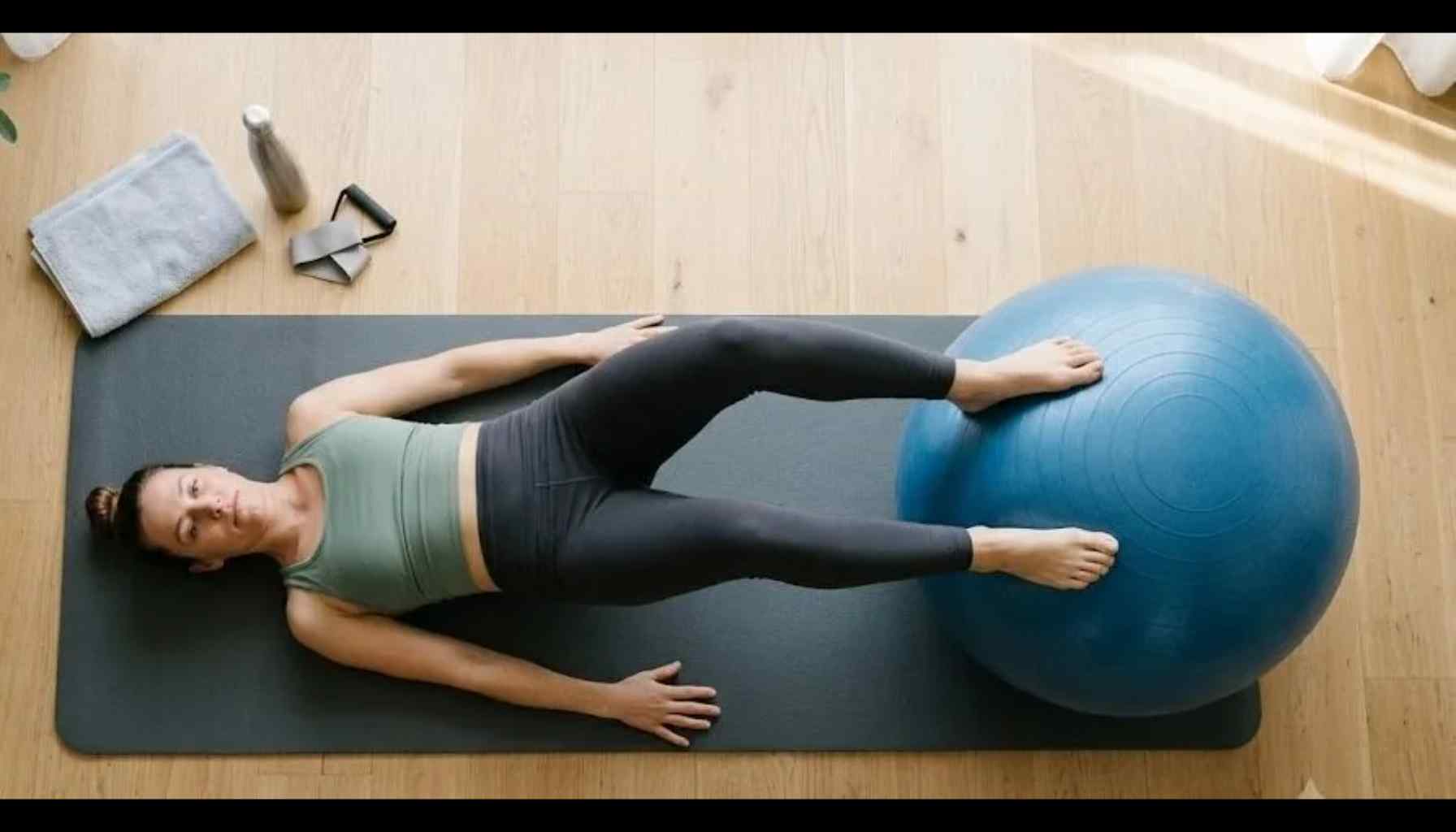
Lie on your back with your heels on the ball and raise your hips until your body makes a straight line. Pause for two seconds, then come down slowly. Complete 8 to 10 reps while trying to keep the ball steady.
Forearm plank on the ball
Place your forearms on the ball, walk your feet back, and hold your body in one long line. Stay there for 15 to 30 seconds without letting your lower back sag.
Back extension
Lie face down with the ball beneath your hips and your toes on the floor. Lift your chest slightly and keep your neck long. Perform 8 to 10 slow reps, since small movements are enough.
Ball Russian twist
Sit on the ball, walk your feet out until your upper back rests on it, and clasp your hands over your chest. Turn your torso slowly to one side and then the other. Do 8 reps each way and keep your hips still.
Advanced Yoga Ball Exercises
Progress only once you can hold a steady plank for 30 seconds with no shaking or sagging.
Ball roll-out
Kneel with your forearms on the ball. Roll forward slowly, keeping your ribs down and your abdomen braced, then pull back. Begin with five or six reps over a short range.
Hamstring curl
Starting in the bridge position, bend your knees to draw the ball toward your hips, then extend your legs again. Keep your hips raised the whole time. Aim for 6 to 8 reps.
Knee tuck
Get into a push-up position with your shins on the ball. Draw your knees in toward your chest, then roll back out, keeping your hips level. Aim for 6 to 8 reps.
Pike
From that same position, raise your hips toward the ceiling as the ball rolls toward your hands, then come down with control. This move is tough on the shoulders and wrists, so wait until the knee tuck feels easy. Try 5 or 6 reps.
Yoga-Style Stretches on the Ball
The ball is also well suited to slower, yoga-style stretching. Breathe steadily and stay in each stretch for about 30 seconds.
Seated cat-cow
Sit upright with your hands on your thighs. Arch your back while you inhale, then round it while you exhale. Repeat 8 to 10 times.
Child's pose over the ball
Kneel facing the ball and lay your chest and forearms on it, letting your arms hang forward. Stay for 30 seconds and breathe slowly.
Seated side stretch
Sit upright, stretch one arm overhead and lean gently toward the other side. Hold for 20 seconds, then swap sides.
A Simple Weekly Plan for Yoga Ball Workouts
Exercise ball workouts do not call for long sessions. A sensible start is fifteen to twenty minutes, two or three days a week, leaving at least one rest day between sessions.
- Weeks 1 and 2: seated hold, seated march, pelvic tilts, wall squat and glute bridge, doing one or two sets of each.
- Weeks 3 and 4: include the forearm plank and back extension, with two sets of each.
- Week 5 onward: introduce roll-outs and hamstring curls, and add a set only if your form stays clean.
Warm up for a few minutes beforehand, and end with a gentle supported stretch over the ball.
A 15-Minute Routine You Can Follow Today
If you would like a single session to follow from beginning to end, try this routine on non-consecutive days. Rest 30 to 45 seconds between exercises, and put down a mat for the floor moves.
|
Exercise |
Sets and reps or time |
|
Seated march and pelvic tilts (warm-up) |
2 minutes |
|
Wall squat |
2 sets of 10 |
|
Glute bridge with heels on the ball |
2 sets of 10 |
|
Forearm plank on the ball |
2 holds of 20 seconds |
|
Back extension |
2 sets of 8 |
|
Ball Russian twist |
2 sets of 8 per side |
|
Child's pose over the ball |
1 minute |
Beginners can cut back to one set of each and leave out the twist until the other moves feel steady.
Should You Sit on a Yoga Ball at Your Desk?
Many people replace their office chair with a ball in the hope of easing back pain. A randomized crossover trial on sitting on stability balls for up to 90 minutes a day found no significant change in low back pain or disability, although core endurance did improve.
Put simply, short spells may keep you moving, yet a ball is not a treatment for back pain. Combine it with regular movement breaks.
Are Yoga Balls Safe During Pregnancy?
Many pregnant women use a ball for sitting, gentle pelvic tilts and slow hip circles. Ask your doctor or midwife for approval first, because every pregnancy is different.
Pick a non-slip spot with a wall or sturdy chair close at hand. Avoid planks, roll-outs and anything that presses on the belly, and ask your provider if you should limit lying flat on your back as the pregnancy advances. Stop and get advice if you feel dizzy or in pain, or if you notice bleeding.
Common Mistakes That Hold Results Back
- Picking the wrong size, which disrupts your posture from the very first rep.
- Rushing the reps. Speed masks weakness and lets momentum take over.
- Moving ahead too soon. A wobbly plank is not ready for a roll-out.
- Arching the lower back too much during planks, bridges and roll-outs.
- Holding your breath. Breathe out during the effort and keep your breathing even.
- Assuming exercise ball workouts will improve every exercise. They help some moves and hinder others.
Frequently Asked Questions
What size yoga ball do I need?
Most adults who stand between 5 ft and 5 ft 5 in do well with a 55 cm ball, whereas those between 5 ft 6 in and 5 ft 11 in usually favor 65 cm. When you sit on it with your feet flat, your knees should bend to about 90 degrees.
Are yoga ball workouts good for beginners?
Yes, provided you begin with seated holds, marches and pelvic tilts before moving to planks or roll-outs. Stay near a wall, move slowly, and stop if anything feels off.
How often should I do yoga ball workouts?
Two to three sessions weekly, with a rest day between them, suit most people. Fifteen to twenty minutes is plenty as long as your form is controlled.
Can yoga ball exercises help you lose belly fat?
They build the muscles under the belly, but no exercise burns fat from a single spot. Fat loss comes down to your overall activity, food choices and sleep. Think of the ball as a tool for building core strength, and combine it with regular cardio and balanced eating.
Is sitting on a yoga ball good for your back?
The evidence is mixed. One controlled trial saw no significant change in back pain from sitting on a ball, though core endurance did improve. Short periods are fine, but take regular movement breaks and see a clinician if pain persists.
How long does it take to see results from a yoga ball routine?
Most people feel steadier balance and better core control after a few weeks of two or three sessions weekly. Visible body changes take longer and depend on your diet, sleep and overall activity.
Bottom Line
Yoga ball workouts are a low-cost, low-impact way to train balance, core control and body awareness at home. Choose a ball that suits your height, start with the basics, and raise the difficulty only when your form holds up.
Stay realistic about what the ball can do. It shines for core and stability work, and it will not replace heavier strength training. Practice a little every week, and the wobble will become steady control sooner than you think.

Discussion (0)
No comments yet. Be the first to comment!
Leave a Comment
You need to login to post a comment.