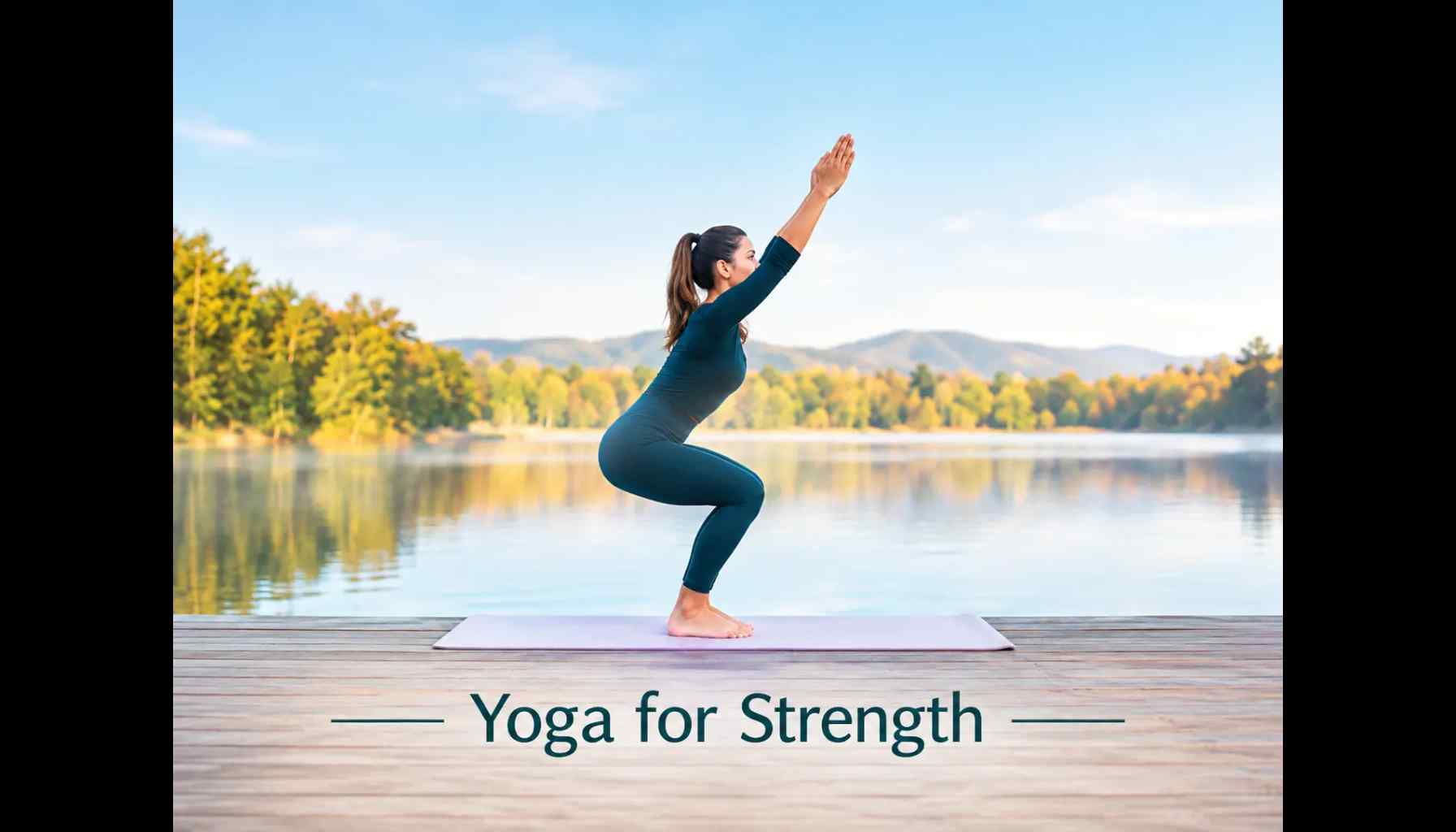
Yoga for Strength: Powerful Asanas
Yoga for strength can help improve muscular endurance, balance, stability, and body control when practised consistently and with proper technique.
Strength is not only about lifting heavy weights. It also involves the ability to control your body, maintain balance, stabilize your joints and perform everyday movements with greater ease. Unlike a workout focused only on one muscle, many yoga postures engage several areas simultaneously. Plank, for example, requires the arms, shoulders, abdomen and legs to work together, while Warrior III challenges the legs, hips and core through balance and stabilization.
Understanding Yoga for Strength
Yes, gentle yoga for strength can contribute to muscle development, particularly when practices include challenging weight-bearing postures and progressive holds. Strength-focused yoga commonly uses isometric contractions, in which muscles work while the joint position remains relatively stable, as well as controlled movements.
The specific strength gained is largely determined by the type of postures, how often the exercises are performed, their duration, and progression. Yoga can be highly beneficial in functional strength and balance, as well as muscular endurance; however, traditional strength training might be a better approach for maximizing muscle growth.
How Yoga Supports Strength
|
|
|
|
|
|
|
|
|
|
|
|
|
|
|
|
|
|
|
|
|
Gentle Yoga for Strength - Best Asanas
1. Chaturanga Dandasana
Steps: Begin in the plank position, flex your elbows towards your rib cage and slowly lower your body while maintaining its alignment.
This asana has considerable emphasis on the work of the shoulders, arms, chest and core muscles. Novices can learn this asana with their knees touching the ground before attempting the full asana.
2. Utkatasana - Chair Pose
Steps: Begin in a stand with your feet firmly placed, bend your knees as if seated in a chair and lift your arms overhead.
This asana emphasizes the work of the legs, gluteus and core muscles. Chair Pose demands stability from the body and can be made more difficult by holding the asana for increasing amounts of time.
3. Virabhadrasana III - Warrior III
Steps: From a stand position, stretch one leg backward and lean the torso forward such that your body is in a horizontal line.
Warrior III develops lower-body strength while challenging balance and core stability. It particularly requires controlled engagement of the standing leg.
4. Naukasana – Boat Pose
Steps: Sit with your knees bent, lean slightly backward and lift your feet while extending your arms forward.
Boat Pose challenges the abdominal muscles and hip flexors while requiring you to maintain balance. Beginners can keep their knees bent rather than straightening the legs completely.
5. Phalakasana – Plank Pose
Steps: Place your hands beneath your shoulders, extend your legs backward and maintain a straight line from your head to your heels.
Plank is a simple but effective full-body strength posture that engages the shoulders, arms, abdomen, glutes and legs.
6. Vasisthasana – Side Plank
Steps: From plank, shift your weight onto one hand, rotate your body sideways and extend the opposite arm upward.
Side Plank focuses on the shoulders, arms and oblique muscles while improving lateral stability and balance.
Five Exercises for Strength
Gentle yoga for strength uses bodyweight resistance, sustained poses, controlled transitions and balance to challenge different muscle groups.
In case your objective is to gain strength through yoga, here are some exercises that you can practice as part of a routine:
1. Plank Pose: Hold this pose for a certain period of time while engaging the core muscles.
2. Chaturanga Lowering: Lower down into the Chaturanga pose from the plank position slowly to build strength in the upper body.
3. Chair Pose Hold: Stay in the seated pose to test your thighs and buttocks muscles.
4. Warrior III: Hold this pose on each side.
5. Boat Pose: Hold the balanced pose.
These exercises can be modified according to fitness level. Starting with shorter holds and gradually increasing duration is generally more practical than attempting difficult poses immediately.
Benefits of Yoga for Strength
Regular yoga for strength may offer several physical benefits:
- Builds functional strength: Bodyweight poses train muscles to work together during movement.
- Strengthens the core: Balancing and weight-bearing postures require continuous abdominal stabilization.
- Improves muscular endurance: Longer holds can help muscles sustain effort.
- Supports balance: Single-leg and arm-supported poses challenge stability.
- Improves body control: Slow movements encourage greater awareness of alignment.
- Supports mobility: Yoga combines strengthening with movement through different ranges of motion.
- Requires little equipment: Many strength-focused poses can be practised using only bodyweight.
How to Practise Gentle Yoga for Strength Safely
Follow these steps:
- Start with a warm-up: Prepare your muscles and joints with gentle stretches and movements before strength-focused poses.
- Focus on proper alignment: Keep your posture controlled and avoid forcing your joints into uncomfortable positions.
- Begin with shorter holds: Start with manageable durations and gradually increase the holding time as your strength improves.
- Use modifications: Choose easier variations, such as knee-supported Plank, when a full pose feels too challenging.
- Breathe steadily: Maintain slow, comfortable breathing instead of holding your breath during demanding poses.
- Listen to your body: Stop if you experience sharp pain, dizziness, or unusual discomfort, and seek professional guidance when needed.
Final Thoughts
Yoga for strength offers a practical way to challenge the muscles while also developing balance, mobility and body awareness. Postures such as Chaturanga Dandasana, Utkatasana, Warrior III, Naukasana, Plank and Side Plank can engage multiple muscle groups without requiring traditional gym equipment.
The key is progressive practice. As your control improves, you can gradually increase hold duration, explore more challenging variations and improve the quality of each movement. Yoga may not replace every form of resistance training, particularly when the goal is maximal strength, but it can be a valuable part of a well-rounded fitness routine.
Frequently Asked Questions
1. What is the best time of the day to do gentle yoga for strength?
Generally, morning time is considered the best time of the day to do gentle yoga for strength. But you can practice yoga at any time that fits your schedule.
2. What are 5 exercises for strength?
Five useful yoga-based strength exercises are Plank Hold, Chaturanga Lowering, Chair Pose Hold, Warrior III and Boat Pose. They collectively challenge the upper body, lower body and core.
3. Which yoga is best for strength?
Physically demanding styles such as Power Yoga and Vinyasa Yoga can be useful for strength because they often include weight-bearing poses and dynamic transitions. However, the best practice depends on individual fitness level and goals.
4. How often should I practise yoga for strength?
A consistent routine of several sessions per week can provide a useful strength stimulus. Beginners should focus on proper technique and gradual progression rather than increasing intensity too quickly.
Also Read: Naukasana
By Umesh Kumar Khiri


Discussion (0)
No comments yet. Be the first to comment!
Leave a Comment
You need to login to post a comment.