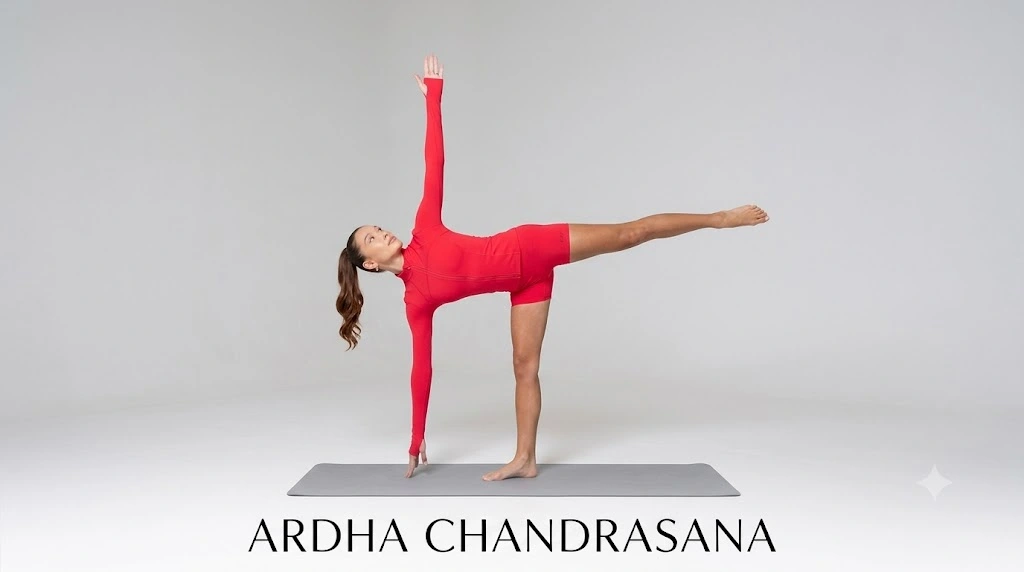
Ardha Chandrasana (Half Moon Pose): Benefits
Ardha Chandrasana, which translates to “Half Moon Pose” in English, is an effective practice for improving lower body strength, core stability, and spatial balance in a vibrant manner. The pose gets its name from Sanskrit words such as Ardha meaning “half,” Chandra meaning “moon,” and Asana meaning “pose.” Ardha Chandrasana is the same as the bright shape that the half moon forms.
Key Takeaways
- Lower Body & Core Fortification: Deeply engages the standing leg, gluteus medius, and oblique abdominal muscles to stabilize the pelvis.
- Chest & Hip Opening: Expands the intercostal muscles and hamstrings while opening the hips and chest in a single lateral plane.
- Proprioceptive Balance Training: Sharpens spatial awareness and focus by shifting weight to a single foot while turning the gaze upward.
Biomechanical Impact of Ardha Chandrasana
Physiological methods of enhancing structural integration in Ardha Chandrasana include the following:
1. Activation of Gluteus Medius: Maintaining the raised leg horizontal on the ground enhances the strength of the gluteus medius and gluteus minimus to avoid pelvic tilting and lower back misalignment.
2. Spine Axial Decompression: The spine is elongated from the top of the head all the way down to the heel of the lifted foot.
3. Joint Proprioception: The tiny stabilizer muscles in the ankle, knee, and hip joints of the supporting leg contract continuously.
Performance Overview and Variations
Practising Ardha Chandrasana requires steady focus and core activation to maintain balance on one leg. The following table details key structural aspects of Ardha Chandrasana alongside accessible modifications:
|
|
|
|
|
|
|
|
|
|
|
|
|
|
|
|
|
|
|
|
|
|
|
|
|
|
|
|
|
|
How to Perform Ardha Chandrasana Step-by-Step
Integrating Ardha Chandrasana into your standing pose sequence deeply strengthens the ankles and outer hips.
- Setting the Foundation: Start from Triangle pose on the right side, placing your right hand onto the shin or a block and reaching out the left arm towards the sky.
- Shifting the Weight: Place your left hand on the hip, bend the right knee a bit, and move your right hand (or block) forward by 12 inches and a little towards the outer side of your right pinky toe.
- Lifting into the Pose: Take a breath and press strongly into your right foot; straighten your right leg and lift the left one off the floor at the same time until the leg becomes parallel to the floor.
- Hip and Torso Alignment: Point your left foot forcefully towards the floor and drive your heel back; align your left hip right above the right one and open your chest towards the side.
- Extension: Straighten your left arm up to the sky; your arms should form a line that goes from shoulder to shoulder; broaden your collarbones.
- Setting the Gaze (Dristhi): Either keep your head neutral or slowly look up towards the extended arm; breathe smoothly and evenly through the nose for 30 to 45 seconds.
Physical Complications and Injuries Prevented
Regular practice of Ardha Chandrasana improves posture by strengthening the gluteal and spinal stabilizer muscles.
- Gluteal & Pelvic Instability: Prevents hip drop and weak abduction that contribute to chronic lower back sprains and knee valgus (caving knees).
- Slouched Posture (Kyphosis): Opens tight pectoral muscles and strengthens upper back extensors to counter forward-head desktop fatigue.
- Ankle Instability: Rebuilds strength in the ligaments and tendons of the feet and ankles, lowering the risk of accidental slips or sprains.
- Tight Hamstrings and IT Band Strain: Gently stretches the hamstrings and iliotibial (IT) band of both the standing and lifted legs.
Precautions
Follow these measures:
- Contraindications in Acute Neck Injury: When suffering from an acute neck injury or any problems in the cervical vertebrae, try to look straight or downwards towards the ground and not upwards.
- Adjustment in Low Blood Pressure: Yoga practitioners with low blood pressure or feeling dizzy must always fix their gaze towards the floor to ensure stability.
- Use of Equipment for Balance: There should always be a block kept under the bottom hand when the distance to the floor is too far to ensure that the hand touches the floor and the spine remains rounded.
- Standing Leg Knee Should Not Be Extended: The standing leg should always have a microbend in it.
Embrace Stability, Space, and Focus
When you practise Ardha Chandrasana, you get an amazing combination of strength, flexibility, and mental control. You develop endurance in your ankles, abdominal muscles, and spine through the opening of your hips and chest and balancing on one leg. Whether it is practiced with the use of a block or in the classical style, Half Moon Pose will bring balance to your yoga practice.
Frequently Asked Questions (FAQs)
1. What are the major advantages of doing Ardha Chandrasana?
Benefits of Ardha Chandrasana include increased strength in the standing leg, ankles, core, and glutes, along with stretching of the hips, hamstrings, chest, and shoulders. Additionally, Ardha Chandrasana enhances spatial balance, coordination, and focus.
2. Why do I fall when looking up in the Half Moon Pose?
Looking up changes your visual field and vestibular system because you change the focal point in your eyes. Start practicing this pose by looking downwards on the floor and then progress to looking to the side and upwards.
3. Is it safe for beginners to perform Ardha Chandrasana?
Sure! Beginners can place a yoga block under the bottom hand to decrease the distance to the floor or practice this pose with a wall behind their back to learn how to stack their hips properly.
4. In what ways does Ardha Chandrasana differ from Trikonasana (Triangle Pose)?
Both postures have a lateral spine alignment and hip stacking. However, the major difference between these two poses is that in Trikonasana both feet remain on the floor, while in Ardha Chandrasana you perform a one-legged balancing posture lifting one leg parallel to the mat.
Disclaimer: The content on LifePositive.com, including articles/blogs on yoga, acupuncture, naturopathy, and other alternative healing modalities for holistic wellness, is for informational and educational purposes only. It is not a substitute for professional medical advice, diagnosis, or treatment. Always consult a qualified healthcare provider before starting any new health protocol or making changes to an existing treatment plan.
Also Read
By Umesh Kumar


Discussion (0)
No comments yet. Be the first to comment!
Leave a Comment
You need to login to post a comment.