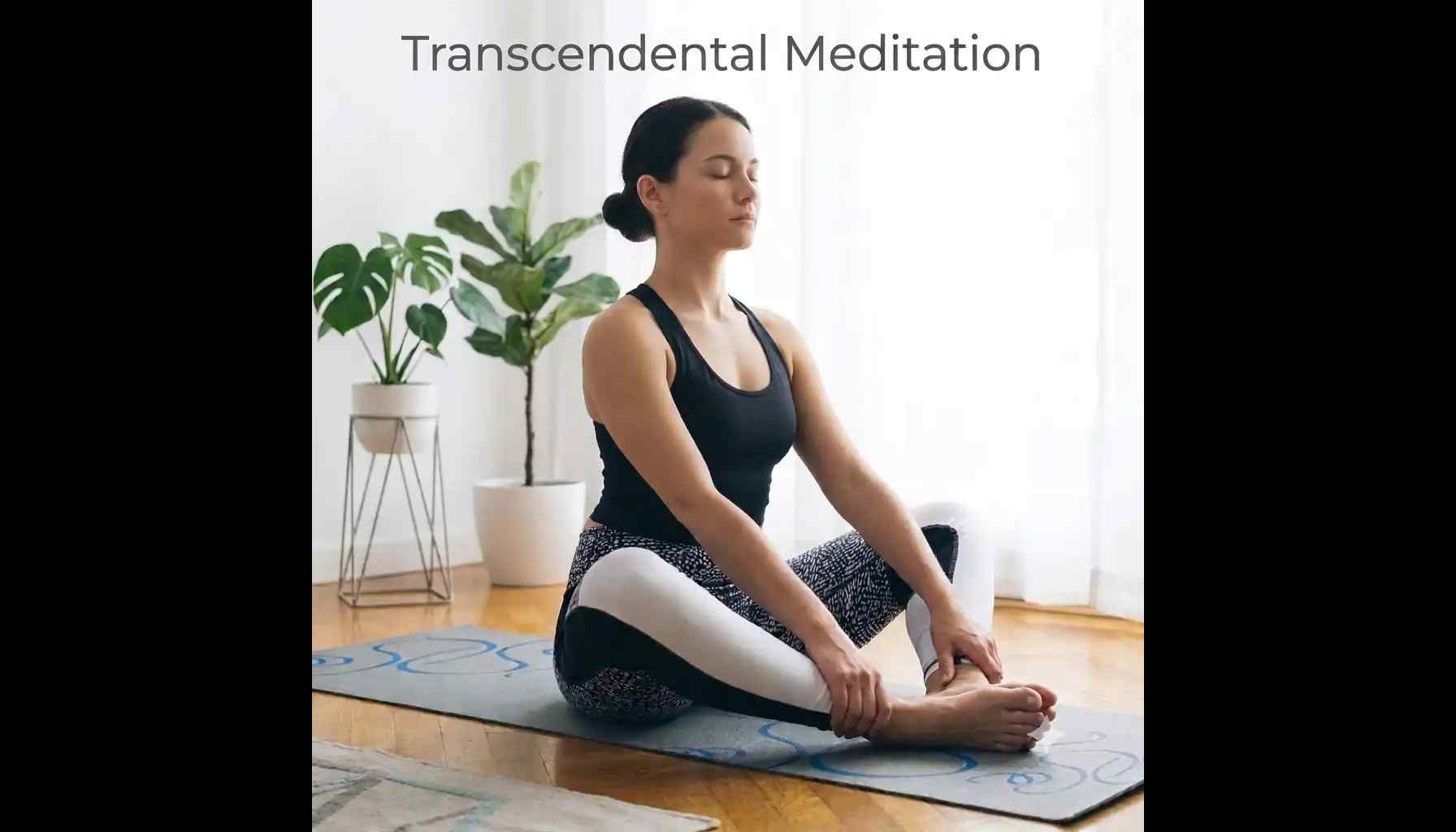
Transcendental Meditation: Essential Facts, Real Benefits
Transcendental meditation is a silent mantra meditation technique developed in the 1950s by Maharishi Mahesh Yogi. You sit comfortably with your eyes closed and repeat a personal sound in your mind for about 20 minutes, twice a day, letting your thoughts settle without forcing them. Often shortened to TM, it is taught as a secular practice, though you can only learn it properly from a certified teacher through a paid course. If you are wondering what is transcendental meditation, this guide explains how it works, what the research really says, what it costs, and who should be careful before starting.
Key Takeaway
- TM is a silent mantra practice, done sitting with your eyes closed, usually for 20 minutes twice a day.
- It is taught one-on-one by a certified teacher, and the course fee is paid and usually income-based.
- The strongest evidence points to a small drop in blood pressure. Results for stress are mixed.
- Other meditation styles seem to offer similar benefits, so TM is not clearly better than the rest.
- It is generally low-risk, but some meditators report unwanted effects, so check with a doctor first if you have a mental health condition.
What Is Transcendental Meditation?
TM is a type of mantra meditation. You sit comfortably, close your eyes, and silently repeat a sound that your teacher gives you. There is no special posture, no breath control, and no attempt to empty your mind.
The word “transcend” means to go beyond. The mantra gives your attention something gentle to rest on, so ordinary thinking settles and the mind drops into a quiet but fully awake state. Supporters call this restful alertness or pure awareness, and Maharishi described it as a fourth state of consciousness beside waking, dreaming, and deep sleep.
When your mind wanders, which it will, you simply drift back to the mantra without scolding yourself. You do not need any particular belief system or lifestyle to follow it.
Where Did TM Come From? A Short History
Maharishi Mahesh Yogi, born Mahesh Prasad Varma, built the method on ancient Indian Vedic traditions. He learned it from his own teacher, Swami Brahmananda Saraswati, often called Guru Dev.
After Guru Dev died in 1953, Maharishi began teaching in India and later toured the world. He brought the method to the United States in 1959, and it became known as Transcendental Meditation.
Public interest grew when celebrities, including the Beatles, travelled to Rishikesh, India, in 1968 to study with him. Maharishi died in 2008, but TM centres and certified teachers still operate in many countries.
How Does the Practice Work Day to Day?
The routine for transcendental meditation is simple, and that is a big part of its appeal. Most teachers recommend two sessions a day, usually one in the morning before breakfast and one in the late afternoon or early evening. The official TM organisation suggests about 20 minutes per session, though some health sources say beginners can start with 10.
- Sit comfortably in a chair or on a cushion with your back supported.
- Close your eyes and let your body settle for a moment.
- Begin silently repeating your mantra without forcing it.
- When thoughts or noises pull you away, return to the mantra gently.
- When your timer ends, open your eyes slowly before getting up.
Your teacher chooses the mantra for you. It is typically a sound rather than an everyday word, which keeps your mind from chasing its meaning, and you are asked to keep it private.
Common beginner mistakes
- Fighting your thoughts. Thoughts are part of the process. The skill is returning to the mantra, not blocking them.
- Repeating the mantra with effort. It should feel light and easy, never forced.
- Judging each session. Some days feel calm and others restless. Both count.
- Skipping busy days. Consistency matters more than any single perfect session.
How to Learn the TM Technique and What a TM Course Costs
Unlike many meditation styles, learning transcendental meditation happens through a structured course. The TM technique is taught one-on-one by a certified teacher. Your first session is private and in person, usually lasts about an hour to an hour and a half, and is where you receive your mantra, often after a short ceremony.
Three more sessions follow, either in person or online, so the teacher can watch you practise and answer questions. Formats differ by country, and some centres run all four sessions over consecutive days. A follow-up check-in usually comes about ten days later, and teachers stay available for support afterwards.
Teachers complete roughly five months of residential training, according to published medical guidance, and continue their education to stay certified.
What the TM course fee looks like
Fees are set by the TM organisation in each country and depend on your income, employment, or student status. In the US, published figures have ranged from roughly $420 to $1,470 depending on household income, so confirm the current price with your local centre.
Many centres allow instalments, and partial scholarships may be available. For most people, the TM course fee is the biggest reason to hesitate.
What Does the Research Say About Transcendental Meditation?
The evidence is encouraging in some areas and thin in others. Here is what holds up best.
Blood pressure
This is the most studied area. A 2008 meta-analysis of nine randomized trials estimated that regular transcendental meditation practice lowered systolic and diastolic blood pressure by about 4.7 and 3.2 mm Hg on average. A larger 2022 analysis of 18 studies and 1,207 people found smaller drops of about 3.3 and 1.8 mm Hg, and the effect faded after three months.
The same 2022 review found that adults over 65 gained more, with a systolic drop of roughly 10 mm Hg compared with under 2 mm Hg in younger groups. If you live with high blood pressure, treat TM as a possible extra, never a replacement for prescribed treatment.
Stress, burnout, and sleep
In a 2022 randomized trial at Duke University, 80 healthcare workers either learned TM or continued usual care for three months. Overall psychological distress, the main outcome, did not improve significantly. However, the TM group reported less emotional exhaustion, a core part of burnout, along with lower anxiety and less insomnia.
A smaller 2019 study of 27 nurses also found lower compassion fatigue and better resilience after learning TM. Still, participants knew which group they were in, and the trials were small. Read the results as promising rather than final.
Anxiety, PTSD, and brain activity
Reviews of trials have linked TM to lower anxiety, including in groups such as veterans with post-traumatic stress disorder. A small 2018 brain imaging study of 16 experienced practitioners found more blood flow in areas tied to attention and less in areas tied to arousal, which fits the calm-but-alert description.
These findings are interesting, but the studies are small. They do not prove that TM treats any condition.
Heart health
A 2017 American Heart Association scientific statement looked at seated meditation in general. It concluded that meditation may be a reasonable add-on to standard heart-risk care for people who are interested, while stressing that its benefits still need to be better established.
What the evidence cannot tell us yet
Many TM studies are small, and some earlier work came from researchers linked to TM-affiliated institutions. The same AHA statement called for future trials run by teams with no stake in the outcome. Most research also studies meditation as a whole, and few studies focus on TM specifically.
You may also see claims about memory, creativity, and self-esteem. Those rest on smaller or weaker evidence, so treat them as possibilities rather than promises.
TM vs Mindfulness Meditation: Which Suits You?
In mindfulness meditation, you deliberately notice the present moment, such as your breath or body sensations, and bring your attention back when it drifts. Transcendental meditation takes a different route. You are not monitoring anything, only resting your attention on a mantra.
- Focus: TM is built around a silent mantra. Mindfulness uses the breath, body, or surroundings.
- Learning: TM needs a certified teacher and a paid TM course. Mindfulness has many free books, apps, and classes.
- Evidence: TM has fewer dedicated studies. Research on mindfulness is broader, though much of it is still preliminary.
Other styles are worth knowing too, including loving-kindness meditation, Zen meditation, and yoga meditation, which blends breathing with gentle movement. So far, reviews do not crown a clear winner. The best technique is usually the one you will keep doing.
Is TM a Religion?
TM is presented as a secular technique, and you do not need any religious belief to practise it. Still, its roots lie in Vedic Indian tradition, and the first lesson includes a short ceremony that some followers compare to a puja, a worship ritual in the Hindu faith. The TM organisation says it is not a religion.
If that matters to you, ask a teacher to explain the first session before you pay.
Is Transcendental Meditation Safe?
For most healthy people, meditation is considered low-risk. Still, the National Center for Complementary and Integrative Health points out that few studies have looked for harm, so no one can make firm promises about safety. It also advises people with existing mental health conditions to speak with a healthcare provider before starting and to tell their instructor.
A 2017 online survey of 342 meditators found that about one in four had experienced at least one unwanted effect, such as anxiety, physical pain, dizziness, or a feeling of being detached from themselves. Most effects were temporary and did not lead people to quit or seek medical help. The survey covered meditation in general, so treat it as a reminder rather than a verdict.
- Keep taking prescribed medicine unless your doctor says otherwise.
- Mention any health condition to both your doctor and your teacher.
- Never meditate while driving or when you need to stay alert.
- If the practice leaves you distressed, pause and ask a professional for advice.
Is It Worth Trying? A Practical Way to Decide
Transcendental meditation may suit you if you like clear structure, prefer a technique with no effort to concentrate, and are comfortable paying for personal instruction. If your budget is tight, free mindfulness resources and other stress management techniques may offer similar benefits, according to the broader research.
Many centres offer a free introductory talk, which is a low-pressure way to meet a teacher before you pay. Ask about their certification, what the fee includes, and what follow-up support you get.
If cost is the sticking point, you can test the idea at home first. Sit quietly, pick a soft, neutral sound, and repeat it gently for 10 minutes. It is not the official method, but it can show whether you enjoy mantra meditation.
Whichever route you choose, consistency matters more than perfection. Give it a fair trial, notice how your sleep, mood, and stress feel, and keep your doctor in the loop if you are managing a health condition.
Frequently Asked Questions
Can you learn transcendental meditation on your own?
Not in the strict sense. You can find videos and apps that teach similar practices, and they may help you relax. But the official TM technique is taught one-on-one by a certified teacher, who assigns your mantra and checks your practice.
How much does learning TM cost?
It depends on where you live and your income. US figures have run from about $420 to $1,470, and other countries set their own fees. Ask your local centre about instalments, scholarships, and a free introductory talk.
Is TM a religion?
No. It is taught as a secular technique and requires no belief. Its roots are in Vedic tradition, and the first session includes a short ceremony, so ask your teacher to explain it beforehand if you are unsure.
How long should you do TM each day?
The standard routine is two sessions a day of about 20 minutes each. Some health sources say beginners can start with 10 minutes, so ask your teacher what suits you.
What is the difference between TM and mindfulness meditation?
Mindfulness asks you to observe the present moment, while TM asks you to rest your attention on a silent mantra. TM also requires a certified teacher, whereas mindfulness can be learned in many free ways.
Bottom Line
So, what is transcendental meditation in short? It is a simple, structured form of mantra meditation with a modest but real evidence base, mainly for blood pressure and possibly for burnout, anxiety, and sleep. It is not a cure-all, and it is not clearly better than other styles. If the teacher support and routine appeal to you, it is a reasonable low-risk practice to try, ideally after a chat with your doctor if you have a health condition.


Discussion (0)
No comments yet. Be the first to comment!
Leave a Comment
You need to login to post a comment.