
UJJAYI PRANAYAMA
February 2000
By BKS Iyengar
The prefix ‘ud‘ means expanding or upward. ‘Jaya’ means victory or success. It also means restraint or curbing. In Ujjayi Pranayama, the lungs of the practitioner are fully expanded as that of a mighty conqueror.
 |
All the stages in pranayama begin with exhalations (rechaka) by breathing out whatever air is in the lungs and end with inhalations (puraka). In inhalations the breath touches the inner surface of the sinus passages at the bottom and in exhalations, the breath touches the outer surface at the top.
Technique
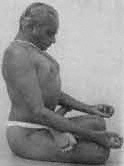
1. Sit comfortably so that your spine is raised along with the chest, floating ribs and navel. The most appropriate postures are Padmasana or Siddhasana. Keeping the spine erect, lower the head to the trunk.
2. Rest the chin in the notch between the collarbones just above the breastbone. This is called Jalandhara Bandha.
3. Stretch the arms out straight and rest the back of the wrists on the knees. Join the tips of the index fingers to the tips of the thumbs, keeping the other fingers extended. (The index finger symbolizes the individual soul and the thumb is the universal soul. The union of the two symbolizes knowledge.)
4. Extend the upper eyelids towards the lower eyelids to close the eyes and look within.
5. Exhale completely.
6. Take a slow, deep steady breath through both the nostrils. The passage of the incoming air is felt on the roof of the palate.
7. Fill the lungs up to the brim. Care must be taken to see that the abdomen does not bloat in the process of inhalation. This filling up of the lungs is called puraka.
8. The entire abdominal area from the pubis up to the breastbone should be pulled back towards the spine.
9. Hold the breath for a second or two.
10. Exhale slowly until the lungs are completely empty. As you begin to exhale, keep a grip on the abdomen. After two or three seconds of exhalation, relax the diaphragm gradually and slowly. While exhaling the passage of the outgoing air should be felt on the roof of the palate. This exhalation is called rechaka.
11. Wait for a second before drawing a fresh breath. This waiting period is called bahya kumbhaka.
12. The process described above completes one cycle of Ujjayi Pranayama.
13. Repeat the cycles for five to 10 minutes keeping the eyes closed.
14. Lie on the floor for Savasana.
15. Ujjayi Pranayama can also be done without Jalandhara Bandha while lying down on the floor. This pranayama can be done at any time of the day and night.
Benefits
• Ujjayi Pranayama aerates the lungs and removes phlegm.
• Gives endurance, soothes the nerves, tones the entire system.
• Ujjayi without kumbhaka (retention), done in a reclining position, is ideal for persons suffering from high blood pressure or coronary troubles.
• Steadies the mind.
Discussion (0)
No comments yet. Be the first to comment!
Leave a Comment
You need to login to post a comment.