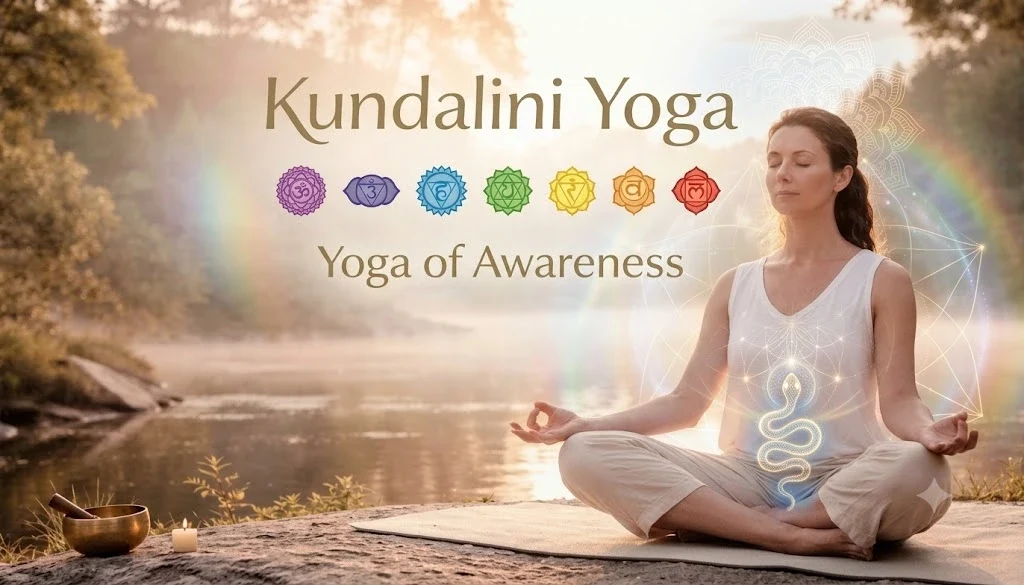
Kundalini Yoga (Yoga of Awareness)
Kundalini Yoga is a practice that combines physical movements with breathing exercises, chanting, meditation and repetitive sequences. Unlike yoga styles that mainly focus on physical postures, Kundalini Yoga places strong emphasis on awareness, breath, sound and spiritual practice. It is sometimes described as the “Yoga of Awareness.”
The practice is traditionally associated with the idea of Kundalini energy, which is described as a dormant spiritual energy located at the base of the spine. Practitioners believe that specific practices can help awaken this energy and develop greater awareness.
Key Takeaways
- Kundalini Yoga combines movement, breathwork, chanting and meditation.
- Its traditions emphasize awareness and spiritual development.
- Research suggests potential psychological and cognitive health benefits.
What Is Kundalini Yoga (Yoga of Awareness)?
Kundalini Yoga encompasses a number of practices in one single exercise. A routine session of the yoga may include warm-up, breathing exercises, kriya, which is a series of exercises, meditating, relaxing, and chanting.
The spiritual practice that is followed in Kundalini Yoga is that of the movement of Kundalini energy in the chakras of the body. It is helpful for spiritual enlightenment and awakening.
Origins and History of Kundalini Yoga (Yoga of Awareness)
The exact historical origin of Kundalini Yoga as a distinct practice is difficult to establish. The concept of Kundalini energy, however, has existed for centuries and is discussed in ancient Indian texts. Healthline notes references to the concept in ancient Vedic literature dating back to around 1,000 B.C.
The traditional idea describes Kundalini as a coiled energy at the base of the spine. Through particular practices, practitioners seek to awaken this energy and direct it through the chakras.
In the 20th century, Yogi Bhajan became strongly associated with Kundalini Yoga in the West. He began teaching the practice in the United States in the late 1960s, helping introduce a particular form of Kundalini Yoga to Western audiences.
What Does Kundalini Yoga (Yoga of Awareness) Involve?
A Kundalini Yoga session can contain several interconnected practices:
|
|
|
|
|
|
|
|
|
|
|
|
|
|
|
|
|
|
|
|
|
|
|
|
Kundalini Yoga Poses and Their Steps
1. Padmasana (Lotus Pose)
Steps: Sit down with the legs straight, bend the knees, and slowly place each foot on the thighs of the opposite side, while maintaining an erect spine.
2. Bhujangasana (Cobra Pose)
Steps: Lie on the stomach position, place the hands under the shoulders, take deep breaths and lift the head and chest.
3. Dhanushasana / Archer Pose
Steps: Stand straight up, put the legs apart and the feet at an angle backward, slightly bending the knees; straighten both hands and bend back one of the hands as if pulling a bow string.
4. Sukhasana (Easy Pose)
Steps: Sit comfortably cross-legged, maintain an erect spine, let shoulders fall and place the hands on the knees.
5. Marjaryasana-Bitilasana (Cat-Cow Pose)
Steps: When you inhale, you drop your belly and lift your chest into Cow Pose. When you exhale, you arch your back and tuck your chin toward your chest into Cat Pose.
6. Ardha Matsyendrasana (Half Lord of the Fishes Pose)
Steps: Get into the sitting position, bend the knee over the opposite leg, turn towards the bent knee, and keep a straight spine.
The Seven Chakras
The practice works with seven major energy centers located along the spine:
- Root Chakra (Muladhara): Base of the spine- Stability, grounding, and security.
- Sacral Chakra (Svadhisthana): Below the navel- Creativity, emotion, and adaptability.
- Navel Chakra (Manipura): Solar plexus - Personal power, willpower, and commitment.
- Heart Chakra (Anahata): Center of the chest- Love, compassion, and forgiveness.
- Throat Chakra (Vishuddha): Throat- Truth, expression, and clear communication.
- Third Eye Chakra (Ajna): Between the eyebrows- Intuition, clarity, and wisdom.
- Crown Chakra (Sahasrara): Top of the head- Universal connection and elevated consciousness.
At Home Beginner Sequence:
- Opening Chant (1 min): Sit in Easy Pose with hands in Prayer Mudra and chant "Ong Namo Guru Dev Namo" three times to tune in.
- Breath of Fire (2 mins): Sit tall and practice rapid, rhythmic breathing through your nose, pulling your navel in on each exhale.
- Cat-Cow Warm-up (3 mins): On all fours, inhale to drop your belly into Cow Pose and exhale to arch your spine into Cat Pose.
- Sat Kriya (3 mins): Sit on your heels with arms stretched overhead, chanting "Sat" while pulling your navel in and "Nam" while releasing it.
- Deep Relaxation (4 mins): Lie flat on your back in Savasana to rest completely and integrate the energy of the practice.
- Closing Chant (1 min): Return to a seated position in Prayer Mudra and conclude by chanting a long "Sat" and short "Nam" three times.
Health Benefits of Kundalini Yoga
Research into Kundalini Yoga is still developing, but studies have reported several potential benefits.
1. Stress and Anxiety Management
Kundalini Yoga combines controlled breathing, movement and meditation, which may help support stress management. Healthline reports studies in which participants experienced reductions in stress and anxiety following Kundalini Yoga practice.
2. Cognitive Function
A controlled study involving subjects with mild cognitive impairment found a positive influence on some domains of executive function in participants who practiced Kundalini Yoga.
3. Emotional Health
Some studies indicate that Kundalini Yoga can positively influence emotional health by relieving depressive symptomatology and promoting emotional regulation.
4. Improved Self-Awareness
Mindfulness, breath awareness and repetition-based practices enable practitioners to develop better self-awareness of their thoughts, feelings and physical sensations.
5. Sleep Improvement Potential
Recent studies looking into Kundalini Yoga have found improved results in sleep-related parameters in some subjects, but further studies are needed to make any definitive conclusions.
Final Thoughts
Kundalini Yoga is a distinctive yoga tradition that goes beyond physical exercise by combining kriyas, pranayama, meditation, mudras, chanting and relaxation. Its historical roots are connected with longstanding Indian concepts of Kundalini energy, while its modern Western development has been influenced significantly by Yogi Bhajan.
Research suggests that the Yoga of Awareness may support stress management, anxiety, cognitive function, emotional wellbeing and sleep. However, it should be viewed as a complementary practice rather than a replacement for medical diagnosis or treatment.
FAQs
1. What does Kundalini Yoga do?
Kundalini Yoga combines movement, breathing, chanting and meditation to develop physical awareness, concentration, stress management and, traditionally, spiritual awareness.
2. What's the difference between yoga and Kundalini Yoga?
Yoga is a broad tradition with many styles, while Kundalini Yoga specifically emphasizes kriyas, breathwork, chanting, meditation and awareness alongside physical movement.
3. Can beginners do Kundalini Yoga?
Yes, beginners can practice Kundalini Yoga by starting with suitable introductory exercises and learning breathing and kriya techniques under proper guidance.
4. Why is Kundalini Yoga so powerful?
Practitioners often describe it as powerful because it combines movement, breath, sound, meditation and focused attention in a structured practice, although claims about spiritual energy and awakening are traditional beliefs rather than scientifically proven effects.
Also Read: Yoga for strength
By Umesh Kumar Khiri


Discussion (0)
No comments yet. Be the first to comment!
Leave a Comment
You need to login to post a comment.