
Helping the young ones take wing
Parenting is a tough yet rewarding journey, where the most unconditional love prevails. Parents do everything possible for their children. But do they teach them adequately how to handle tough times, asks Jamuna Rangachari? It is time we ponder on this.

“If you can’t fly, run; If you can’t run, walk; If
you can’t walk, crawl; but by all means keep
moving,” -The late Martin Luther King Jr.
Dealing with tough times is a lesson many of us fail to impart to our children as we are always focussed on success and good times. I remember my late grandmother used to alwaysadvise us to keep trying and never give up on any challenge we may be facing. I had shifted to a Tamil school from an English medium one in class VII and found it very difficult to write my exams in Tamil as the script was alien to me till then. At that time, she became my impromptu teacher and guide, and made me read aloud all the Tamil magazines at home to her. Her advice “Jamuna, if you want to prove yourself, forget about being the best, but just do your best,” was her mantra in all areas of life. And yes, this is what has made me face the journey of life in all situations, facing a challenge as just a challenge and not something that cannot be faced or overcome.
Learn through life’s challenges
All of us are bound to face challenges in the journey of our lives. This is what makes us stronger. As parents, we need to guide and en courage our children too, so that they are not afraid to face any adverse situations that come their way. At the same time, they need the sup port and right guidance from their parents. As parents, we need to make sure that we monitor our children so that they do not take any un wanted risks they cannot handle.
We must know that making children physically fit and strong is not enough. Making them men tally strong is equally important. More specifi cally, making them strong enough so that they can thrive alone in this world. The fact is that those kids who face challenges become more in dependent and self-reliant.
Mr C P Kumar, a retired Scientist from the Na tional Institute of Hydrology, Roorkee, Uttara khand, India, who is also a Reiki healer, says that parents can play an essential role in help ing their children combat challenges. He sug gests that everyone should encourage a growth mindset by teaching children to view challenges as opportunities for growth and learning rath er than obstacles. They should also encourage the young ones to embrace their mistakes and failures, and use them as opportunities to learn and improve. He asks parents to also provide emotional support when children are facing challenges and feels that it is essential that par ents let their children know that they believe in them and are there to help them through diffi cult times.
Ramdeo Chaudhary, a grandparent from Vara nasi, says, “Guiding restive and resistive young minds to combat challenges is significant as most not willing to listen to and obey their peers and parents. The era of my children was different, but I never tried to impose anything on them. My sole objective was to create an at mosphere at home where children could learn playfully. They used to feel pressurised some times due to the excessive burden of homework and exams. I used to belittle their problems by telling them stories of our childhood days when child-beating was a common feature. I always used to inject in them a sense of freedom while suggesting playfully that they do whatever they can.”
Nowadays, people often do not take life seriously enough and then fail when the going gets tough. Par ents often mollycoddle children or overprotect them.
This again is not a good practice. Life needs to be handled appropriately and not made too easy.
Parenting 27
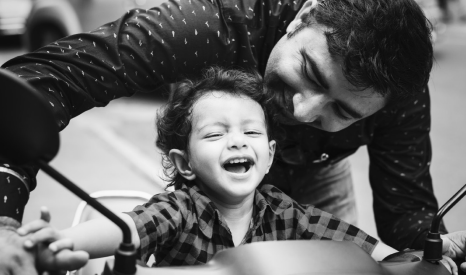
Making children mentally and emotionally strong is as important as making them physically fit. Take challenges as a lesson Nowadays, people often do not take life se riously enough and then fail when the going gets tough. Parents often mollycoddle children or overprotect them. This again is not a good practice. Life needs to be handled appropriate ly and not made too easy. This cannot be taught overnight but should be made a part of life. For instance, I would always be late for my school bus and would be asked to walk instead of be ing given money for an autorickshaw, unlike other children. I then began to take the school bus timings very seriously. To date, this has in stilled a basic consciousness of time in me.
Pulkit Sharma, a psychoanalyst from Puducherry, says, “All parents should encourage their children by highlighting and appreci ating their strengths. When children receive validation and encouragement from their par ents, they develop a strong and powerful sense of self. This lays down a robust foundation to combat all challenges in the future.”
Do not rebuke them if they fail Not understanding children’s challenges is another common feature. Mr Ramdeo says, “I used to practise outer detachment but silent in ner involvement with the children’s challenges to find solutions to pass on to them in a play ful manner. For example, my grandson [now an advocate] used to get poor marks in maths in his tutorials, tests, and exams. My daughter [his mother] used to scold him unnecessarily for neglecting this subject. As they were stay ing close to our house, every Sunday, I used to call on him to understand the root of his prob lems, which I found out in two or three meet ings. He used to get confused while trying to grasp theorems in geometry. I rewrote the text of this subject [100 pages] and shared it with him part by part to ensure that he assimilated it easily. He was so happy to grasp them and another portion of mathematics also. Since a good score in maths is essential for an overall higher percentage, I helped him gain complete
Whenever the child is feeling helpless in a situation, the parent needs to talk to them at length and guide them about how to deal with the situation effectively. Such experiences slowly help the child develop skills.mastery over this subject as well as develop an interest in it within three months. He got the highest score in this subject which boosted his morale and self-confidence. He passed the board exams with a decent first-class percentage. I never pressurised him into aiming for a high percentage and advised him to accept and feel happy with the marks he procured, wheth er they were high or low. Therefore, the role of a parent should be that of a sincere friend, who helps their children combat challenges. Anoth er very essential thing is to teach simple and easy meditation of 10–15 minutes whenever they feel free. With higher awareness, all chal lenges pale into insignificance.”
Pulkit avers, “Whenever the child is feeling helpless in a situation, the parent needs to talk to them at length and guide them about how to deal with the situation effectively. Such experiences slowly help the child develop skills.”
We need to show and tell children that failure is only a step towards success in the journey of life while quoting their own successes in vari ous areas.
Share responsibilities
Sharing responsibilities is the best way to make people feel more confident about han dling life—physically, mentally, and spiritual ly. When parents ask children to do this, they will try to please their parents by winning over every situation. When they start doing well, their self-confidence increases. Then they themselves will take up responsibilities and try to succeed.
Do not praise excessively
Praise must be earned and not given too much. As parents, keeping praise within limits is the best thing to do; otherwise, children may feel life is a cakewalk. My late mother-in-law, Manjula, though exceedingly kind, would never praise anyone unnecessarily, which is why “Even amma likes it” became an indication that someone in our family had performed well.
Recognise the positive side of problems I remember the time my son, a keen footballer in his school days, fell and broke his ankle. He became extremely depressed. I told him to get some rest by going and attending the match
es as a viewer and not as a participant. As it turned out, this period made him much better at understanding the techniques for excelling at football. So, yes, there are plus points in every situation, and we need to let our children know this.
Take critical action
We need to help our children take action after identifying their strengths. Each child is differ ent, and it is the parents who can guide them after understanding them well. I remember the time my son did very badly in science. I looked for a tuition teacher and briefed him about the situation. My son then became very good after a
while and even started helping others. Pulkit also agrees with this and says, “While guidance is important, parents mustn’t encour age too much dependence and spoon-feeding, because this will hamper the growth of the child.”
Develop consciousness
Suzy Singh, a mental health therapist, an in ternationally known author, and a grief expert and karma scholar, shares her experience in this area: “I have relied heavily on value-based parenting to build resilience and understand ing of life’s principles in my children so that they have an enduring anchor to turn to when ever their tree of life is shaken by gusty winds
Simple steps to help children handle challenges
and storms. It was clear to me early enough that these precious lessons would definitely outlive me and serve them well. It was thus important that the first tool I used was ‘example setting’ because most learning in humans occurs pri
marily through imitation. Performing my daily prayers, meditating, dealing with my emotional triggers responsibly, offering support while re specting their choices, knitting the family to gether, and serving others were influences they were exposed to throughout their childhood.
“I also developed some life mantras that be came our family’s philosophical GPS. Here are some of them:
• Play to win and lose to learn.
• Reflect deeply and choose wisely as every action has a consequence.
• Deal with your upsets privately to arrive at peace before discussing them with others. • Never go to bed angry.
“One principle that I repeatedly emphasised as their SOS measure was for them to do nothing when confused but to wait patiently until clar ity dawned. If for some reason they were hard pressed into making a decision, I urged them to choose the harder option because it would most likely be the beneficent one in the long run.
• Teach children that a challenge is meant only to teach lessons and they should learn to handle it.
• Encourage positive actions.
• Don’t rebuke or mollycoddle; only understand.
• Make them know you are there to guide them.
• Let them know there is always a solution to all problems.
• Tell them tough times never last and we need to only be patient and work on the situation as it presents itself.
“Authoring my book 7 Karma Codes as a prescriptive guidance tool for answering life’s complex questions was another way of guiding them. It was written with the intent that long after I had departed from my earthly journey, they could still turn to this book whenever they were confused and needed guidance.
“As they grew into adults, I emphasised the im portance of developing emotional and social in telligence, and taught them to process their de structive emotions, be mindful of their mental self-talk, cultivate compassion for others, and regulate their likes and dislikes. Both my chil dren have been exposed to the positive impact of belief change work, faith in a greater power, and loving others through acts of service.
“I think the idea that I needed to be my chil dren’s conscience keeper allowed me to parent them in this manner. Even though I believe I have sown some useful seeds in their conscious ness, which will sprout as and when required to activate specific virtues in their lives, I continue to play my part in cultivating good mental and emotional habits so that they can reduce their karmic burdens in this lifetime and enhance their human potentialities. However, given that they are both adults now, I’m careful to offer my advice only when asked for so that I do not intrude upon their agency and personal power.”
Even Sister Shivani, the spiritual guru, has said in her talks that we need to only impart good sanskar (upbringing) and never compare one with another.
Learn lessons as a parent
We can see that parenting, when done with the right intent and principles, is the greatest les son for all parents too as all of us do become better people by guiding our children. Let us then walk on the right path by raising our chil dren as resilient and responsible citizens of the world.
TEACHING STORY
Farmer and the Horse
One morning, the old farmer’s horse ran away. The neighbours came and said, “Extremely un fortunate. So sad!”
The farmer replied: “We’ll see.”
The next day, the horse returned with many horses. The neighbours came over, overly excit ed for him. “Such a wonderful situation!” The farmer replied, “We’ll see.”
The next morning, his son mounted a horse to teach it to take him as a rider. He fell and broke his leg. The neighbours showed consolation: “Such bad luck!”
The farmer replied, “We’ll see.”
One day later, the army drafted soldiers. They skipped the farmer’s son. The neighbours were delighted: “What a blessing!”
The farmer replied: “We’ll see.”
This story shows us that life keeps changing and we need to handle each situation as it presents iself.
Jamuna Rangachari is a former assistant editor of Life Positive, has authored two books for children, and compiled and interpreted Teaching Stories-I and II for Life Positive.

Discussion (0)
No comments yet. Be the first to comment!
Leave a Comment
You need to login to post a comment.